Edifício Copan: Plunge into Darkness Highlights its Role as Soul of São Paulo
08SÃO PAULO, BRAZIL – The world’s largest residential building, São Paulo’s Edifício Copan was built to be the Rockefeller Center of the city, as great a residential building as Washington’s Watergate. With its undulating shape, it has lorded over the center of the city and defined the city’s skyline as its architectural shining star. Late this September 8th evening, however, it was eerily black as a massive power outage plunged Copan and other downtown buildings into darkness.
The blackout shut down the Copan and several buildings along Avenida Ipiranga, including the famous Círculo Italiano building at the end of the block. Exasperated groans could be heard from windows that slid open hoping for a breeze and saw the wavy building coated in darkness and themselves trapped in the massive 32-story building.
The outage lasted from around 7 PM until 3:30 AM. “It has happened a couple of times in the three years I live here,” said a building resident on a Copan Facebook posting. “Once it was very fast, another time it took until the next day.” The blackout extended to Duque de Caxias and the streets of the city’s historic Santa Cecília neighborhood, where darkened street lights and buildings on both sides of the streets without energy left the area in total darkness.
In the middle of the pandemic, however, the energy outage served to underscore Copan’s role as the soul of the city.

Copan is not just a building that is beautiful to look at. Designed by Brazil’s superstar architect Oscar Niemeyer, it is a building that expresses an idea of how the city can understand itself, its shape shouts São Paulo and graces the city center’s skyline, defining its character. Before the pandemic it was home to some 5,000 residents, making it the country’s and the world’s largest residential structure.
For Niemeyer and Brazil, Copan symbolizes an expression of a new kind of architecture, uniquely Brazilian, an astonishing vision, a floating dreamlike building shaped like the wavy “tilde” accent over the “ã” in São Paulo.
Edíficio Copan has inspired filmmakers, artists, photographers, writers, and more. Indeed, like New York’s landmark Plaza Hotel serves as the setting for the Eloise at the Plaza books, Copan is the star of the award-winning Portuguese-language book Arca sem Noé — Histórias do Edifício Copan (Ark without Noah).
This August Copan became the São Paulo home of Malu Gravassi, the Brazilian-born uber-successful filmmaker, singer, songwriter, actress, and social media superstar whose short film “It Must Be Horrible to Sleep Without Me,” reached three million views in 24 hours after its release on YouTube. The New York-raised Gravassi recently threw open the doors of her 149-sq. meter Copan apartment to the pages of Casa Vogue.
Copan embodies Niemeyer’s idea of how the building and the city should co-exist. Before the pandemic, the organic lines of the building attracted daily traffic of some 22,000 people, but having stopped the terrace tours to keep the mostly foreign tourists away as coronavirus took hold in the area, and with the effect of the quarantine, that traffic has now dropped to an estimated 2,000 per day.
The pandemic has had a significant impact on the building, shedding as many as 20 percents of its residents and leaving only 12 of its 72 stores still operating.
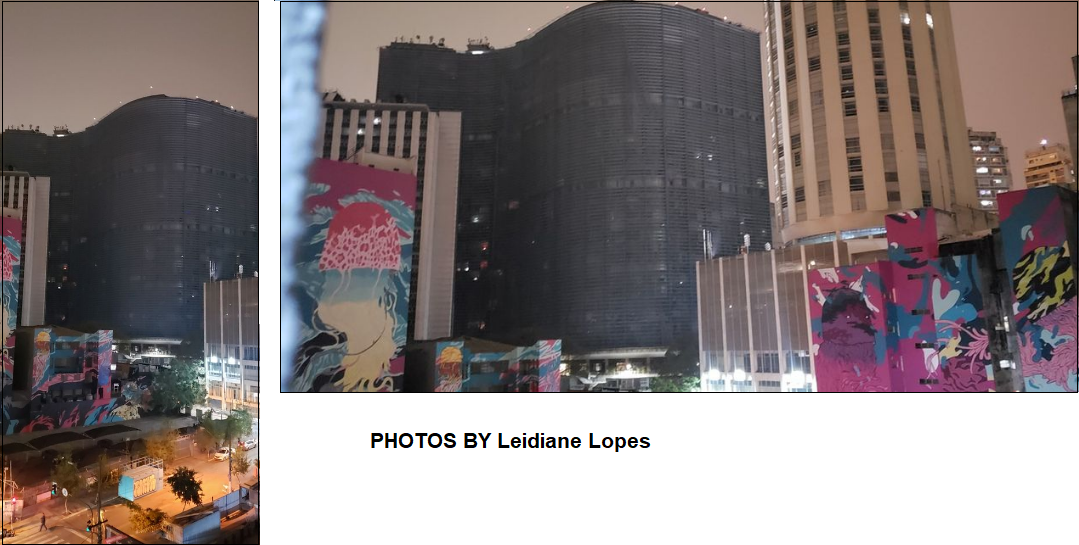
Still, Copan today stands out in the city’s center. Newly draped, the building’s north face and fanciful brise soleil, have a new blue construction mesh covering the curving louver that deflects sunlight and shapes the building’s imposing façade. It is a symbol of a city that wants to return to its pre-pandemic glory.
In the landscape of thousands of buildings in soaring straight lines and right angles, the curvaceous Copan steals the imagination and the scene, making it perhaps the most famous building in Brazil, and today a beacon for the city’s resurgence.
More: Brazil news in English, every day from The Rio Times.
Editorial responsibility: Matthias Camenzind, Editor-in-Chief · Editorial standards · Report an error