Ecuador’s Prison War Reveals Cocaine Empire’s Grip on Power
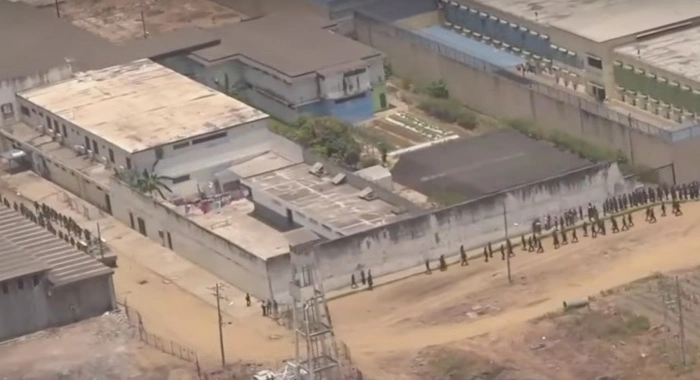
Ecuador’s military stormed its most dangerous prison on Sunday as the government battles criminal organizations that have transformed the facility into a cocaine trafficking command center.
The operation at Penitenciaría del Litoral exposes how drug cartels now control both Ecuador’s prisons and its role as a global cocaine hub.
Defense Minister Gian Carlo Loffredo led specialized troops in searching the overcrowded facility that houses 7,107 prisoners in space designed for 3,900.
The prison has become a symbol of Ecuador’s security collapse, recording over 300 deaths in four years as rival gangs fight for control of lucrative trafficking routes.
Seven major criminal organizations operate from different sections of the complex. Los Choneros, Chone Killers, Águilas, Fatales, Latin Kings, Los Lobos, and Los Tiguerones run their drug empires from behind bars.
These groups coordinate with Mexican cartels to move approximately 70% of the world’s cocaine through Ecuador’s ports.
The numbers reveal Ecuador’s transformation from peaceful transit country to major trafficking center. Colombian cocaine production increased sixfold to 1,700 tons in 2022.
Ecuador seized nearly 300 tons of drugs in 2024, representing a 30% increase in shipments destined for Europe.
Authorities estimate they intercept only 32% of total cocaine flow, meaning 68% continues generating profits for criminal networks.
Ecuador’s Prison War Reveals Cocaine Empire’s Grip on Power
President Daniel Noboa declared an “internal armed conflict” against 22 criminal groups in January 2024.
However, Ecuador’s Constitutional Court consistently ruled against this designation, stating insufficient evidence exists to justify such classification under international law.
The Court suspended key provisions of new security laws in August 2025, creating confrontation between executive and judicial branches.
The military takeover of all prisons since January 2024 has generated serious human rights concerns.
Organizations documented over 100 torture complaints between January and June 2024, including beatings, waterboarding, and electric current torture.
Twenty-four detainees died in custody during February and March 2024, some showing torture signs.
Ecuador recorded 3,036 homicides in the first half of 2024, representing a 429% increase from 2019 levels.
The country’s homicide rate reached 44.5 per 100,000 people, higher than Mexico, El Salvador, and Honduras. January 2025 became the deadliest month with 781 recorded homicides.
The violence stems from territorial disputes between criminal organizations allied with Mexican cartels.
Guayaquil Port Under Emergency Rule as Carriers Shift Routes Amid Rising Violence in Ecuador
Los Choneros serves as the Sinaloa Cartel’s armed wing, while Los Lobos aligns with Jalisco New Generation Cartel.
These international connections intensify local conflicts as Mexican cartels use Ecuadorian groups to secure trafficking routes.
Ecuador’s geographic position between Colombia and Peru, combined with major Pacific ports and dollarized economy, makes it ideal for cocaine trafficking.
Criminal organizations exploit the country’s banana export industry, which ships 7.2 million tons annually, to smuggle drugs in legitimate cargo containers.
The prison intervention demonstrates how organized crime has overwhelmed Ecuador’s institutions.
What began as a regional security problem has become a global cocaine crisis, with European demand directly fueling violence in Ecuador as criminal organizations compete for control of trafficking networks worth billions of dollars.
More: Ecuador news in English, every day from The Rio Times.
This article was produced by The Rio Times’ automated newsroom system. How we use AI · Report an error · Editorial responsibility: Matthias Camenzind, Editor-in-Chief