Dollar-Real Pair Consolidates as Investors Weigh Economic Signals
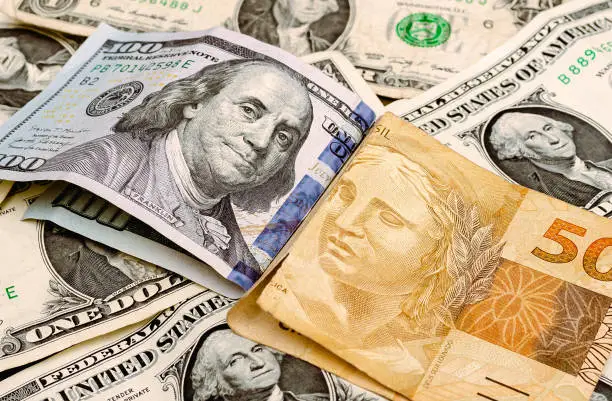
The US dollar traded at R$5.8864 against the Brazilian real early Wednesday morning, according to TradingView data published April 16, 2025. Currency markets remain cautious amid escalating trade tensions between the United States and China.
The exchange rate showed minimal movement from Tuesday’s close of R$5.8900, when the dollar gained 0.66% against the Brazilian currency. Trade war concerns dominate market sentiment after China ordered its airlines to cancel Boeing aircraft deliveries.
This direct retaliation followed President Trump’s imposition of 145% tariffs on Chinese imports. Trump’s accusations that Beijing broke agreements with American farmers and Boeing sparked immediate market reaction.
The dollar’s strength reflects investor flight to safety during periods of global uncertainty. Meanwhile, Brazilian assets face additional pressure from weakening commodity prices.
Both the International Energy Agency and OPEC recently reduced their oil demand growth forecasts. These revisions raise concerns about global economic health and impact Brazil’s export-dependent economy.
Technical analysis shows the USD/BRL pair trading in a consolidation pattern. The currency pair currently sits below the recent high of R$6.0160 reached on April 8.
Several resistance levels exist between R$5.89-5.90, with stronger resistance at the psychological R$6.00 mark. Support levels appear at R$5.85, followed by R$5.83.
Brazilian Real Faces Pressure
Brazil’s domestic economic concerns also contribute to the real’s vulnerability. Investors await the presentation of Brazil’s 2026 Budget Guidelines Law Project to Congress.
This document will outline fiscal targets, inflation estimates, GDP growth projections, and debt trajectories. Market participants scrutinize these figures for signs of fiscal discipline amid growing government spending.
Financial institutions maintain a bearish outlook for the Brazilian currency. Trading Economics models project the real to reach R$5.99 by quarter-end and weaken further to R$6.36 within twelve months.
Similarly, ING forecasts USD/BRL at R$5.90 in one month, R$6.00 in three months, and R$6.25 in six to twelve months. The Brazilian real’s performance aligns with broader emerging market currency trends.
Heightened volatility characterizes these markets as investors assess the implications of US trade policies. The unpredictability of Trump’s trade stance creates ongoing uncertainty in currency markets.
Trading volumes may decrease ahead of the upcoming Easter weekend. Financial institutions typically adopt more cautious positions before extended holiday periods.
This potential liquidity reduction could amplify price movements in either direction. Brazil’s central bank faces the challenge of stabilizing the currency without excessive interest rate hikes.
Economic growth concerns compete with inflation risks as policymakers navigate these turbulent markets. The bank’s response to these pressures will significantly influence the real’s trajectory in coming weeks.
This article was produced by The Rio Times’ automated newsroom system. How we use AI · Report an error
LatAm Markets: Live Signals → — real-time movers, turnover leaders and FX across Latin America.
Read More from The Rio Times