Dollar Drops Over 1% to R$5.41 Following Powell’s Comments, Bucks Global Trend
The US dollar fell sharply against the Brazilian real, erasing previous gains as investors processed Federal Reserve Chair Jerome Powell’s remarks to the US Congress.
Powell noted that the US economy is no longer overheating and that the central bank must consider economic risks before deciding on interest rate cuts.
On July 9, the commercial dollar dropped 1.12%, closing at R$5.414. The August futures contract on B3 fell 1.04% to 5,432 points.
Despite these local drops, the US Dollar Index (DXY), measuring the dollar’s strength against six major currencies, rose 0.13% to 105.110 points.
The day’s trading saw reduced liquidity due to São Paulo’s Constitutionalist Revolution holiday. Although the stock exchange operated normally, trading volumes were lower than usual.
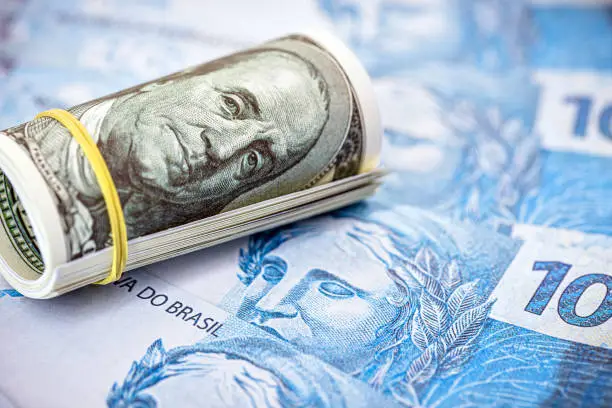
This drop in the dollar continues Brazil’s recent trend of decreasing risk premiums.
However, this movement contrasts with the global market, where the US dollar gained strength following Powell‘s statements.
He argued that although US inflation is above the 2% target, it has improved in recent months.
Further positive data could support interest rate cuts, though Powell did not specify a timeline, leaving some global markets disappointed.
In Brazil, Senate President Rodrigo Pacheco called for a detailed debate on granting financial autonomy to the Central Bank.
He responded to concerns from President Lula, suggesting the proposal needs more development with expert and official input.
This context highlights Brazil’s economic dynamics amid global financial shifts. The falling dollar indicates local confidence despite global uncertainties.
Powell’s comments impact international markets, but local factors like legislative discussions also play a crucial role.
Understanding these elements helps investors navigate the complex financial landscape.
This article was produced by The Rio Times’ automated newsroom system. How we use AI · Report an error · Editorial responsibility: Matthias Camenzind, Editor-in-Chief
LatAm Markets: Live Signals → — real-time movers, turnover leaders and FX across Latin America.