Bitcoin Slips as Oil Jumps — Crypto Wrap Aug 10
Key Facts
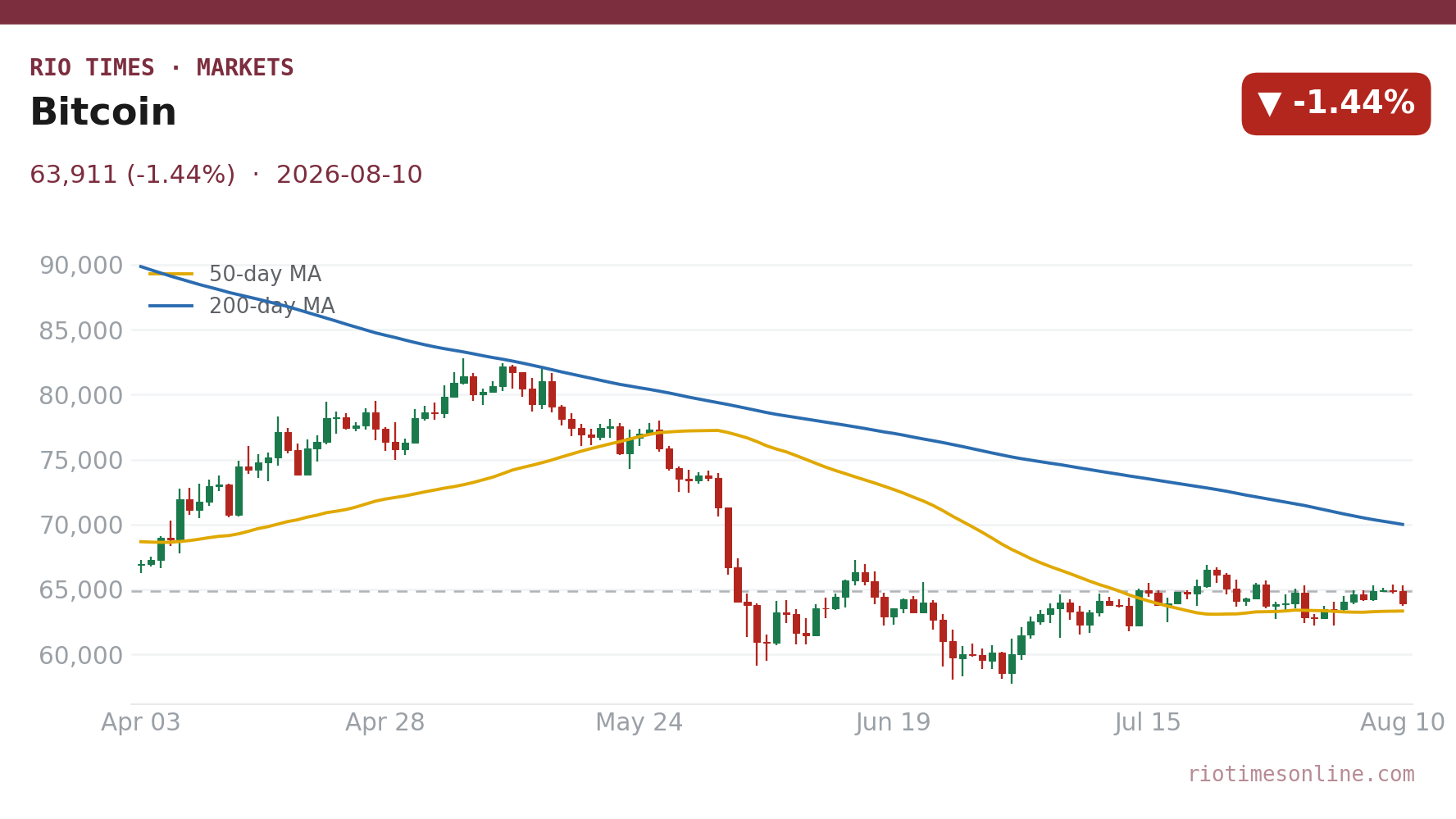
- Oil rose about 1% on Monday after Iran deflated hopes for a quick reopening of the Strait of Hormuz, sending a risk-off shudder through equities and pulling Bitcoin down 1.44% to US$63,911.
- Bitcoin gave back all its weekend gains, slipping from an intraday high near US$65,000 after the Iran-linked disruption to the crucial oil transit chokepoint.
- Ethereum fell harder, down 1.96% to US$1,871, as Vitalik Buterin’s newly updated roadmap placing quantum resistance and privacy at the network’s core failed to stem the risk-off tide.
- XRP weakened to US$1.0115, a drop of 1.69%, still pinned under a technical ‘death cross’ pattern while legislative tailwinds from the stalled CLARITY bill fade.
- TRON’s USDT supply hit an all-time high of US$87.9 billion in the second quarter, with transfers reaching US$2.1 trillion, underscoring the stablecoin rail’s centrality to emerging-market dollar access.
- Brazil’s US$319 billion crypto market is facing a formal October licensing deadline, a regulatory push that will reshape how the region’s largest economy supervises digital-asset trading and custody.
Today’s Focus
Bitcoin erased a short-lived weekend rally on Monday, closing at US$63,911, a drop of 1.44%. The catalyst was not a crypto-native event but a geopolitical shock: Iran signalled that the Strait of Hormuz, the conduit for a fifth of the world’s oil, would not reopen quickly. Crude rose about 1%, and risk assets from US equities to digital tokens sold off in lockstep with the flight-to-safety. Bitcoin had briefly touched US$65,000 earlier in the session before the Hormuz headline hit.
Ethereum fell further, down 1.96% to US$1,871, as a major roadmap update from Vitalik Buterin emphasizing quantum resistance and AI-assisted verification was drowned out by macro noise. Solana held up relatively well, dipping just 0.35% to US$75.95. XRP, pinned at US$1.0115, shed 1.69% and remains stuck below a technical death cross, with the US Senate’s procedural delay on the CLARITY market-structure bill removing a hoped-for catalyst.
The oil spike has a specific resonance for Latin American portfolios. A sustained crude rally props up export-heavy national accounts in Brazil and Colombia, but it also feeds inflation, which keeps local central banks hawkish and drains speculative liquidity from emerging-tech bets, including crypto. On-chain, the real story is stablecoins: TRON’s USDT supply hit a fresh record of US$87.9 billion, with quarterly transfer volume above US$2.1 trillion, showing the network is now a primary dollar rail for remittances and savings in Argentina and Brazil.
Brazil’s October licensing deadline is tightening the noose on unregistered exchanges. With a market valued at US$319 billion, the rule change will force platforms to segregate customer assets and report transactions, a move that institutional investors from BlackRock, which just launched a Canada-listed ETF with 3% Bitcoin allocation, are watching closely as a template for broader LatAm integration.
What matters today. The Strait of Hormuz disruption is a painful reminder that Bitcoin, for all its native drivers, still trades like a leveraged play on global risk appetite, and a prolonged oil shock could delay the capital rotation into crypto that Latin America’s real-economy users need.
01 The session in one read
Bitcoin gave up all the ground it had gained over the weekend, dropping 1.44% to close at US$63,911 on Monday. The move mirrored a sharp sell-off in US equity futures and a 1% rise in crude oil after Iran dampened expectations that the Strait of Hormuz would reopen, renewing fears of a prolonged supply disruption through the world’s most important energy chokepoint.
The oil shock acted as an instantaneous risk-off switch. Bitcoin had bounced to US$65,000 in early trading before the Hormuz headlines crossed, but the weekend bid vanished within hours. Ethereum suffered a steeper 1.96% slide to US$1,871, while XRP slipped 1.69% to US$1.0115, hovering just above a psychologically critical dollar-handle. Solana was the relative winner, giving up only 0.35% to settle at US$75.95.
Monday’s decline was a headline-driven retracement, not a breakdown in crypto-specific architecture. Institutional flows remain constructive, with Bitcoin mining output soaring at Bitdeer and BlackRock continuing to stitch token exposure into conventional wrappers. The variable to watch is whether Brent crude sustains above US$85 a barrel for more than a week, as that would reprice inflation expectations across Brazil, Mexico and Argentina just as their regulators are reshaping the digital-currency landscape.
02 The board
Across the major tokens, the session painted a uniform picture of modest but broad-based pressure, with no coin escaping the macro drag. Bitcoin’s US$63,911 close placed it squarely back inside the range that has held since mid-July, frustrating bulls who saw the weekend push above US$65,000 as a breakout signal. Ethereum was the weakest link, its US$1,871 print taking it further below the US$2,000 mark that traders have treated as a sentiment floor since the network’s last upgrade cycle.
Solana’s US$75.95 was a quiet show of resilience; the token lost just 0.35% on a day when most risk assets fell by more than one percent. XRP at US$1.0115 remains technically fragile, with chartists pointing to a death cross that formed in late July and has yet to be invalidated. Stablecoin supply data, though not a price print, framed the real action: TRON’s USDT balance hit a record US$87.9 billion in the second quarter, a number that dwarfs the market capitalization of all but the largest layer-one blockchains.
| Asset | Level | Change |
|---|---|---|
| Bitcoin | US$63,911 | -1.44% |
| Ethereum | US$1,871 | -1.96% |
| Solana | US$75.95 | -0.35% |
| XRP | US$1.0115 | -1.69% |
Source: RT close, 2026-08-10. Where a commodity has no spot feed, an exchange-traded tracker or leading producer is shown as a labelled proxy.
Live Market IntelligenceThe live market board
Rio Times · Live Market Intelligence
Latin America — Cross-Market Board
| Instrument | Last | Change | YoY | Prev. | High | Low | Volume |
|---|---|---|---|---|---|---|---|
| IBOV | 182,707.99 | -0.68% | +21.85% | 183,965.91 | 168,310 | 167,142 | — |
| IPSA | 11,294.87 | -0.05% | — | 11,300.53 | 11,210 | 10,984 | 1,513,213,483 |
| IPC MEX | 64,264.16 | -0.02% | +12.17% | 64,276.72 | 66,121 | 65,405 | 108,886,187 |
| MERVAL | 2,909,312 | -1.04% | +30.51% | 3,022,485 | 3,042,365 | 2,991,150 | — |
| COLCAP | 2,583.81 | -0.98% | — | 9.04 | 9.05 | 9.02 | 4,133 |
| BVL PERÚ | 59,934.37 | +0.57% | — | — | — | — | — |
| USD/BRL | 5.16 | +0.01% | -5.13% | 5.16 | 5.18 | 5.14 | — |
| EUR/BRL | 5.95 | +1.01% | -5.83% | 5.89 | 5.98 | 5.94 | — |
| USD/MXN | 17.06 | -0.24% | -8.58% | 17.10 | 17.08 | 17.01 | — |
| USD/CLP | 913.98 | +0.04% | -5.67% | 913.65 | 915.11 | 906.68 | — |
| USD/COP | 3,140 | +0.03% | -22.04% | 3,139 | 3,141 | 3,105 | — |
| USD/PEN | 3.36 | -0.66% | -4.82% | 3.38 | 3.38 | 3.35 | — |
| USD/ARS | 1,493 | +0.10% | +12.96% | 1,491 | 1,494 | 1,480 | — |
| USD/UYU | 40.27 | +1.24% | +1.80% | 39.77 | 40.27 | 40.23 | — |
| USD/PYG | 5,939 | +1.68% | -19.54% | 5,841 | 5,939 | 5,925 | — |
| USD/BOB | 11.64 | -0.76% | +72.04% | 11.73 | 11.72 | 11.64 | — |
| USD/DOP | 58.34 | +1.25% | -3.44% | 57.62 | 58.34 | 58.04 | — |
| USD/CRC | 445.92 | +0.89% | -9.71% | 441.97 | 448.50 | 445.92 | — |
03 What moved it
The proximate trigger was geopolitical. The Strait of Hormuz, through which roughly 20 million barrels of oil passed daily before the war, became a live risk again when Iran signalled that diplomatic progress toward reopening the waterway had stalled. Crude futures rose about 1%, triggering a classic flight-to-safety rotation that punished duration-sensitive and speculative assets alike. Bitcoin, which has traded with an increasingly tight correlation to the Nasdaq 100 in recent months, was swept along.
Compounding the pressure was a procedural delay in Washington. The US Senate punted a vote on the CLARITY Act, a market-structure bill that the crypto industry has championed, to after the August recess. The postponement deflated a legislative tailwind that had lifted names like XRP in July. Meanwhile, Ethereum’s roadmap update from Vitalik Buterin, which centres on quantum resistance and AI-assisted formal verification, is a multi-year vision that offered no immediate bid against a maelstrom of macro anxiety.
04 The Latin American read
For Latin America, Monday’s crypto price action is a sidebar to a much larger structural story. Brazil’s US$319 billion digital-asset market is racing toward an October licensing deadline that will require exchanges to register with the central bank, segregate customer funds and meet transparent reporting standards. The regulation, which officials hope will curb a long history of opaque offshore platforms, is the most consequential policy shift in the region’s largest economy.
Argentina and El Salvador inhabit the other end of the adoption spectrum. In Argentina, where annual inflation still runs above triple digits, stablecoins on networks like TRON have become the de facto savings technology. TRON’s US$87.9 billion USDT float and US$2.1 trillion in quarterly transfer volume are a direct reflection of this reality: a parallel dollar economy moving on rails built by a Cayman Islands-based protocol. El Salvador, meanwhile, continues to accumulate Bitcoin as sovereign treasury, though its holdings are now deeply underwater relative to the 2021 entry price.
The oil spike adds a specific twist for Brazil and Colombia. Higher crude prices improve fiscal accounts for Petrobras and Ecopetrol, but they also raise domestic fuel costs, forcing central banks to keep interest rates elevated. That monetary stance starves the local venture-capital and crypto-startup scene of cheap capital, creating a two-speed market where offshore stablecoin usage booms but onshore exchange volumes languish.
05 The names to watch
Bitdeer, the mining firm, reported a nearly fivefold increase in Bitcoin production during the second quarter, mining 2,694 coins, yet it ended June holding just 150 BTC after liquidating its treasury earlier in the year. The decision to sell into strength rather than hoard suggests that even the industry’s most efficient operators see near-term price uncertainty. In the traditional fund space, BlackRock’s Canadian arm launched two new ETFs, one of which allocates 3 percent directly to Bitcoin through its own iShares Canadian product, embedding crypto exposure inside a conventional 60/40-style wrapper.
On the regulatory front, Australia’s AUSTRAC suspended the registration of an operator running 96 crypto ATMs, effective August 7, a warning shot for Latin American jurisdictions evaluating how tightly to police the physical cash-to-crypto interface. In the UK, a businessman tied to a money-laundering probe reportedly bought US$100 million in tokens linked to a Trump-affiliated crypto venture in 2025, a case that will feed the compliance narrative as Brazilian regulators finalise their own anti-money-laundering rules ahead of October.
06 The outlook
The path for Bitcoin and the broader crypto complex over the next two weeks hinges on the Strait of Hormuz dynamic and the speed at which the Senate returns to the CLARITY bill after Labour Day. A de-escalation in the Gulf would likely send Bitcoin back above US$65,000 quickly, given the institutional accumulation trend visible in the new BlackRock products and the sheer volume of stablecoin liquidity waiting on the sidelines. Conversely, a prolonged oil shock above US$85 a barrel would compound the regulatory headwinds facing Brazil’s October licensing transition, squeezing the Latin American on-ramps just as they are being formalised into the global financial architecture.
07 What to watch
- Strait of Hormuz: Whether crude sustains above US$85 a barrel for more than a week; a prolonged disruption would keep Bitcoin correlated with risk-off equity moves and delay a crypto-specific recovery.
- Brazil October licensing: Watch for central bank guidance on exchange registration. Any delay or softening would lift Brazilian exchange volumes; a hard deadline could push trading offshore to unregulated platforms.
- CLARITY Act vote timing: Senate floor action after the August recess will set the tone for US market-structure optimism. A positive vote would act as a sector-wide catalyst, especially for tokens tagged as securities in previous enforcement actions.
- TRON stablecoin flows: Quarterly transfer volume above US$2 trillion makes TRON a systemic on-chain dollar rail. Any disruption, regulatory or technical, would immediately ripple through Argentina’s informal dollar savings market.
Frequently Asked Questions
Why did Bitcoin fall on Monday?
Iran signalled that the Strait of Hormuz would not reopen quickly, sending oil up about 1% and triggering a flight from risk assets that pulled Bitcoin down 1.44% to US$63,911.
What does the oil spike mean for Latin American crypto markets?
Higher crude improves fiscal balances for exporters like Brazil and Colombia but feeds inflation, keeping interest rates high and draining speculative liquidity from domestic crypto trading.
What is Brazil’s October crypto deadline?
It is a regulatory requirement for exchanges operating in Brazil’s US$319 billion market to obtain a central bank licence, segregate customer assets and comply with anti-money-laundering rules.
Why is TRON’s USDT supply important?
The record US$87.9 billion float and US$2.1 trillion in quarterly transfers show that TRON has become a primary dollar rail for remittances and savings across Argentina, Brazil and other emerging economies.
This article was produced by The Rio Times’ automated newsroom system. How we use AI · Report an error
LatAm Markets: Live Signals → — real-time movers, turnover leaders and FX across Latin America.
Read More from The Rio Times