
Key Facts
- Bitcoin drop: Bitcoin fell as much as 2.8% to US$79,197 on Friday after stronger-than-expected US jobs data, Bloomberg reported.
- Ether and Solana: Ethereum fell 2.07% to US$2,456, and Solana lost 1.95% to US$101.95.
- XRP worst hit: XRP closed at US$1.399, down 3.61%, the sharpest drop among major tokens.
- Brazil stablecoins: About 90% of Brazil’s first-quarter 2026 crypto purchases were USDT or USDC, not Bitcoin.
- Argentina pattern: In Argentina, over 70% of Bitso buys and 75% of crypto salaries use dollar-pegged stablecoins.
- The catch: Stablecoin transfers cut remittance fees by about 40% across a US$170 billion corridor.
Today’s Focus
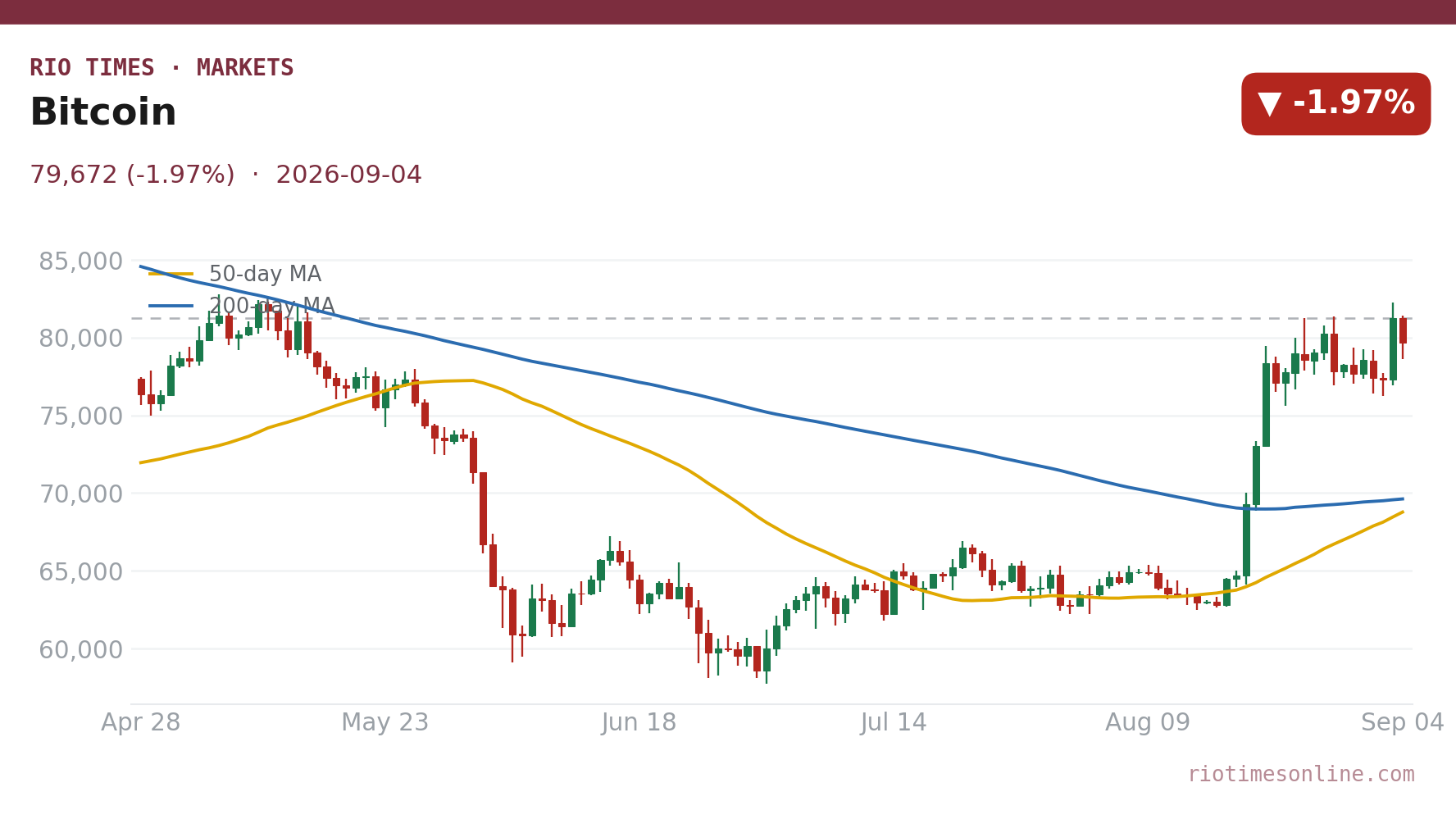
Bitcoin fell as much as 2.8% to US$79,197 on Friday, Bloomberg reported. US job growth surprised to the upside.
Traders now see less chance the Federal Reserve cuts rates this month. Ethereum dropped 2.07% to US$2,456.
Solana lost 1.95% to US$101.95. XRP fell 3.61% to US$1.399.
Some traders had borrowed money to buy Bitcoin. When prices fell, they were forced to sell, which likely deepened the drop.
They had bought when prices rose above US$81,000 earlier in the week. Then the dollar strengthened and rate expectations rose.
A September futures contract fell 2.52% to US$79,900 from its US$81,705 open. That move tracked the drop in Bitcoin’s own price.
For Latin America, crypto prices today matter less than a deeper change. Brazil bought mostly stablecoins in the first quarter.
That volume was near US$6.9 billion, or 90% of purchases. In Argentina, Bitso users buy more than 70% in USDT or USDC.
Stablecoins are digital dollars, like USDT and USDC. They keep a steady value, unlike Bitcoin or Ether.
Friday’s bitcoin dip barely touches the region’s real use case. People are buying crypto rails, not crypto volatility.
Stablecoin remittance fees are about 40% cheaper than traditional channels. El Salvador’s crypto remittances remain tiny at US$35.4 million in the first half.
That is under 1% of the total.
What matters today. Friday’s bitcoin drop follows US economic news.
Latin America’s crypto use is about stablecoin payments.
That trend does not depend on bitcoin’s price.
01 The session in one read
Bitcoin fell as much as 2.8% to US$79,197 on Friday, Bloomberg reported. A strong US jobs report made traders drop hopes for a quick Fed rate cut.
Other digital coins also fell. Ethereum dropped 2.07% to US$2,456.
Solana fell 1.95% to US$101.95. XRP lost 3.61% to US$1.399.
A surprise jump in August hiring pushed September rate-cut odds sharply lower. That lifted the dollar and made risky assets less attractive.
Traders had bought bitcoin above US$81,000 earlier in the week. Those bets were unwound, making the drop worse.
Bitcoin’s drop to US$79,197 followed a stronger-than-expected US jobs report, Bloomberg said. That report cut hopes for a quick Federal Reserve rate cut, and it pushed some borrowed-money traders to sell.
Ethereum, Solana and XRP fell too. That points to a broad reaction to the jobs data, not a lasting change in how investors view crypto.
In Latin America, bitcoin’s drop below US$80,000 barely touches stablecoin use. Dollar-pegged tokens still dominate purchases, salaries and remittances in Brazil, Argentina and El Salvador.
Watch whether US rate expectations keep the dollar strong next week. That could pressure crypto prices further, but it should not slow Latin American stablecoin flows.
02 The board
Prices fell together across major cryptocurrencies. Bitcoin traded at US$79,197.
Ethereum traded at US$2,456. Solana reached US$101.95.
XRP was US$1.399. XRP fell the most, down 3.61%.
Bitcoin dropped as much as 2.8%. Solana also lost 1.95%.
Smaller, riskier tokens often suffer more when cash runs short. Futures markets moved with the spot price.
One September 2026 futures contract fell 2.52% to US$79,900 from its US$81,705 open. That suggests some of the selling came from traders closing borrowed-money bets, alongside the wider reaction to the jobs report.
| Asset | Level | Change |
|---|---|---|
| Bitcoin | US$79,197 | -2.8% |
| Ethereum | US$2,456 | -2.07% |
| Solana | US$101.95 | -1.95% |
| XRP | US$1.399 | -3.61% |
Source: RT close, 2026-09-04. Where a commodity has no spot feed, an exchange-traded tracker or leading producer is shown as a labelled proxy.
Live Market IntelligenceThe live market board
Rio Times · Live Market Intelligence
Latin America — Cross-Market Board
| Instrument | Last | Change | YoY | Prev. | High | Low | Volume |
|---|---|---|---|---|---|---|---|
| IBOV | 208,295.98 | +1.57% | +21.85% | 205,079.25 | 168,310 | 167,142 | — |
| IPSA | 10,926.50 | -0.42% | — | 10,972.40 | 11,210 | 10,984 | 1,513,213,483 |
| IPC MEX | 69,258.58 | +0.36% | +12.17% | 69,010.67 | 66,121 | 65,405 | 108,886,187 |
| MERVAL | 3,017,221 | — | +30.51% | 3,022,485 | 3,042,365 | 2,991,150 | — |
| COLCAP | 2,533.22 | +0.47% | — | 9.04 | 9.05 | 9.02 | 4,133 |
| BVL PERÚ | 59,903.86 | -0.06% | — | — | — | — | — |
| USD/BRL | 5.16 | +0.01% | -5.13% | 5.16 | 5.18 | 5.14 | — |
| EUR/BRL | 5.95 | +1.01% | -5.83% | 5.89 | 5.98 | 5.94 | — |
| USD/MXN | 17.06 | -0.24% | -8.58% | 17.10 | 17.08 | 17.01 | — |
| USD/CLP | 913.98 | +0.04% | -5.67% | 913.65 | 915.11 | 906.68 | — |
| USD/COP | 3,140 | +0.03% | -22.04% | 3,139 | 3,141 | 3,105 | — |
| USD/PEN | 3.36 | -0.66% | -4.82% | 3.38 | 3.38 | 3.35 | — |
| USD/ARS | 1,493 | +0.10% | +12.96% | 1,491 | 1,494 | 1,480 | — |
| USD/UYU | 40.27 | +1.24% | +1.80% | 39.77 | 40.27 | 40.23 | — |
| USD/PYG | 5,939 | +1.68% | -19.54% | 5,841 | 5,939 | 5,925 | — |
| USD/BOB | 11.64 | -0.76% | +72.04% | 11.73 | 11.72 | 11.64 | — |
| USD/DOP | 58.34 | +1.25% | -3.44% | 57.62 | 58.34 | 58.04 | — |
| USD/CRC | 445.92 | +0.89% | -9.71% | 441.97 | 448.50 | 445.92 | — |
03 What moved it
US jobs data made traders think the Federal Reserve will keep rates high for longer. That strengthened the dollar and hurt bitcoin, which some see as an alternative to regular money.
Cointelegraph and Decrypt, two crypto news sites, both said the drop was a direct reaction to the jobs report. Two smaller stories ran below the big market move.
FinCEN, the US Treasury unit that fights financial crime, linked about US$13 billion in crypto scams to Southeast Asian crime groups. The G7, a group of seven large economies including the US, warned that future quantum computers could break today’s crypto security.
That added a longer-term worry to the market. Neither story caused Friday’s drop.
But both made big investors careful.
04 The Latin American read
For Latin America, Friday’s bitcoin slide is mostly a foreign event. Brazil’s first-quarter 2026 crypto buys were about 90% stablecoins.
USDT and USDC volume neared US$6.9 billion. First-half buying hit US$14.68 billion, up 135% year-on-year.
Almost all of it was in dollar-pegged tokens. Argentina shows an even sharper preference.
Over 70% of purchases on Bitso, a major Latin American crypto exchange, were stablecoins. About 75% of workers paid in crypto chose stablecoin salaries.
They hedge against inflation and capital controls. El Salvador made Bitcoin legal tender voluntary in early 2025.
Crypto remittances there hit US$35.4 million in the first half of 2026. That is up 39.1% but still only 0.7% of the US$5.06 billion total.
05 The names to watch
Felix Pago, based in Miami, raised US$200 million. The round was led by a16z, a big tech investor.
The firm sends money through WhatsApp using USDC, a digital dollar. It serves over one million users in nine Latin American corridors.
So far, it has processed more than US$5 billion in transfers.
Felix Pago will now enter Colombia, Ecuador, and Peru. These countries are part of a US$112 billion remittance market, excluding Mexico.
Revolut and OpenReserve, two fintech firms, got early approval from the OCC, the US bank regulator, to start national banks. These banks will handle crypto and stablecoins.
Polymarket, a prediction-market platform, launched crypto futures that let traders bet up to 20 times their money. This shows crypto trading and payment systems are merging.
06 The outlook
Will strong US jobs data delay Federal Reserve rate cuts? That could slow bitcoin’s rise.
If the dollar stays strong, crypto traders may stay cautious. Bitcoin might test US$78,000 again before it steadies.
For Latin America, the outlook is different. Stablecoin use in Brazil, Argentina, and remittance corridors is growing on its own merits.
A lower bitcoin does not reverse 135% yearly growth in Brazilian purchases. It also does not erase the 92% fee savings stablecoins offer in some corridors.
Watch the US dollar’s path, not bitcoin’s price.
Market data: RT
This article was produced by The Rio Times’ automated newsroom system. How we use AI · Report an error · Editorial responsibility: Matthias Camenzind, Editor-in-Chief
LatAm Markets: Live Signals → — real-time movers, turnover leaders and FX across Latin America.