Costa Rica Dollar Climbs 2.7% From Record Low
ECONOMY · COSTA RICA
Key Facts
- —The country Costa Rica lets its currency, the colón, float. The Central Bank of Costa Rica (BCCR) runs Monex, the wholesale market that sets the daily dollar rate.
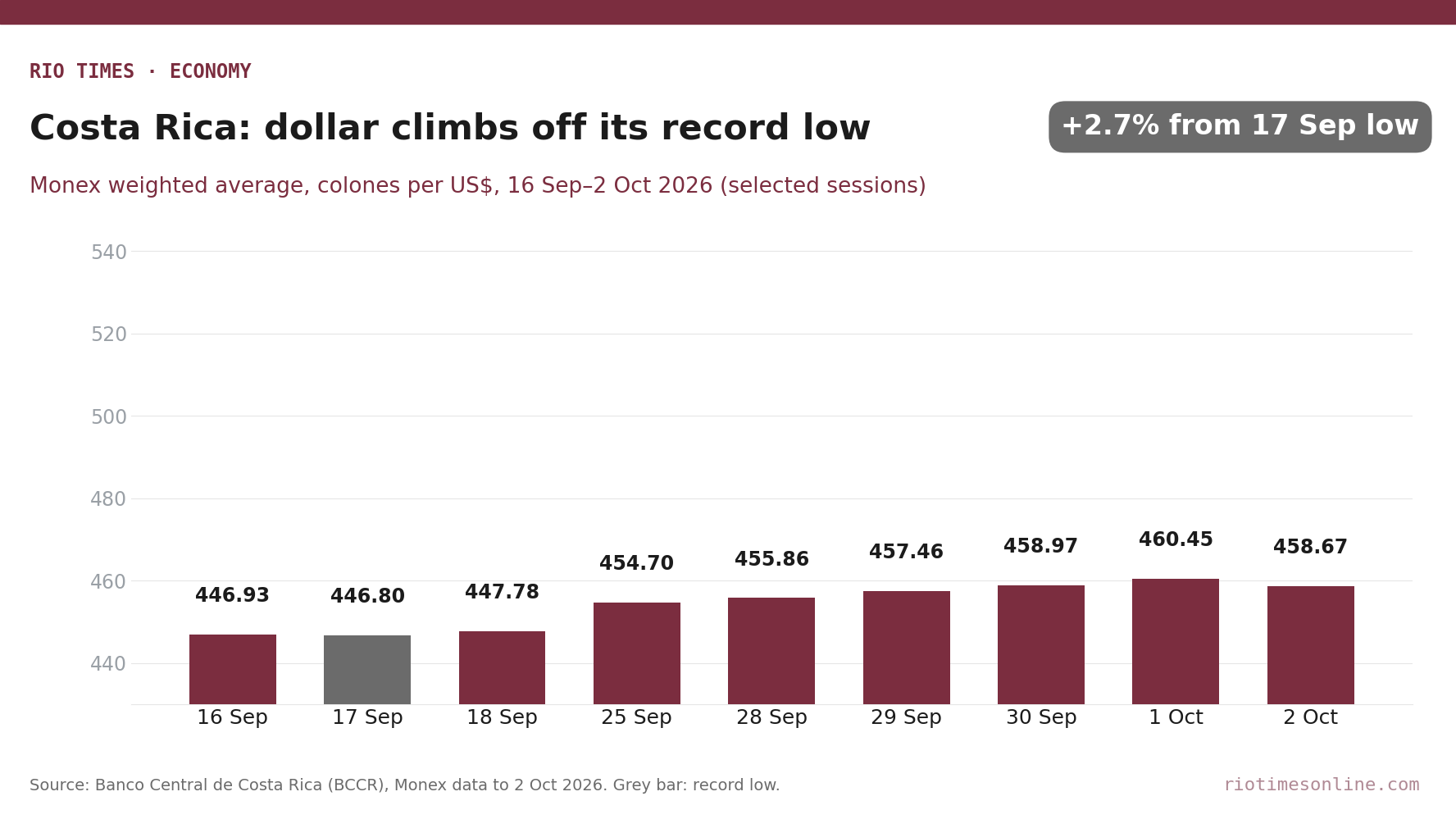
- —What happened The dollar’s Monex average rose from a record low of 446.80 colones on 17 September to 458.67 on 2 October. That is a 2.7% rise, BCCR data show.
- —The numbers The US Federal Reserve raised its rate by a quarter point to 3.75–4.00% on 16 September. The BCCR held its own rate at 3.00% on 24 September.
- —What it means for you At Monex averages, US$1,000 fetched 11,870 colones more on 2 October than on 17 September (about US$26). Dollar earners gain; dollar borrowers paid in colones pay slightly more.
- —Still open Whether the rise lasts. Analysts expect year-end bonus payments to bring dollars back in, and the BCCR next sets its rate on 26 November.
Costa Rica’s exchange rate has turned after months of record colón strength. The dollar’s average on Monex closed at 458.67 colones on Friday 2 October, up 2.7% from the 17 September low.
The turn began the day after the US Federal Reserve’s first rate rise since 2023, a quarter-point move on 16 September. A currency analyst quoted by Diario Extra on 3 October calls the Fed the main driver, with oil and thin trading also weighing.
From a record low to a four-month high
On 17 September the Monex average fell to 446.80 colones, the lowest since the market opened, BCCR data show. It beat the earlier record of 447.77 set on 11 September.
The dollar then rose in almost every session, reaching 460.45 on 1 October. El Observador noted that was the first close above 460 since early June.
On Friday the average eased 1.78 colones to 458.67, the first fall after five straight rises, La Nación reported. The central bank’s reference rate for Saturday is 455.71 colones to buy and 462.08 to sell.
Why analysts point to Washington
Carlos Valerín, a currency market analyst, told Diario Extra the Fed hike was the main factor. He added the BCCR’s decision to hold its rate and talk of further US rises.
The BCCR kept its policy rate at 3.00% by majority vote on 24 September. That leaves the local rate below the new US range of 3.75–4.00%, a gap that favours saving in dollars.
Bank president Róger Madrigal, quoted by Diario Extra, said the wider gap could prompt capital outflows and lift the exchange rate. He said the bank’s stance is to watch the move prudently rather than widen the difference.
Not only the Fed
Economist Daniel Ortiz told Diario Extra that oil near US$100 a barrel raises the dollars needed for fuel imports. Valerín said September and October are thin months, so moves tend to be sharper.
The pressure is regional rather than local. Diario Extra noted the Mexican and Colombian pesos also weakened, and Peru’s sol had its worst month since March.
The colón is still far stronger than a year ago
The rise is small against the colón’s long climb. Friday’s 458.67 is 7.7% below the 497.07 of 2 January and well under 504.02 a year earlier, BCCR data show.
Ortiz said free-zone companies, which export from tax-exempt zones, ran a US$7 billion currency surplus to August. Valerín expects year-end bonuses and transnational payrolls in November and December to push the dollar down again.
For exporters, tourism firms and households paid in dollars, each dollar now buys more colones. Borrowers with dollar loans and colón incomes face slightly higher repayments in local terms.
What Is Not Yet Known
It is unclear whether the move is a turn or a pause. Year-end inflows push the exchange rate down, while oil prices and US rates push it up.
The BCCR has not signalled any change before its final scheduled rate meeting on 26 November. Whether the Fed raises rates again this year is also open.
Sources: Banco Central de Costa Rica (BCCR), Monex trading summary and Monex average exchange rate table, data to 2 October 2026; BCCR monetary policy statement 05-2026, 24 September 2026; Ministry of Finance (Hacienda), BCCR reference rate for 3 October 2026; Diario Extra, 3 October 2026; El Observador, 1 October 2026; La Nación, 2 October 2026; El Financiero, 17 September 2026; Infobae, 22 September 2026. Rate: 457 colones per US$ (2 October 2026 close).
Editorial responsibility: Matthias Camenzind, Editor-in-Chief · Editorial standards · Report an error
LatAm Markets: Live Signals → — real-time movers, turnover leaders and FX across Latin America.