Copper Falls Friday: Chile, Peru Exposed as CPER Slides

Key Facts
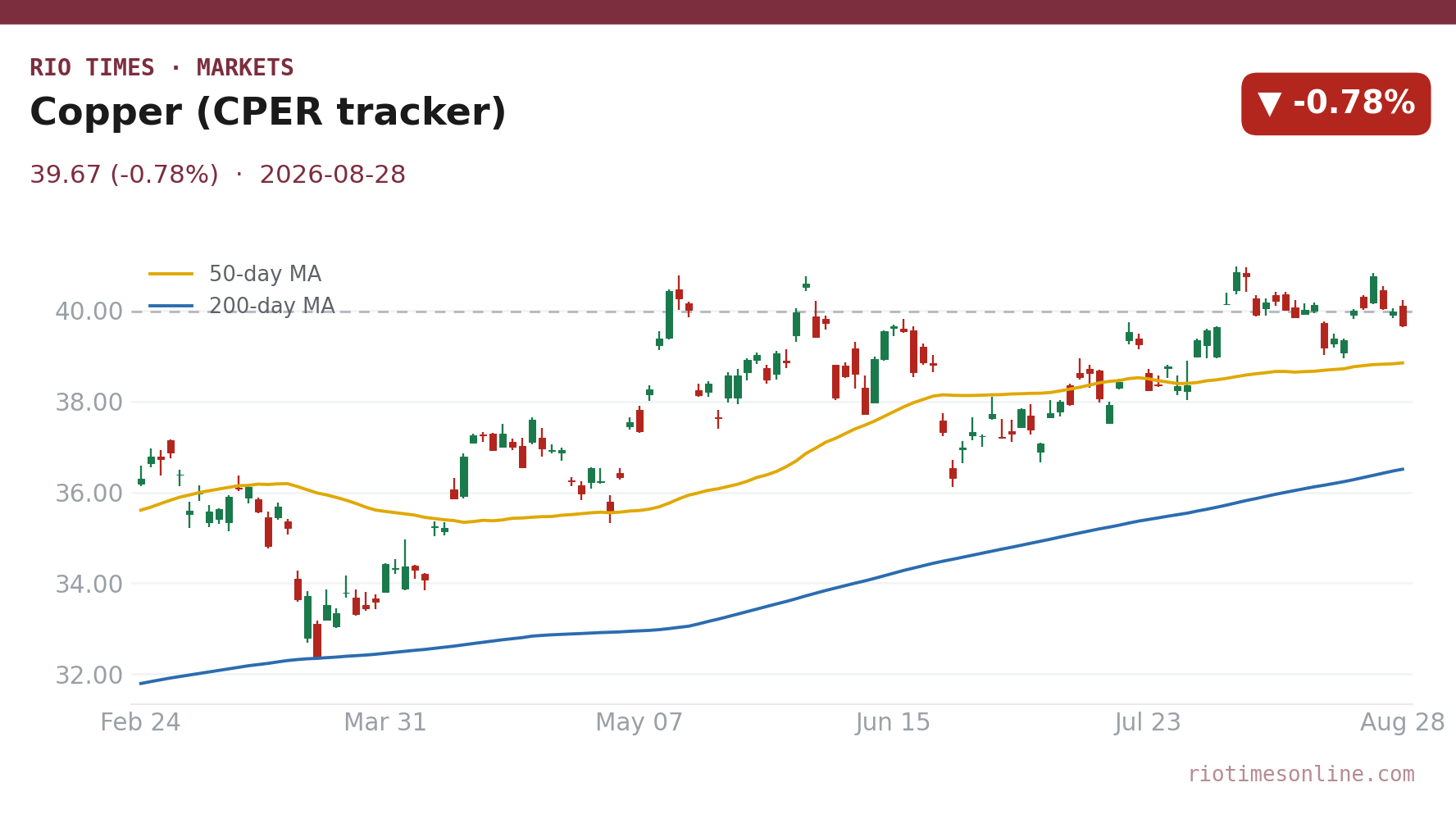
- —CPER fell 0.78% to US$39.67, showing the copper-tracking fund declined in the Friday, August 28 session.
- —Southern Copper dropped 3.00% to US$209.80, a steeper fall for the miner than the commodity proxy itself.
- —Freeport-McMoRan slid 2.51% to US$76.45, underperforming the copper fund as equity investors sold producers.
- —China demand is the driver. Softer Chinese manufacturing activity weighs on copper used in grids, electric vehicles and renewables.
- —Chile is the world’s largest producer with Peru a top global supplier, so Latin American export revenue tracks every move in this market.
- —Fed policy rippled into metals a Jackson Hole speech by Federal Reserve chair Kevin Warsh, warning the US central bank still has work to do on inflation, helped pull industrial commodities lower.
Today’s Focus
Copper proxies lost ground on Friday, August 28, 2026, pulling back from record territory. The copper-tracking fund CPER, which follows futures rather than spot metal, closed at US$39.67, down 0.78%.
Big miners fell harder. Southern Copper ended the session at US$209.80, a 3.00% decline, while Freeport-McMoRan closed at US$76.45, down 2.51%.
Softer Chinese demand and cautious messaging from Federal Reserve chair Kevin Warsh set the tone, cooling enthusiasm for an industrial metal tied to grids, electric vehicles and construction.
What matters today. The copper complex is being driven by China’s recovery and by Fed policy signals, not just by supply news from Latin America.
01 The session in one read
Friday, August 28, 2026 was a down day for copper proxies. CPER, the exchange-traded product that tracks copper futures rather than physical spot metal, closed at US$39.67, down 0.78% on the day.
The weakness was amplified in the shares of producers. Southern Copper, one of the bluest-chip names in the sector, ended at US$209.80, a decline of 3.00%, while Freeport-McMoRan closed at US$76.45, down 2.51%.
The story was driven less by mine output in the Andes and more by the demand outlook in Asia and the tone of US monetary policy. The pullback came off a record: Chile’s copper commission Cochilco put the metal’s closing high at US$6.59 a pound in August, with the 2026 average at US$6.00, up 39.28% on the year.
The uniform decline across the copper-tracking fund and major producer shares suggests a cyclical growth wobble rather than a mining disruption in Chile or Peru. China’s July manufacturing reading of 49.2, a slowdown in Chinese industrial profit growth to 11.2% year on year, and the Fed chair’s warning that inflation work remains unfinished gave investors a reason to trim exposure to economically sensitive assets.
The key variable to watch is whether Chinese infrastructure and grid orders rebound strongly enough to absorb the coming wave of mine supply from Latin America and central Africa.
02 The board
The price board shows a consistent risk-off pattern. CPER’s 0.78% decline to US$39.67 was the mildest move of the three copper-linked instruments tracked here.
Southern Copper’s 3.00% drop to US$209.80 exceeded the commodity proxy’s fall, reflecting how equity holders bear operating leverage and liquidity risk on top of metal prices. Freeport-McMoRan fell 2.51% to US$76.45, a middling move on this board: sharper than the copper tracker, but shallower than Southern Copper’s slide.
| Asset | Level | Change |
|---|---|---|
| Copper (CPER tracker) | US$39.67 | -0.78% |
| Southern Copper | US$209.80 | -3.00% |
| Freeport-McMoRan | US$76.45 | -2.51% |
Source: RT, close of 2026-08-28. Where a commodity has no spot feed, an exchange-traded tracker or leading producer is shown as a labelled proxy.
Live Market IntelligenceThe live market board
Rio Times · Live Market Intelligence
Latin America — Cross-Market Board
| Instrument | Last | Change | YoY | Prev. | High | Low | Volume |
|---|---|---|---|---|---|---|---|
| IBOV | 205,430.33 | +0.54% | +21.85% | 204,324.26 | 168,310 | 167,142 | — |
| IPSA | 10,970.29 | -0.01% | — | 10,971.88 | 11,210 | 10,984 | 1,513,213,483 |
| IPC MEX | 68,929.72 | +1.87% | +12.17% | 67,663.29 | 66,121 | 65,405 | 108,886,187 |
| MERVAL | 2,848,945 | -0.35% | +30.51% | 3,022,485 | 3,042,365 | 2,991,150 | — |
| COLCAP | 2,566.28 | -0.55% | — | 9.04 | 9.05 | 9.02 | 4,133 |
| BVL PERÚ | 60,210.69 | -0.91% | — | — | — | — | — |
| USD/BRL | 5.16 | +0.01% | -5.13% | 5.16 | 5.18 | 5.14 | — |
| EUR/BRL | 5.95 | +1.01% | -5.83% | 5.89 | 5.98 | 5.94 | — |
| USD/MXN | 17.06 | -0.24% | -8.58% | 17.10 | 17.08 | 17.01 | — |
| USD/CLP | 913.98 | +0.04% | -5.67% | 913.65 | 915.11 | 906.68 | — |
| USD/COP | 3,140 | +0.03% | -22.04% | 3,139 | 3,141 | 3,105 | — |
| USD/PEN | 3.36 | -0.66% | -4.82% | 3.38 | 3.38 | 3.35 | — |
| USD/ARS | 1,493 | +0.10% | +12.96% | 1,491 | 1,494 | 1,480 | — |
| USD/UYU | 40.27 | +1.24% | +1.80% | 39.77 | 40.27 | 40.23 | — |
| USD/PYG | 5,939 | +1.68% | -19.54% | 5,841 | 5,939 | 5,925 | — |
| USD/BOB | 11.64 | -0.76% | +72.04% | 11.73 | 11.72 | 11.64 | — |
| USD/DOP | 58.34 | +1.25% | -3.44% | 57.62 | 58.34 | 58.04 | — |
| USD/CRC | 445.92 | +0.89% | -9.71% | 441.97 | 448.50 | 445.92 | — |
03 What moved it
Softer Chinese demand remains the anchor for copper’s direction. The country is the world’s biggest consumer of the red metal, pulling in cargoes for power grids, electric vehicles, renewable energy systems and construction.
Friday’s session also absorbed a hawkish signal from Federal Reserve chair Kevin Warsh, speaking at the Jackson Hole symposium. His warning that the US central bank still has work to do to tame inflation cooled appetite for cyclical industrial commodities across the board.
Copper is not gold. While bullion producers and investors were also digesting Warsh’s comments, copper lacks the safe-haven bid that precious metals receive from central bank buying and geopolitical anxiety.
04 The Latin American read
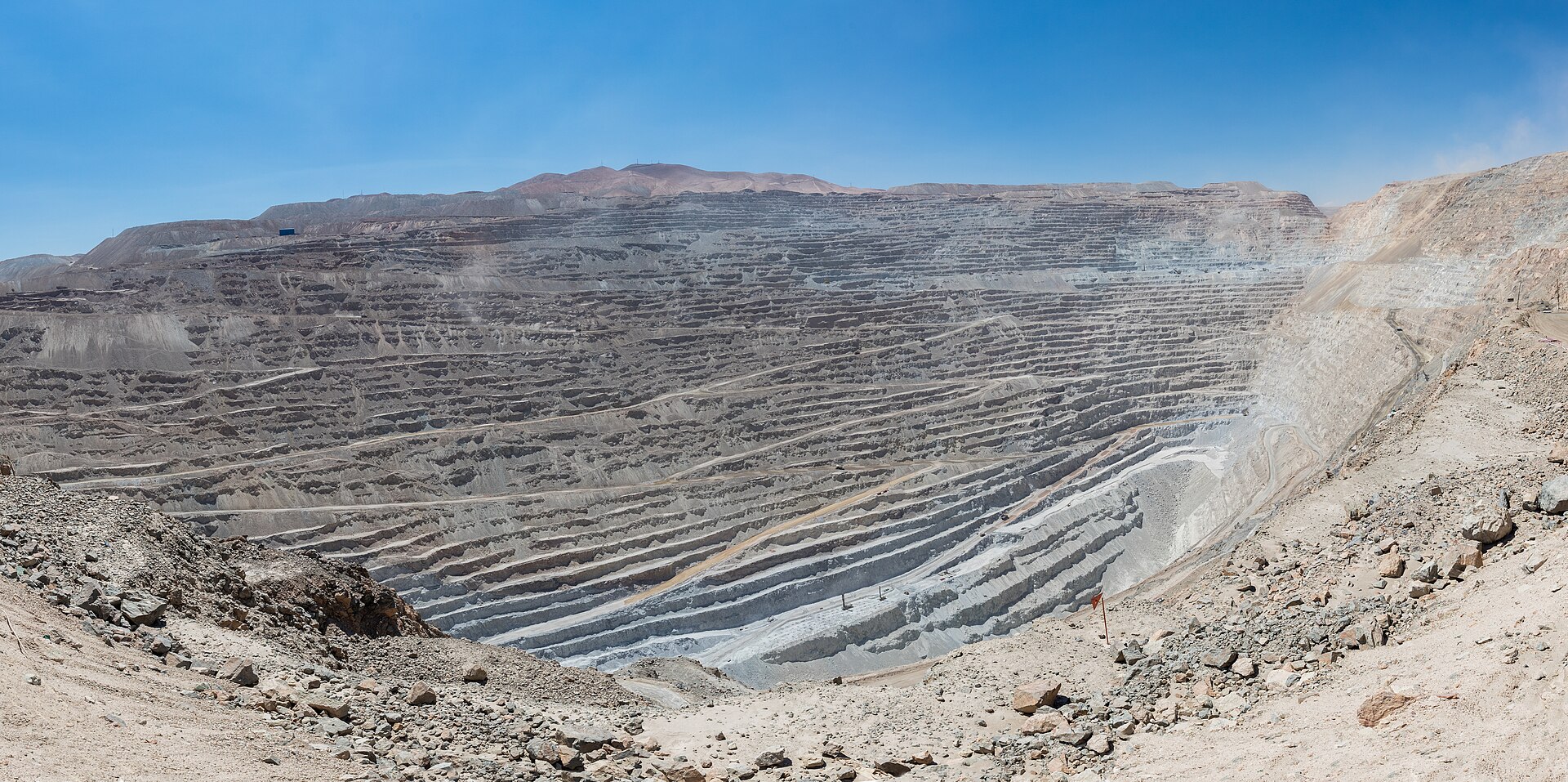
Chile is the world’s largest copper producer, and Peru has long sat near the top of the global rankings. That makes every percentage move in copper futures a direct input into export earnings, mining wages and fiscal revenue in both countries.
For foreign investors watching Santiago or Lima, the 3.00% slide in Southern Copper shares is a starker signal than the modest CPER decline. It shows that equity markets are pricing in thinner margins and potentially slower project approvals if global demand softens.
Even without a mine disruption, a demand-led price slide pressures the tax base that funds social spending in copper-dependent regions.
05 The names to watch
Southern Copper, with flagship assets in Peru and Mexico, is the most direct Latin American bellwether on the board. Its 3.00% drop to US$209.80 shows how quickly producer shares amplify a modest futures move.
Freeport-McMoRan’s 2.51% decline to US$76.45 highlights the global nature of copper capital. Freeport’s Grasberg operation in Indonesia and its Americas portfolio tie the stock to Chinese demand just as tightly as Andean miners.
BHP, though not quoted on this board, remains a company the market watches closely. Copper is a major earnings driver for the global miner, and any sustained price retreat would dent its growth narrative around electrification.
06 The outlook
The next move hinges on data from China. If manufacturing and infrastructure orders accelerate, copper could stabilise quickly, even against a firmer dollar and cautious Fed rhetoric.
The energy transition remains the long-term case. Grid build-out, electric vehicle adoption and renewable power installation all require copper at a scale that Chile and Peru supply disproportionately to the world.
But Friday’s session is a reminder that a long-term theme does not protect a price from near-term demand scares. Until Chinese consumption prints a convincing rebound, Latin America’s copper complex may stay sensitive to every central bank headline.
07 What to watch
- Chinese manufacturing and infrastructure data: Any acceleration would lift copper demand expectations for grids, EVs and construction.
- Federal Reserve policy signals: A more hawkish tone raises the dollar and pressures industrial metals priced in dollars.
- Chile and Peru production headlines: Strikes, water shortages or policy shifts in top producers would tighten supply quickly.
- Global energy transition capex: Grid and renewable spending plans indicate whether long-term copper demand is rising or stalling.
More: Brazil news in English, every day from The Rio Times.
Frequently Asked Questions
Why did copper fall on Friday, August 28, 2026?
Softer Chinese demand and a Federal Reserve chair’s warning on inflation pressured industrial commodities.
What is CPER?
CPER is an exchange-traded product that tracks copper futures, not spot copper, so its price reflects forward market expectations.
Why did Southern Copper fall more than CPER?
Miner shares carry operating leverage and equity risk, so they often move more than the underlying commodity proxy.
Which Latin American country is the top copper producer?
Chile is the world’s largest copper producer, with Peru also holding a top global position.
Market data: RT
This article was produced by The Rio Times’ automated newsroom system. How we use AI · Report an error · Editorial responsibility: Matthias Camenzind, Editor-in-Chief
In depth
LatAm Markets: Live Signals → — real-time movers, turnover leaders and FX across Latin America.
Copper in Latin America
- Copper in Latin America 2026: Mines, Prices and Politics
- What Is Codelco? Chile’s State Copper Giant, Its Debt and the El Teniente Crisis
- Peru Copper Mining Explained: Output, Big Mines, Exports and Risks in 2026
- Peru Natural Resources Explained 2026