Colombia remains world’s largest cocaine producer, despite declining crops
RIO DE JANEIRO, BRAZIL – World cocaine production reached an all-time high in 2020, with an 11% growth over 2019, and reached 1,982 tons, despite stabilization in coca bush cultivation, according to the United Nations Office on Drugs and Crime (UNODC) World Drug Report 2022.
Colombia accounts for 62% of that global production.
Global seizures also increased, despite the covid-19 pandemic, to a record 1,424 tons in 2020. The data suggest that cocaine trafficking is expanding to regions outside the major markets of North America and Europe, with increasing levels of trafficking to Africa and Asia.
These figures reflect the increase “in cocaine production levels, particularly in Colombia, where, despite a clear decrease in the area under coca bush cultivation, there was a steady concentration of cultivation in areas with high yield levels and sophisticated production, resulting in highly efficient laboratories,” the report said.

MORE EFFICIENT COCAINE PRODUCTION
Indeed, in 2020, 143,000 hectares of coca crops were registered in Colombia, representing a 7% decrease compared to 2019. Likewise, there was a 9% decrease in the productive areas under cultivation.
In any case, Colombia remains the country with the largest cultivation, accounting for 61% of the global total.
However, despite the decline in cultivation, Colombia’s potential cocaine production increased 8% to 1,228 tons in 2021 “due to higher yields and higher laboratory efficiency rates,” the report says.
“The average yield of fresh coca leaf harvested per hectare of coca bush cultivation increased by 10%, from 5.8 tons in 2019 to 6.4 tons in 2020, while the total amount of cocaine hydrochloride obtained from one hectare of productive coca bush cultivation increased by 18%, from 6.7 kilograms in 2019 to 7.9 kilograms in 2020,″ explains the United Nations Office on Drugs and Crime (UNODC).
The analysis also addresses the relationship between conflict and the production, trafficking, or supply of the narcotics market, which “in many cases, overlap geographically.”
“Notable examples include Afghanistan and Colombia, which had long-standing insurgencies in the past and are responsible for a significant share of global heroin and cocaine manufacture.”
The report states that “in Colombia, coca bush cultivation and trafficking were central” to the FARC.
“However, when the FARC agreed to stop participating in the drug business as part of the 2016 peace agreement, coca cultivation did not decrease nationally, partly because not all non-state armed groups signed the agreement.
“There were also increases in some areas, as some farmers planted coca to qualify for government payments to cease cultivation and, as a result, production reached a record high in 2017,” UNODC specifies.
OTHER DRUGS IN THE WORLD
The legalization of cannabis in some parts of the world appears to have accelerated daily use and related health consequences, says UNODC.
The Organization warned about the unprecedented increase in cocaine production, the expansion of the synthetic drugs market, and the continuing shortcomings in the availability of drug treatment, especially for women.
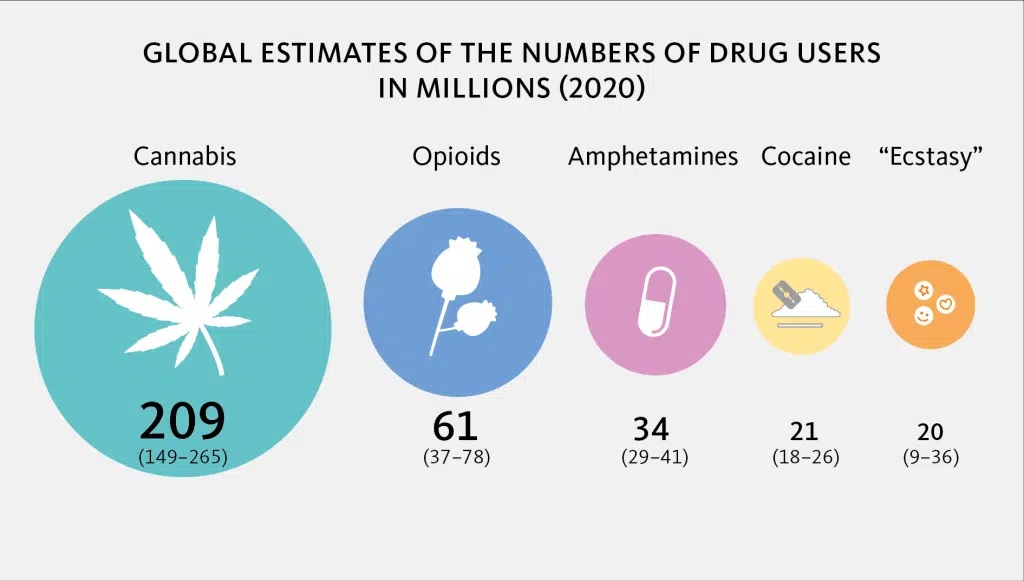
According to the report, about 284 million people between the ages of 15 and 64 used drugs worldwide in 2020, a 26% increase from the previous decade.
Likewise, people under 35 are most of those receiving treatment for use-related disorders in Latin America and Africa.
The report also estimates that 11.2 million people worldwide are injecting drug users. About half of them have hepatitis C, 1.4 million have HIV, and 1.2 million have both diseases (transmitted by needle sharing and sexual transmission).
LEGALIZATION AND INCREASED USE
The legalization of cannabis in North America seems to have increased its daily use, especially its potent derivatives, especially among young adults, the UNODC report highlights.
Although legalization has increased tax revenues and reduced the number of arrests for cannabis possession, the report also exposes related increases in people with a history of psychiatric disorders, suicides, and hospitalizations.
In this sense, marijuana remains the main reason for treatment in Argentina, Colombia, Peru, Venezuela, and almost all of Central America, while cocaine prevails in Canada, Chile, Uruguay, and Paraguay.
AMPHETAMINES, THE DRUG WITH THE GREATEST IMPACT IN MEXICO
Methamphetamine trafficking continues to expand geographically, reports the UNODC in its latest report, and stimulants rise in Mexico as the drug with the greatest impact and the leading treatment cause.
“Mexico is the only country in the Americas where amphetamine-type stimulants have become the leading drug causing treatment,” said Sofia Diaz, UNODC’s Mexico coordinator.
Between 2013 and 2020, Mexico experienced a 218% increase in the number of people in treatment for amphetamine and methamphetamine use, Diaz detailed.
This trend is part of an escalation in production by large drug trafficking cartels in the country, usually aimed at the US market.
Opioids, both natural and synthetic, prevail in the United States, while other drugs and pharmaceuticals stand out in Brazil and the rest of the countries.
In North America, methamphetamine use rose from 1.3% of the drug-using population in 2010 to 3.8% in 2020, while the bulk of production is consumed within the subcontinent, the UN report states.
The manufacture and trafficking of synthetic drugs “are increasing at a much faster rate” than drugs of natural origin, with methamphetamines predominating, warned Diaz.
Of the total synthetic drugs seized globally between 2016 and 2020, 72% corresponded to methamphetamines. And the number of countries where seizures occurred increased from 84 between 2006 and 2010 to 117 between 2016 and 2020.
Commenting on the report, UNODC Executive Director Ghada Waly explained: “Production and seizure figures for many illicit drugs are reaching record levels, even as global emergencies are increasing vulnerabilities.
“At the same time, misperceptions about the magnitude of the problem and related risks are depriving people of care and treatment services and driving youth into risky behaviors.”
The document also highlights the importance of mobilizing the international community, governments, civil society, and all partners to take urgent protective measures, including strengthening the prevention and treatment of drug use and addressing the supply of illicit drugs.
With information from Diario Criterio
More: Colombia news in English, every day from The Rio Times.
Editorial responsibility: Matthias Camenzind, Editor-in-Chief · Editorial standards · Report an error