COLCAP Drops 1.75% as Selloff Erases Recovery; Peso Pauses

COLCAP plunged 1.75% to 2,375.82 on Wednesday — its sharpest single-session drop since the post-rate-shock selloff — as financials, industrials, and utilities all sold off hard. The index gave back the entirety of Tuesday’s recovery and then some, falling 42 points in a session that saw broad-based selling despite a resilient performance from Banco Davivienda Pf (+3.91%) and Grupo Energía de Bogotá (+2.23%). Cementos Argos hit an all-time high at COP 13,940 even as the broader index crumbled. Ecopetrol slipped 1.78% to COP 2,210.
The TRM rose to COP 3,659.71 — up COP 7.81 (+0.21%) — snapping a multi-session strengthening streak as the dollar found a floor. USD/COP on the ICE spot closed at 3,664.0, up 0.20%. The DXY stabilized near 96.8 after its sharp recent decline, with markets awaiting the US January CPI release now rescheduled to February 13. The peso’s 11.45% year-over-year appreciation against the dollar remains intact despite Wednesday’s modest pullback.
Oil prices surged over 2% on Wednesday as US-Iran tensions re-escalated, with Brent pushing toward $70 and WTI nearing $65. Crude inventory data showed a massive build of 8.53 million barrels — far exceeding the expected draw of 204,000 — but geopolitical risk premiums dominated the session. OPEC’s monthly report forecast that demand for OPEC+ oil will drop by 400,000 bpd, reinforcing the medium-term bearish outlook even as near-term supply risks keep prices elevated above Ecopetrol’s $60/barrel budget assumption.
| Indicator | Level | Change |
|---|---|---|
| MSCI COLCAP | 2,375.82 | -1.75% |
| USD/COP (TRM) | 3,659.71 | +0.21% |
| USD/COP (ICE spot) | 3,664.0 | +0.20% |
| Brent Crude | $69.33 | +0.77% |
| WTI Crude | $64.84 | +0.32% |
| Gold (XAU/USD) | ~$5,116 | +1.68% |
| DXY | 96.82 | +0.15% |
| BanRep Rate | 10.25% | unch |
| Colombia CPI (Jan YoY) | 5.35% | +0.25pp |
Colombian equities suffered their sharpest single-session decline since the post-rate-shock selloff as the COLCAP fell 1.75% to 2,375.82, erasing Tuesday’s 0.92% recovery and then some. The selloff was broad-based, with the financials, COL Inversionist, and utilities sectors all dragging the index lower.
This is part of The Rio Times’ daily coverage of Colombian markets and Latin American financial news.
For context on regional markets, see Brazil’s Ibovespa for the same session.
Also tracking regional peers: Chile’s IPSA closed the same session.
The session’s damage was concentrated in the index’s heavyweight names. Despite the overall carnage, pockets of strength emerged: Banco Davivienda Pf surged 3.91% to COP 28,700, Grupo Energía de Bogotá gained 2.23% to COP 2,975, and Cementos Argos climbed 2.05% to a record COP 13,940. Positive breadth slightly exceeded negative breadth at the individual stock level, suggesting the selling was driven by large-cap rotation rather than indiscriminate dumping.

Ecopetrol fell 1.78% to COP 2,210, its second consecutive down session, despite oil prices firming on the day. The stock continues to lag the broader index recovery, weighed down by the EIA’s bearish 2026 Brent forecast of $55-56/barrel and uncertainty surrounding the company’s March 3 earnings report.
The dollar staged a modest recovery against the peso on Wednesday, with the TRM rising COP 7.81 to 3,659.71 (+0.21%) — the first increase after a streak of peso-positive sessions. The ICE spot USD/COP closed at 3,664.0, up 0.20%. The DXY stabilized near 96.8, finding a temporary floor after losing more than 1% over the prior two sessions on weak US retail sales data.
Markets had been bracing for the US January CPI release, originally scheduled for February 11, but the Bureau of Labor Statistics rescheduled the report to February 13 following a brief government shutdown in late January that disrupted the data calendar. The delay added an extra day of uncertainty, with consensus expectations ranging from 2.5% to 2.9% headline YoY — either of which would represent a re-acceleration from December’s 2.7%. Any upside surprise would bolster the dollar and pressure the peso, while a soft print would reinforce the dovish Fed trajectory and sustain carry-trade inflows into Colombian assets.
Oil prices rallied sharply on Wednesday, with Brent crude pushing above $69.30 after gaining more than 2% on the session. The move was driven by re-escalating US-Iran tensions — the US maritime advisory warning American-flagged ships to avoid Iranian waters remains in effect, and uncertainty over the nuclear talks continues to inject a supply-risk premium into crude. However, the EIA’s weekly inventory data poured cold water on the demand outlook, showing a massive 8.53 million barrel build against expectations of a modest 204,000 barrel draw.
OPEC’s monthly report, also released Wednesday, forecast that demand for OPEC+ crude will drop by 400,000 bpd in 2026, underscoring the medium-term supply overhang that has kept prices range-bound despite geopolitical flare-ups. For Colombia, current Brent prices near $69 remain well above Ecopetrol’s 2026 budget assumption of $60/barrel, but the structural headwinds for crude are mounting.
Gold surged 1.68% to approximately $5,116 per ounce, fueled by haven demand as markets digested the CPI delay and rising geopolitical tensions. The precious metal continues to benefit from the dovish repricing of Fed rate expectations and persistent central bank buying.
Domestically, the political calendar remains in focus as the March 8 legislative elections and presidential primaries approach. BanRep’s hawkish January Monetary Policy Report — which flagged that annual inflation stopped decreasing throughout 2025 and raised its 2026 year-end inflation forecast to 6.3% — continues to shape the monetary backdrop. With the policy rate at 10.25% following the January 30 shock 100bp hike, the rate differential favoring the peso remains among the widest in emerging markets.
The peso’s year-over-year appreciation of 11.45% against the dollar and the COLCAP’s 55.73% annual gain underscore the remarkable run Colombian assets have had — but Wednesday’s selloff served as a reminder that the path higher remains uneven, particularly with BanRep’s punitive rate regime creating friction for the domestic economic recovery.
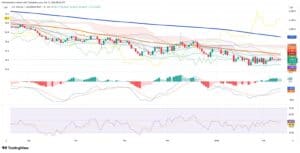
Wednesday’s 1.75% decline has materially altered the COLCAP‘s technical picture. On the daily chart, the index opened at 2,397.85, tested a high of 2,404.68 before sellers overwhelmed the session, driving price to a low of 2,368.05 and closing at 2,375.82. The bearish engulfing candle from Wednesday now sits below the upper Bollinger Band (2,399.51), with the daily RSI retreating to 68.14 — still elevated but pulling back from Tuesday’s overbought reading of 70.41.
The daily MACD histogram remains deeply negative at -20.08, with the MACD line at 44.77 and the signal line at 64.85. This persistent negative divergence between rising price (until Tuesday) and falling momentum suggests the rally from the post-rate-shock lows near 2,370 lacked conviction — a diagnosis confirmed by Wednesday’s sharp reversal.
Live Market IntelligenceColombia — Live Market Board
Rio Times · Live Market Intelligence
Colombia — Live Market Board
+0.35%
205,526.47
-0.47%
66,790.35
-0.26%
10,912.39
-0.49%
2,857,176
+0.75%
2,591.39
+0.35%
59,543.73
+0.54%
| Instrument | Last | Change | YoY | Prev. | High | Low | Volume |
|---|---|---|---|---|---|---|---|
| COLCAP | 2,591.39 | +0.35% | — | 9.04 | 9.05 | 9.02 | 4,133 |
| USD/COP | 3,140 | +0.03% | -22.04% | 3,139 | 3,141 | 3,105 | — |
| BRENT | 88.88 | -0.03% | +34.42% | 88.91 | 90.07 | 88.12 | 29,713 |
| WTI | 83.11 | -0.11% | +31.57% | 83.20 | 84.35 | 82.40 | 166,848 |
| ECOPETROL | 16.92 | -0.53% | +98.01% | 17.01 | 17.05 | 16.79 | 737,591 |
| BANCOLOMBIA | 95.87 | -2.18% | +96.15% | 98.01 | 100.36 | 95.73 | 188,740 |
| GRUPO AVAL | 5.40 | +2.66% | +76.89% | 5.26 | 5.49 | 5.32 | 146,447 |
| TECNOGLASS | 42.30 | -1.10% | -48.04% | 42.77 | 42.73 | 42.05 | 60,908 |
| CREDICORP | 375.17 | -0.49% | +49.60% | 377.00 | 384.43 | 372.27 | 88,375 |
| BUENAVENTURA | 34.45 | -1.02% | +88.07% | 34.80 | 35.62 | 34.33 | 275,831 |
| SOUTHERN COPPER | 193.97 | -0.26% | +104.01% | 194.48 | 199.36 | 192.59 | 367,102 |
On the 4-hour chart, the picture has deteriorated significantly. Price has broken below the Ichimoku cloud and is now trading at the lower end of the recent range. The 4H RSI has collapsed to 47.65/47.02 — neutral territory that suggests the short-term overbought condition has been fully unwound. The 4H MACD has turned negative, with the histogram at -4.96 and both signal lines converging near zero (MACD: -1.63, Signal: 3.33).
The key support zone sits at 2,348–2,365, defined by the 4H Ichimoku cloud base and the Kijun-sen. A break below this range would target 2,308 and potentially the January correction lows near 2,282. To the upside, bulls need to reclaim 2,401 (the upper Bollinger Band on the 4H) to re-establish the recovery trajectory.
| Level | Daily | 4H |
|---|---|---|
| Resistance 2 | 2,399.51 | 2,401.47 |
| Resistance 1 | 2,375.92 | 2,380.83 |
| Current Price | 2,375.82 | 2,375.82 |
| Support 1 (Kijun-sen) | 2,348.32 | 2,365.91 |
| Support 2 (Ichimoku cloud) | 2,293.91 | 2,348.32 |
| RSI | 68.14 | 47.65 |
USD/COP edged higher on Wednesday, with the ICE spot closing at 3,664.0 (+0.20%) and the TRM rising to 3,659.71 (+0.21%). The pair’s modest bounce from the multi-year lows comes as the DXY found a temporary floor near 96.8, with the delayed US CPI release removing a key catalyst for further dollar weakness.
On the daily chart, the broader downtrend from the 4,200+ September 2025 highs remains firmly intact. Price is trading well below the Ichimoku cloud (top at 3,915.3) and beneath both the Tenkan-sen (3,706.3) and Kijun-sen (3,722.2). The daily RSI at 48.22/46.54 is neutral, having stabilized after the recent oversold bounce. The daily MACD remains deeply negative, with the histogram at -20.1 and the signal line at -14.2 — confirming sustained bearish momentum despite the near-term consolidation.
The 4-hour chart shows a pair in consolidation mode. Price is hovering near the midline of the Bollinger Bands, with the Ichimoku cloud providing overhead resistance in the 3,668–3,676 zone. The 4H RSI sits at an almost perfectly neutral 50.64/49.36, while the MACD has flattened near zero (histogram: -1.2, MACD: -0.2, Signal: 1.0) — indicating the pair is caught in a tug of war between the broader bearish trend and near-term dollar stabilization.
Key support remains at 3,656.6 (the lower Bollinger Band on the daily) and the 2026 low near 3,603 (set February 2). A break below 3,650 would signal a fresh leg lower toward the 3,600 handle. Resistance lies at 3,676 (4H Ichimoku cloud) and 3,706 (daily Tenkan-sen) — reclaiming the latter would signal a meaningful trend change.
| Level | Daily | 4H |
|---|---|---|
| Resistance 2 (Kumo top) | 3,915.3 | 3,702.3 |
| Resistance 1 (Tenkan-sen) | 3,706.3 | 3,676.0 |
| Current Price | 3,664.0 | 3,664.0 |
| Support 1 (Lower BB) | 3,656.6 | 3,651.9 |
| Support 2 (2026 low) | 3,603.1 | 3,649.8 |
| RSI | 48.22 | 50.64 |
Key Facts
— Wednesday’s 1.75% selloff was a reality check for COLCAP bulls who had been riding the recovery from the post-rate-shock lows. The session revealed the fragility of the rally: a market that gained 0.92% on Tuesday collapsed 1.75% on Wednesday — more than erasing the prior day’s gains — despite no single identifiable catalyst. The breadth data adds a puzzling wrinkle: advancing stocks slightly outnumbered decliners, yet the index was hammered. This suggests large-cap selling in index-heavy names drove the move, possibly reflecting institutional repositioning ahead of the delayed US CPI release.
— The daily technical picture has shifted from cautiously constructive to concerning. The daily MACD histogram at -20.08 is near its worst reading of the current correction cycle, and the RSI at 68.14 — while retreating from overbought — is still elevated relative to the price damage sustained. The 4H chart’s breakdown below the Ichimoku cloud is a near-term bearish signal, with support at 2,348–2,365 now the line in the sand. A failure to hold this zone would confirm that the rally from 2,370 was a dead-cat bounce rather than the start of a new upleg.
— For USD/COP, the peso’s modest pullback to 3,659.71 on the TRM was orderly and unsurprising given the DXY’s stabilization. The broader trend remains firmly bearish for the dollar, with the 2026 low at 3,603 still within reach. However, the near-term picture has turned neutral — the 4H RSI at 50.64 and the flattening MACD suggest the pair could consolidate in the 3,650–3,680 range until a fresh catalyst arrives.
— That catalyst is now the rescheduled US January CPI, due February 13. Forecasts range from 2.5% to 2.9% headline YoY — either outcome would represent a potential re-acceleration from December’s 2.7%, which could challenge the market’s dovish Fed narrative and trigger a dollar bounce. Core CPI is expected to remain sticky near 2.6-2.7%. For Colombian assets, a hot CPI print is the key risk — it would strengthen the dollar, pressure the peso, and remove one of the tailwinds that has supported both the currency and equities. Conversely, a soft print would validate the dovish Fed pricing and likely push USD/COP toward the 3,600 handle.
— Oil remains a two-way risk. Wednesday’s 2%+ rally on US-Iran tensions has pushed Brent back near $70, but the massive 8.53 million barrel inventory build and OPEC’s revised demand forecast paint a bearish medium-term picture. At current levels, Brent remains well above Ecopetrol’s $60/barrel budget assumption, but any rapid convergence toward the EIA’s $55-56 forecast would pressure Colombia’s fiscal accounts and potentially weaken the peso’s fundamental story. The base case remains: equity-cautious, peso-neutral pending CPI, oil-volatile.
Key Facts
— Deep Dive
— For the complete picture, read our in-depth guide: Latin America Stock Markets 2026: Ibovespa, Merval, COLCAP, IPSA and IPC Guide
This article was produced by The Rio Times’ automated newsroom system. How we use AI · Report an error · Editorial responsibility: Matthias Camenzind, Editor-in-Chief
Read More from The Rio Times