Chile’s Peso And Stocks Hit A Crossroad As Copper Cools And Traders Take Profits
Key Points
- The peso steadied near 883 per $ as copper pulled back and the global dollar stayed firm.
- Chile’s stock market reversed from a fresh intraday high, ending lower on broad profit-taking and heavy turnover.
- Policymakers are easing slowly at home, while traders keep looking abroad for the next push in rates and commodities.
Chile’s markets entered Friday’s session with a familiar message: the country’s fortunes still swing on copper, the $ cycle, and global risk appetite.
In foreign exchange, the peso started the morning slightly weaker, with the $ trading around 883 pesos. The move followed a cooling in copper after a stretch of record levels.
With no major local data on deck, attention stayed on external signals, especially the path of U.S. rates and the tone around the Federal Reserve.

Markets also digested renewed political noise in Washington, after President Donald Trump said he had no plan to remove Fed Chair Jerome Powell, easing a small pocket of institutional anxiety.
A market range often cited for the day was 878 to 901, reflecting how quickly USD/CLP can jump when copper and global rates move together. Technically, the pair has shifted from a clean drop near 905–907 into a sideways phase.
Traders have been watching a tight consolidation band around 879.6 to 887.5, with 880–878 as the next support zone and 890–900 as the first ceiling if the $ gains traction.
Local equities delivered the sharper drama. On Thursday, the S&P IPSA fell 1.17% to 11,088.48 after touching roughly 11,302 earlier in the day.
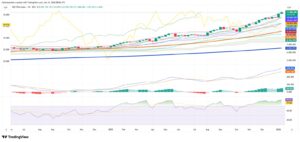
Turnover topped 320 billion Chilean pesos, a sign of active repositioning rather than a quiet drift lower. The index is still up about 7.05% for 2026, but the session looked like a classic “pause day” after a fast run.
The five strongest IPSA gainers were Salfacorp (+2.41%), ILC (+1.99%), CAP (+1.92%), Itaú-CorpBanca (+1.80%), and LATAM Airlines (+1.78%).
The five biggest drags were CMPC (-3.30%), Colbún (-2.93%), Falabella (-2.77%), Cencosud (-2.67%), and SQM-B (-2.56%).
For offshore investors, Chile’s main equity ETF, ECH, traded near $44.15, keeping Chile on the radar even as the local index cooled.
The setup for the day ahead is simple: if copper stabilizes, the peso can hold its floor and stocks can treat the dip as a reset. If copper keeps sliding and the $ firms, Chile may face another round of tightening financial conditions, even without a single domestic headline.
This is part of The Rio Times’ daily coverage of Chilean markets and Latin American financial news.
For context on regional markets, see Brazil’s Ibovespa for the same session.
Live Market IntelligenceChile — Live Market Board
Rio Times · Live Market Intelligence
Chile — Live Market Board
-0.49%
206,505.98
-0.18%
66,659.01
-0.46%
10,966.21
-0.49%
2,835,843
-1.16%
2,582.29
+0.46%
60,511.74
-1.60%
| Instrument | Last | Change | YoY | Prev. | High | Low | Volume |
|---|---|---|---|---|---|---|---|
| IPSA | 10,966.21 | -0.49% | — | 11,020.01 | 11,210 | 10,984 | 1,513,213,483 |
| USD/CLP | 913.98 | +0.04% | -5.67% | 913.65 | 915.11 | 906.68 | — |
| COPPER | 6.61 | +0.03% | +46.70% | 6.61 | 6.71 | 6.61 | 39,543 |
| SQM-B | 65,305 | -0.84% | +49.03% | 65,860 | 66,949 | 64,978 | 76,539 |
| COPEC | 5,964 | -1.09% | -11.70% | 6,030 | 6,100 | 5,960 | 634,331 |
| BSANTANDER | 78.37 | -2.28% | +35.94% | 80.20 | 81.69 | 78.34 | 36,288,711 |
| FALABELLA | 6,334 | -1.48% | +23.28% | 6,429 | 6,450 | 6,300 | 26,085,814 |
| ENELAM | 87.09 | +0.10% | -10.13% | 87.00 | 87.40 | 86.50 | 13,106,417 |
| CENCOSUD | 1,946 | -2.19% | -35.30% | 1,990 | 2,010 | 1,945 | 966,528 |
| CMPC | 1,020 | -1.96% | -29.10% | 1,040 | 1,050 | 1,015 | 3,526,677 |
| BANCO CHILE | 184.96 | -1.01% | +32.87% | 186.85 | 189.99 | 184.33 | 18,101,240 |
| LATAM AIR | 24.08 | -1.11% | +16.61% | 24.35 | 24.59 | 23.88 | 573,612,753 |
| SOUTHERN COPPER | 193.97 | -0.26% | +104.01% | 194.48 | 199.36 | 192.59 | 367,102 |
Also tracking regional peers: Colombia’s COLCAP closed the same session.
Related coverage: Brazil’s Morning Call | Africa Intelligence Brief — January 16, 2026
This article was produced by The Rio Times’ automated newsroom system. How we use AI · Report an error · Editorial responsibility: Matthias Camenzind, Editor-in-Chief
In depth
Read More from The Rio Times