Chile Cancels Hosting World Climate Summit and Asia-Pacific Forum Over Protests
RIO DE JANEIRO, BRAZIL – Chile’s most severe political and social crisis since its return to democracy in 1990, which has resulted in at least 20 deaths, has prompted President Sebastián Piñera to take a new decision: The country will host neither the Asia-Pacific Economic Cooperation Forum (APEC) in November, nor the United Nations Conference on Climate Change (COP25) in December, two major international meetings which the world’s leading figures are expected to attend.

Announcing his decision in La Moneda on Wednesday, President Sebastián Piñera said that the government has adopted this measure “with profound sorrow”. “We feel and deeply regret the problems and inconveniences that this decision will signify both for APEC and for the COP. But as president of all Chileans, I always have to place the issues and interests of Chileans, their needs, their desires and their hopes, in the forefront,” he said.
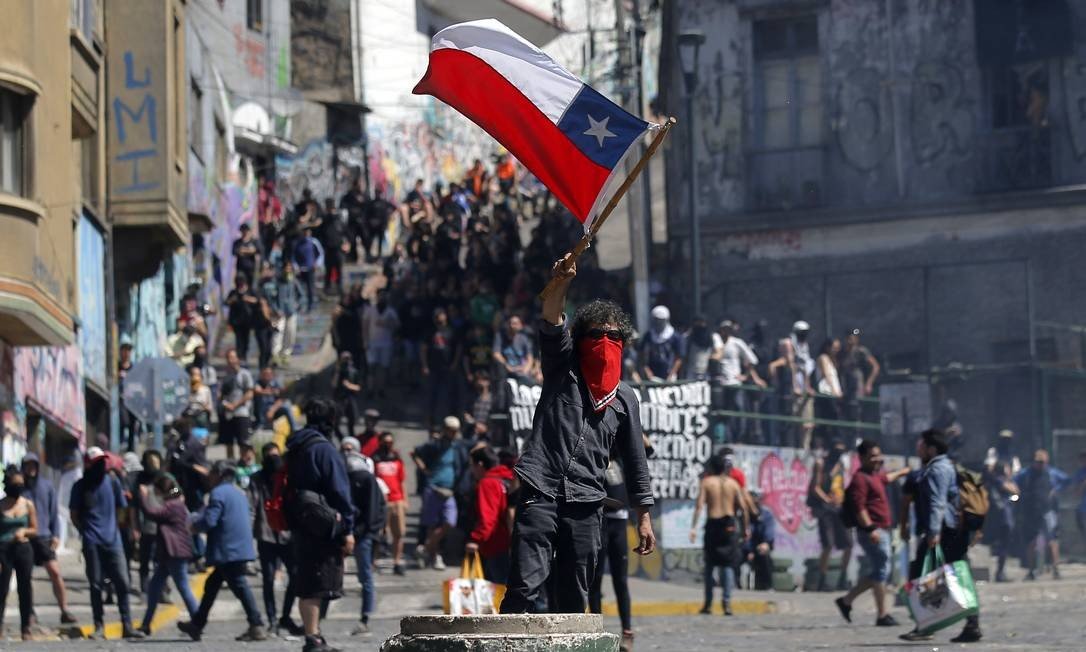
The announcement comes almost two weeks after the explosion of the protests, which began with the increase in the Santiago subway fare but reveal a deep sense of frustration among the population who feel they have been left on the sidelines of the country’s development path for the past 30 years. The protests have not stopped.
Piñera announced a package of social measures and, on Monday, changed eight cabinet ministers, including his political and economic team. But it wasn’t enough: the demonstrations continue daily in Santiago, as well as in other major cities of the country. In addition to the 20 dead, 473 civilians and 745 police officers and members of the armed forces were injured in incidents that took place during the protests, according to official information from the government.
Between October 20th and 27th, 9,696 people were arrested, of whom 389 are still in pre-trial detention and 778 have been declared illegal. The Interior Ministry has brought 228 charges.
Piñera’s announcement was made 17 days before the start of the APEC meeting. Russian President Vladimir Putin was to be one of the leaders to attend. Russia, however, announced on Tuesday that its president would not attend and would send another high-level official in his place.
The president of the United States, Donald Trump, was another of the confirmed presidents. He had planned to sign, in Chile, his agreement with Chinese leader Xi Jinping regarding the trade war between the two countries. “I know they have some difficulties right now, but I know the Chileans and I’m sure they will be able to resolve it,” Trump said on Monday.
But Trump’s presence in Chile would have been seen as a provocation amid the complex situation the country is experiencing, according to the assessments of different political groups.
A country that is far from restoring public order, although the states of emergency and curfews have been lifted, was not in a position to welcome the thousands of environmental activists who would arrive in the country to follow the climate summit that would take place from December 2nd to 13th.
Swedish activist Greta Thunberg was expected to visit the meeting, which would be attended by representatives from 293 countries.
A blow to Chile’s image
Heraldo Muñoz, former Foreign Minister of Socialist Michelle Bachelet‘s last government (2014-2018), said: “This is a serious blow to Chile’s foreign policy, but it was predictable since social peace has not been restored”.
“One thing is the desire to hold these two meetings, and another is the reality. The population would not have understood the spending of resources on the two summits when there are so many social priorities,” said Muñoz, president of the opposition PPD party. “The country’s urgencies are in an internal social agenda and in a new constitution,” he added.
Of Santiago’s 136 subway stations, 118 are damaged, 25 were set on fire, and seven trains were burned. The damage to the subway, which carried 2.8 million users daily in the capital, is estimated at US$376 million (R$1.5 billion) and should take months to restore normal operations.
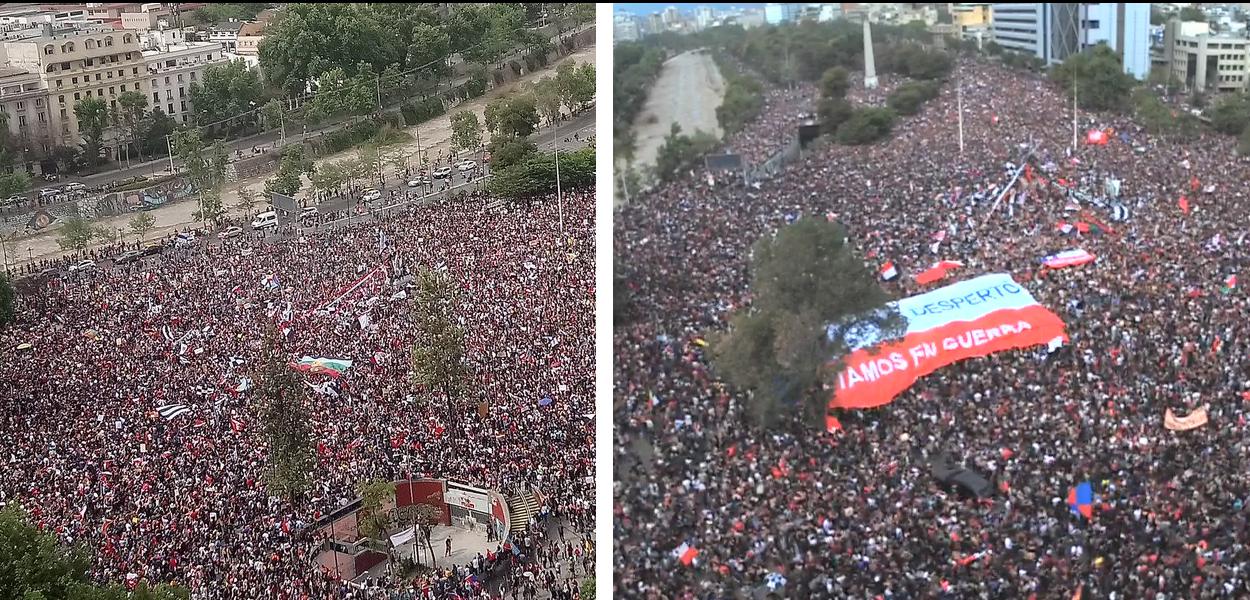
The population demonstrated peacefully, as shown in last Friday’s mass gathering in Santiago, where 1.2 million people congregated, demanding, among other factors, greater equity on all fronts, including education, health, and retirement.
But the damage from the looting of commercial establishments and the destruction of public and private infrastructure throughout the country is still incalculable. On Monday, when Piñera announced his ministerial reform, violent groups set fire to a shopping center on Alameda, the city’s main avenue just a few streets away from La Moneda.
While the Communist Party and the leftist Frente Ampla are seeking impeachment against Piñera in parliament, with the goal of removing him from office, the government is facing charges of excessive use of force, torture, and murder by police and military officers.
Hernán Larraín, the Minister of Justice, acknowledged on Tuesday that “incidents have occurred that appear to be human rights violations,” after meeting with representatives of the National Institute of Human Rights (NHRI), an independent public law organization whose existence is safeguarded by Chilean law.
According to the NHRI, 3,712 people have been arrested since the protests began on October 18th. Of these, 404 are boys, girls, and adolescents. Of the 1,233 injured, according to the NHRI, 37 were shot, 282 were injured by unidentified firearms and 140 suffered eye injuries. In all, the organization has so far lodged 138 lawsuits in court: five for homicide, 18 for sexual violence, and 92 for torture.
Representatives of the United Nations High Commissioner for Human Rights, a body led by Bachelet, arrived in the country on Wednesday to investigate the denunciations.
Source: El País
More: Latin America news in English, every day from The Rio Times.
This article was produced by The Rio Times’ automated newsroom system. How we use AI · Report an error · Editorial responsibility: Matthias Camenzind, Editor-in-Chief