Chile and the Falklands War: What the British Files Show
CHILE · HISTORY
Key Facts
- —The war Britain and Argentina fought over the Falkland Islands in 1982. Chile was officially neutral.
- —What everyone suspected That Chile, then ruled by Pinochet and close to war with Argentina itself, quietly helped Britain.
- —What is new A Chilean book setting out the British documents that describe it.
- —Where the papers come from The United Kingdom National Archives, declassified in the normal way.
- —The striking one A British defence paper of 1 May 1982 ranking options, up to a possible alliance with Chile.
- —What Chile provided Airfields, airspace, a radar at Balmaceda, and British aircraft repainted in Chilean colours.
Chileans have suspected for forty years that their country helped Britain fight Argentina. Two journalists went to London and came back with the paperwork.

A new Chilean book lays out the British defence documents from 1982. They show how far London was willing to go in accepting Chilean help.
The Book and the Archive
El Pacto Perfecto was launched in Santiago in the last week of August.
Its authors are the Chilean journalists Daniel Avendaño and Mauricio Palma, who began working in London in 2019.
They drew on files released by the United Kingdom National Archives through the ordinary declassification process.
The research is new. The documents have been sitting there for anyone who went to find them.
Option Fourteen and Option Fifteen
The centrepiece is a British defence ministry paper dated 1 May 1982, fifteen pages long.
It was marked secret and restricted to British eyes only. It sets out military options in ascending order of Chilean involvement.
Option fourteen is active Chilean participation. Option fifteen goes further, to deeper military cooperation and a possible alliance.
A separate chiefs of staff paper from 2 April 1982, the day Argentina landed on the islands, deals with using Chilean airfields.
What Chile Actually Did
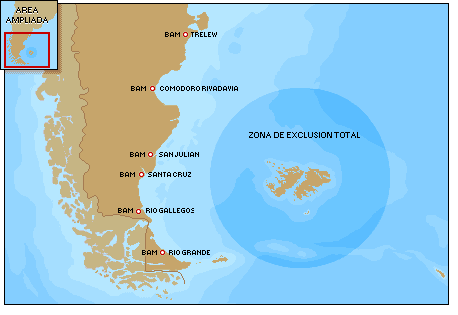
The files describe British use of airfields at Easter Island, Concepción, Punta Arenas and San Félix.
Chilean airspace was opened to British reconnaissance flights.
A Marconi radar was installed at Balmaceda, in Chilean Patagonia, watching Argentine airfields.
British aircraft were repainted in the markings of the Chilean air force.
Chile received things in return, connected to intelligence about Argentina. The relationship ran in both directions.
Why Chile Did It
In 1982 Chile and Argentina had come close to war themselves, four years earlier, over islands in the Beagle Channel.
Papal mediation stopped that conflict, and the settlement was not signed until 1984.
An Argentine army fighting Britain in the South Atlantic was an Argentine army not massing on the Chilean border.
Pinochet’s government also wanted British goodwill. It was diplomatically isolated and short of equipment.
How the Papers Got Out
British records are released on a rolling schedule, with defence files among the slowest to appear.
Nothing about these documents was leaked. They were opened to researchers and waited for someone to read them.
That is the ordinary shape of archive journalism. It rewards patience and travel rather than sources.
The two Chilean journalists spent six years on it. That is why a book about 1982 arrives in 2026.

Why It Lands Now
The South Atlantic dispute is live again. Argentina sharpened its sovereignty claim in early September after remarks from Washington about British support.
Chile and Argentina have also been exchanging statements over the Strait of Magellan.
In Argentina, Chilean help in 1982 has been an article of national memory for four decades. What was missing was paper.
In Chile, it is more awkward. The cooperation happened under a dictatorship, which complicates how the country discusses it.
Neither government has responded to the book.
More: Chile news and analysis, every day from The Rio Times.
Frequently Asked Questions
What is the new book?
El Pacto Perfecto, by Chilean journalists Daniel Avendaño and Mauricio Palma, launched in Santiago in August 2026.
Where do the documents come from?
The United Kingdom National Archives, released through normal declassification.
What do they show?
British use of Chilean airfields and airspace, a radar at Balmaceda, and British aircraft in Chilean markings.
What is the key document?
A British defence paper of 1 May 1982 ranking options, including active Chilean participation and a possible alliance.
Was this already known?
In outline, for decades. The book supplies the documentary record behind it.
Why did Chile help Britain?
It had nearly gone to war with Argentina in 1978 and wanted British goodwill and intelligence.
Sources: The National Archives (UK), El Pacto Perfecto, Infobae, La Nación.
This article was produced by The Rio Times’ automated newsroom system. How we use AI · Report an error
Read More from The Rio Times