Chile, Argentina, Bolivia, Peru, Mexico: their global lithium market potential
Global lithium production has doubled between 2016 and 2020 to 82,000 tons and is on its way to becoming one of the most demanded elements in the world.
That is because lithium is an essential component of ion batteries that enables the flow of electric current and is an indispensable component for electric cars.
The metal’s lightness, long life, and high storage capacity make it a highly sought-after mineral, especially by large electric vehicle manufacturers such as Tesla, Ford, and General Motors.
For this reason, this resource is considered the oil of the future due to its importance for developing long autonomy batteries also used in manufacturing laptops and cell phones.
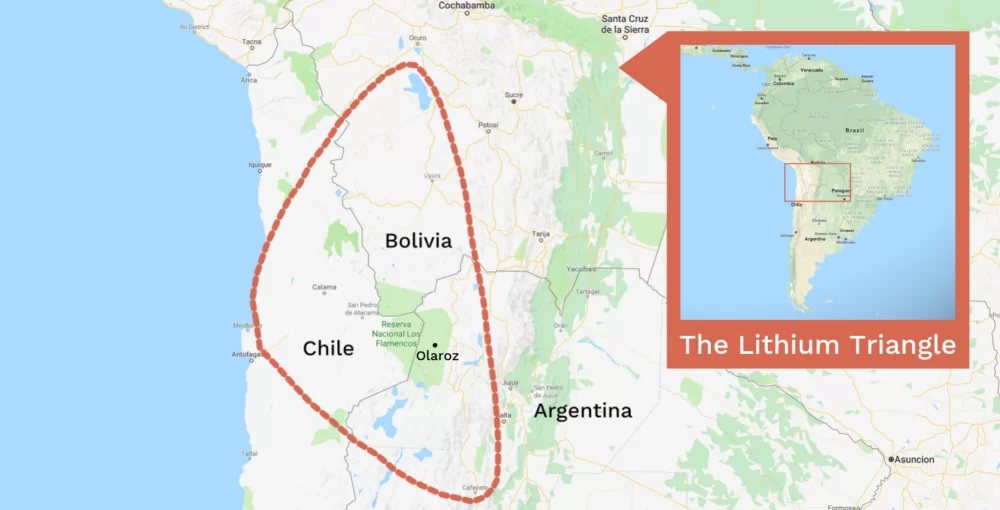
Few countries have managed to dominate the lithium market, but Latin America, especially the so-called ‘Lithium Triangle’ made up of Chile, Argentina, and Bolivia, is the leading world power in exploiting it.

“This region has attracted increased foreign interest in recent years, although its production potential remains underexploited. In Bolivia, for example, extraction is still very limited to small projects. That is due to the technical difficulties associated with lithium extraction in the country, overly restrictive government policies, and a lack of technology at the national level,” explains Gabriel Brasil, Southern Cone analyst for Control Risks.
It is estimated that Argentina, Bolivia, and Chile account for 65% of the world’s lithium reserves. If Mexico and Peru are added, the figure rises to 67%.
That is why these three South American economies have contemplated creating a forum of exporter countries similar to the Organization of Petroleum Producing Countries (OPEC)
The three countries intend to coordinate to have a common policy for the exploitation of the mineral.
“The objective is to move towards a policy for the resources we have so much competitive power. We seek to promote sectoral policies that strengthen productive linkages in sectors considered strategic to improve the quality of employment and give more sophistication to our exports,” explains Chile’s Undersecretariat of International Economic Relations (Subrei).
In 2021, the world’s leading lithium producer was Australia, with 55,000 tons of the mineral. Extraction in the country comes primarily from hard rock mining of spodumene, a mineral that contains high levels of lithium.
Second place went to Chile, with a production of 26,000 tons, as the nation has made more successful progress than its neighbors in developing this resource.
Third place went to China with 14,000 tons, the world’s largest lithium consumer due to its electric vehicle battery manufacturing industry.
Lithium prices have soared by more than 1,000% in the last decade.
According to data from the World of Statistics portal, a ton of lithium cost about US$4,450 in 2012, but this year is worth US$78,032.
“The price of lithium has reached insane levels. Tesla may get into mining and refining directly at scale unless costs improve. There is no shortage of the element itself, as it is found almost everywhere on the planet, but the pace of mining and refining is slow,” explained Tesla co-founder Elon Musk in the face of rising lithium prices.
With information from La Republica
More: Argentina news in English, every day from The Rio Times.
This article was produced by The Rio Times’ automated newsroom system. How we use AI · Report an error · Editorial responsibility: Matthias Camenzind, Editor-in-Chief