Carrefour Constructs São Paulo’s Tallest Tower in Retail-to-Real-Estate Pivot
Brazil · Real Estate
Key Facts
—Record Height The corporate tower rises 219 meters, surpassing Platina 220 to become the tallest building in São Paulo.
—Massive Private Investment The total project value is estimated at R$3 billion, signaling deep investor confidence in São Paulo’s prime south zone.
—Land Monetization Carrefour is generating up to R$550 million in revenue by selling residential and office units on former parking lot space.
—Job Creation The complex is expected to attract 14,000 people daily and generate roughly 250 direct jobs.
—Public Green Space A 32,000 m² public park is integrated into the design, adding rare leisure space to the Marginal Pinheiros corridor.
Carrefour is transforming its first Brazilian hypermarket’s parking lot into São Paulo’s tallest mixed-use tower, pivoting from a pure retail operator to a major urban real estate developer.
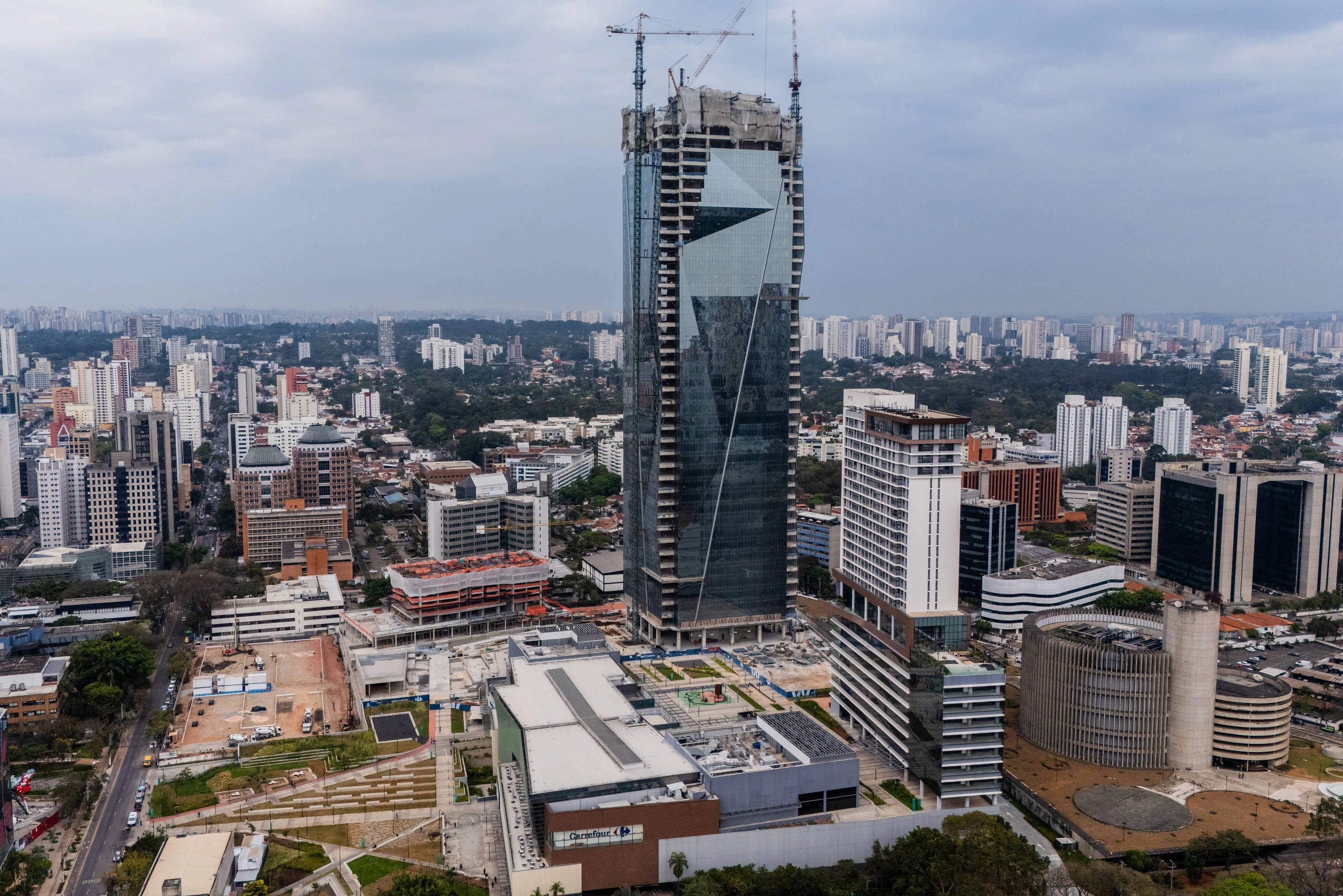
From Parking Lot to Landmark
The site of Carrefour’s original 1975 hypermarket in Chácara Santo Antônio is now home to the Alto das Nações complex. Developed by Carrefour Property in partnership with WTorre, the project replaces excess parking with a 320,000 m² mixed-use destination on the Marginal Pinheiros corridor.
The master plan combines a shopping center, a residential tower, and a corporate high-rise. By breaking ground on underused asphalt, Carrefour is extracting new value from long-held urban land without closing its operating store.
This approach reflects a broader global trend among big-box retailers sitting on large, strategically located land parcels. Instead of letting surface parking consume prime urban real estate, companies are building upward, layering residential, office, and leisure uses above their existing commercial footprints.
A New Skyline Leader at 219 Meters
The corporate component towers above the city at 219 meters, containing either 39 or 40 floors depending on the architectural count. It is set to officially surpass Platina 220, making it the tallest corporate building in Brazil.
While the first mall phase welcomed visitors in December 2022, the high-rise construction was completed in 2026. Sources indicate the record-setting tower should open its doors in the second half of 2026.
For context, São Paulo’s skyline has been shaped by decades of vertical expansion, but height records have historically been held by residential or mixed-use buildings rather than purely corporate towers. The shift toward taller office structures signals confidence in the city’s long-term role as Latin America’s premier business hub.
A Complex Campus for Living, Work, and Leisure
The development is not just office space. It includes a shopping center with over 40 stores across 5,000 to 6,000 square meters of leasable area, a residential tower managed for long-stay rentals by JFL Living, and flexible offices partially occupied by Jive.
Crucial for a crowded megalopolis, the design dedicates a 32,000 m² green area to public use. This park provides a pedestrian-friendly buffer and leisure space in the densely built Granja Julieta district.
The long-stay rental model managed by JFL Living is worth noting. Rather than selling individual residential units to homeowners, the developers are retaining the apartments as rental inventory, a strategy that generates recurring income and responds to growing demand for flexible urban living among young professionals and corporate relocations.
Why This Matters for Investors
The project represents Grupo Carrefour Brasil‘s first major monetization of its real estate holdings. By selling apartments and offices, the company expected to raise R$550 million while retaining a minority stake—between 13% and 16%—in the tower.
For market watchers, the R$3 billion undertaking confirms that international retailers view São Paulo’s prime land not just as store sites, but as vertical development opportunities. The mixed-use model generates recurring service income alongside one-time sales profits.
The “permuta” land-swap structure mentioned in the FAQ is a common Brazilian real estate mechanism. In simple terms, the landowner contributes the property to the development partnership and receives a share of the finished units in return, rather than an upfront cash payment. This allows Carrefour to participate in the project’s upside while minimizing initial capital outlay.
Economic Ripple Effect in the South Zone
Once fully operational, the complex is projected to draw 14,000 people per day. This foot traffic transforms the immediate neighborhood around Avenida Nações Unidas into a high-activity node beyond standard business hours.
The creation of approximately 250 permanent jobs in retail, services, and property management adds a small but stable employment base. The development showcases how integrated projects can reshape urban economic geography.
The Marginal Pinheiros corridor, where the project sits, is one of São Paulo’s most important business arteries, connecting the city’s southwest neighborhoods to the financial district along the Pinheiros River. Adding a mixed-use destination here helps decentralize economic activity away from the historic center and the congested Avenida Paulista and Faria Lima corridors.
What to Watch Next
Several open questions will shape how this project is ultimately judged. Will the corporate tower achieve the occupancy rates its developers are targeting, especially as hybrid work patterns continue to evolve across global business capitals?
Another key unknown is whether Carrefour will replicate this land-monetization model at other Brazilian hypermarket locations. The company holds substantial real estate across the country, and success here could unlock a pipeline of similar mixed-use conversions.
Finally, the public park component raises an interesting test case: can privately developed green space genuinely serve the surrounding community, or will access and maintenance arrangements limit its public benefit over time?
Frequently Asked Questions
How tall is the Carrefour tower in São Paulo?
The corporate tower in the Alto das Nações project stands at 219 meters, making it the tallest building in São Paulo.
When will the tallest part of Alto das Nações open?
Construction of the high-rise was completed in early 2026. Reports project that the corporate tower will be inaugurated in the second half of 2026.
Is Carrefour selling the entire building?
No. Carrefour retained a minority stake of 13% to 16% in the corporate tower while selling the remaining residential and office units through a permuta land-swap structure.
Sources: The Rio Times – Carrefour’s Bold Leap into Brazil’s Urban Future, Bloomberg Línea – A aposta do Carrefour em complexos multiuso, Carrefour Group – Carrefour Brasil New Mall Press Release, O Tempo – Maior prédio de São Paulo tem obra concluída, Brazil Journal – Carrefour e WTorre lançam complexo de R$ 3 bi
Read More from The Rio Times