Tourists climb and sleep hanging from huge trees in Amazon rainforest
In recent years, tourism in Amazonia seems to have undergone little renewal.
But in the world’s largest tropical forest, all it takes is a little climbing to convince people that a tourist trip there can go beyond traditional visits to indigenous communities, alligator watching, and porpoise spotting.
Whether in Manaus or Autazes, 100 kilometers from the Amazon capital, climbing a giant tree is an opportunity to see the forest in different layers, from roots to crown.
“It’s an activity incorporating social and environmental aspects because we don’t hurt a single leaf and offer a view of the green mantle. It’s like seeing the Amazon with different eyes,” describes Fabiano Rodrigues Moraes, owner of Amazon Tree Climbing, a pioneering agency for tourist tree climbing in Brazil.

As he tells the Brazilian UOL outlet, by adapting climbing techniques for redwood trees in California to the Amazon biome, it is possible to climb species such as a 40-meter-high amapaz tree or a samaúma tree at 50 meters.
“These are trees with impressive views,” adds Moraes, an entrepreneur who has hosted climbers ranging in age from 3 to 80 who had no idea about climbing techniques.
WHAT IS IT LIKE TO CLIMB A TREE IN THE AMAZON
The Moraes Agency has not had a single climbing accident since it opened 15 years ago.
It adheres to the standards and techniques established by Inmetro and ABNT and renews safety equipment every five years.
It also recalls that the activity is carried out with a descender, as used in industrial mountaineering, equipped with an anti-panic brake that allows the user to descend at a controlled speed.
A short briefing on the ground is sufficient to familiarize oneself with the ropes, chairs, and carabiners.
The ascent takes between 20 and 45 minutes, depending on the number of stops at different heights of the trees.
Visitors are always accompanied by instructors and return with rappelling techniques.
“The biggest challenge is the fear itself,” says Moraes to UOL, a businessman who has lived in Manaus for 27 years.
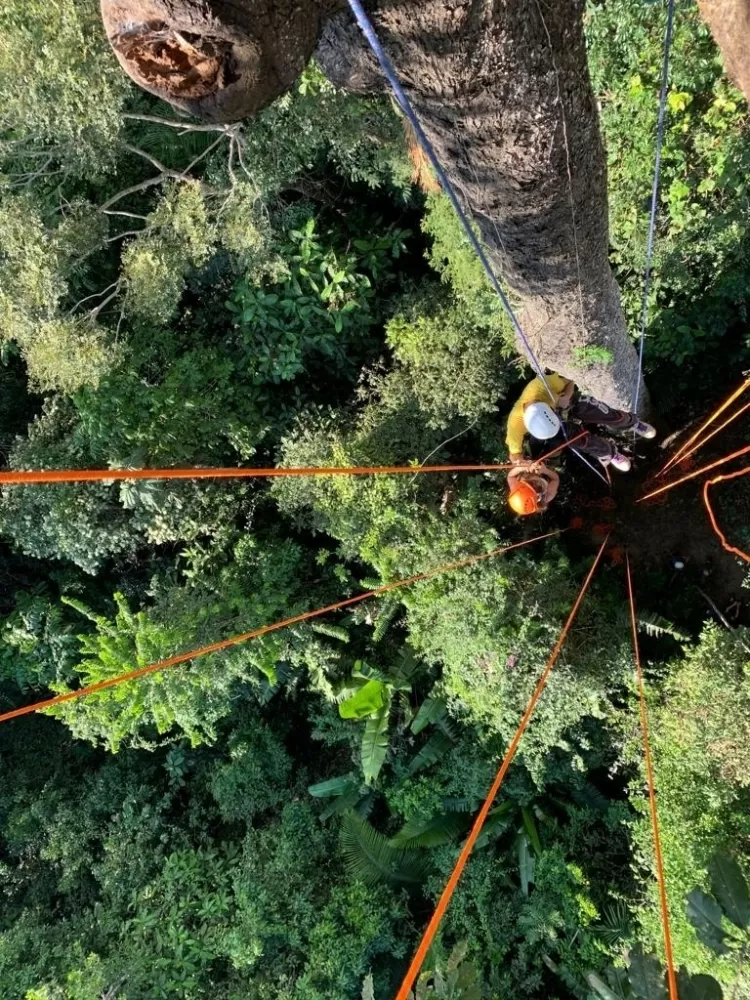
For Carolina Chicca, a business administrator who had only had experience on indoor walls, the most important thing was that the leadership team respected the limits of each first-time climber.
“When I looked down, I was already above the tops of the other trees. From then on, it wasn’t good for me,” she says to UOL.
Still, Carolina can’t hide the transformative power of the experience.
“In the Amazon, you are isolated and, at the same time, completely immersed in nature.
It changed the way I look at tourism,” confesses the Paulistano, who has traded cultural and shopping tours for outdoor ones since her stay in northern Brazil.
Carolina was in the region in 2019 with two children, who were 8 and 10 at the time.
“Just because my daughter emerged victorious [and reached the top of the tree] made me happy. This [Amazonian] environment is a wonderful thing,” she concludes.
NOT EVEN FEAR OF HEIGHTS STOPS THE TOUR
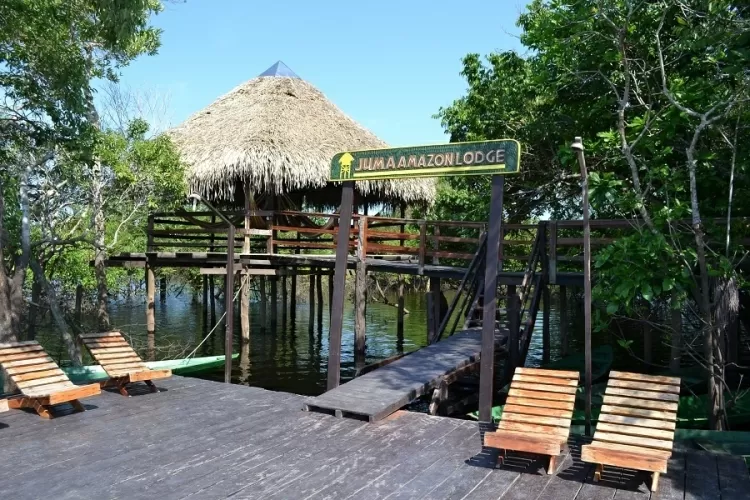
One of the oldest tourist climbing spots in the Amazon that Carolina and her children have climbed is a chestnut tree about 200 years old and 45 meters high at Juma Amazon Lodge, a jungle hotel in the municipality of Autazes, 100 kilometers from Manaus.
The lodge is known not only for its 19 bungalows on stilts in the treetops but also for offering ecotourism activities such as canoeing on streams and climbing centennial trees.
The Brazil nut tree is located on the hotel grounds and can be seen after a short canoe ride from Juma Amazon Lodge, followed by a short walk to the base of the tree.
That’s where São Paulo native Thiago Coelho climbed last year with his wife and seven- and 10-year-old children.
“When we are still hanging [on the ropes], but above the treetops, the spectacle of the view of the forest begins,” he tells the report.
For him, however, the highlight of the experience was reaching the top of the tree, where participants are placed high on a branch, attached adequately to safety equipment, and can see a flock of scarlet macaws flying overhead.
I fear heights, not the one that stops me, but the one that makes my legs shake and makes it hard to think. But if we manage to overcome it, it comes in a rush.
The entrepreneur in charge of the activity believes that for each participant, this experience means an appreciation of the standing forest, overcoming the fear of heights, and rescue from childhood.
“People can not imagine that a tree of this size can offer this view of nature,” describes Moraes.
Outside the hotel grounds, tours (starting at R$450 per person) can be taken to classic Amazon sites, such as the Encontro das Águas, which can be combined with climbing a samaúma tree in the Lake Janauari region, about an hour by boat from Manaus.
The bravest can also count on a route that includes climbing and spending the night in hammocks among the branches of the 50-meter-high summit of a samaúma during the Amazonian summer from August to October.
Otherwise, dear first-time climber, climb to see what few have gotten to see in the land of the tree giants.
With information from UOL
Read More from The Rio Times