Bolsonaro Changes Discourse on China, Invites More Investment in Brazil
RIO DE JANEIRO, BRAZIL – “A considerable part of Brazil needs China, and China also needs Brazil. Brazil is a sea of opportunities, and we want to share them with China”.
With these words, Brazilian President Jair Bolsonaro concluded his three-day visit to Beijing, which marked a radical shift in his stance toward the world’s second-largest economy – from accusing it during the election campaign of “wanting to buy Brazil” to describing it as a “capitalist” country upon landing in the capital.

The visit of the right-wing Brazilian president to China is a clear exercise in contortion: Bolsonaro is a proud anti-communist, who in the electoral campaign not only accused China of “wanting to buy Brazil” but also dared to visit the island of Taiwan, to the dismay of his main trading partner.
But, since winning the election, pragmatism has imposed itself in the face of the reality of a bilateral relationship that was almost US$99 billion in 2018 (almost R$400 billion, at the current exchange rate), with a surplus of nearly US$30 billion for Brazil, according to official figures.
In the first nine months of this year, bilateral trade totaled US$72.8 billion, with a surplus in favor of Brazil of US$19.6 billion – double that of its second main partner and now a preferential ally, the United States.
Bolsonaro launched an offensive to try to seduce China. Brazil is interested in increasing its exports to China, particularly in terms of agricultural products, and also in attracting investors for the privatization of public companies and the infrastructure sector.
China is the ninth-largest investor in Brazil, with an enhanced interest in infrastructure and energy, which makes it theoretically even more interesting for this government that has promoted bids in both sectors.
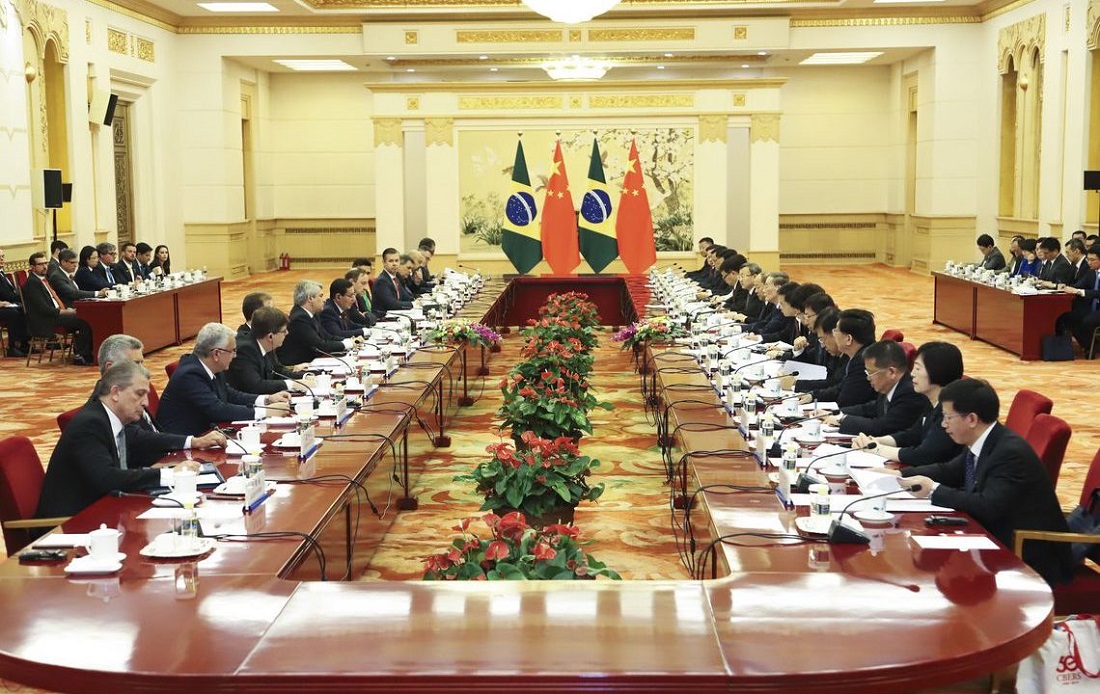
In his meeting with President Xi Jinping at the Great People’s Palace, he invited China to take part in the great gas and oil auction scheduled for November 6th, the first of his government, with which he expects to generate more than US$100 billion.
“China must be there,” he insisted. The two presidents signed a total of eight cooperation agreements, in areas ranging from processed beef to renewable energy. They also aim at speeding up mutual customs procedures, easing contacts between their respective chancelleries and encouraging student exchanges.
The two countries may sign other agreements when Xi returns to Brazil next month during a trip to attend the annual summit of the Asia-Pacific Economic Cooperation Forum (APEC) in Chile.
Brazilian Agriculture Minister Tereza Cristina expressed her hope that China would certify more meat processing plants in Brazil so that they could export to the Asian giant, where demand has soared due to the swine flu epidemic affecting their farms.
A Palmeiras soccer club fan, Bolsonaro, surprised everyone during the gifts exchange: a red and black Flamengo jersey for Xi, who is very closely connected to soccer. “Now, all of Brazil is Flamengo,” he said, referring to the team’s qualification for the Libertadores Cup final.
“With all certainty, 1.3 billion Chinese citizens will also be Flamengo fans,” he said, smiling as he handed over the jersey to his counterpart, visibly grateful. Xi corresponded to the present in a similar tone: a soccer theme print.
Always pragmatic, China spared no attention with the Brazilian president. In the past, the Chinese government had made clear its unease with then-candidate Bolsonaro’s gestures, or with the frustrated bilateral meeting at the end of the G20 summit in Osaka (Japan) – the Brazilian president called it off, claiming he was late to catch the plane.
For Beijing, the relationship with Brazil is also important: it is its main partner in Latin America, an ally within the BRICs, still in the process of deciding its partnerships for the construction of its 5G networks, and an important alternative for the supply of products like soy and meat in the midst of the trade war with the United States.
The meeting of the two presidents was preceded by a quaint welcome ceremony outside the People’s Palace. The two presidents listened to the national anthems and reviewed a flawless gala formation of Chinese troops.
In front of a group of elementary school students waving flags of both countries and bouquets of flowers, Bolsonaro began to shake hands and exchange a few words with the little ones. Xi merely waved, without approaching.
The journey had begun with the confirmation that Brazil will exempt Chinese tourists from the visa requirement. Brazil hopes that tourism will represent ten percent of its GDP, compared to the current six percent, and China is crucial for this purpose.
Although it is the country that sends the most visitors abroad – 150 million citizens have traveled this year -, so far only 60,000 of them come to Brazil, a figure that clearly can be improved.
The Brazilian president, who is traveling today from Beijing to the Middle East, completed his agenda at meetings with Chinese Prime Minister, Li Keqiang, and the president of the Popular National Assembly and number three in the country’s ranks, Li Zhanshu.
Source: El Pais
More: Brazil news in English, every day from The Rio Times.
This article was produced by The Rio Times’ automated newsroom system. How we use AI · Report an error · Editorial responsibility: Matthias Camenzind, Editor-in-Chief