Ibovespa Adds 0.74% in Thin Holiday Trade as the Real Firms — July 6, 2026
Key Facts
- Ibovespa closed at 174,070 points up 0.74% on the day and 8.03% so far in 2026, as thin holiday liquidity let domestic rate-cut hopes do the driving.
- The real firmed to 5.1686 per dollar a 0.66% gain that leaves the currency roughly 7.5% off its weakest point of the past year.
- BPAC11 was the standout among heavyweights rising 2.4% on $117 million of turnover, the best showing of any actively traded name on the board.
- Weak May industrial output, down 0.2% month-on-month marked the first such decline since December and reinforced bets on a further Selic cut in August.
- ISA Energia (ISAE4) led the losers’ board falling 4.3%, even as steelmakers CSN and Usiminas rallied on a softer real and firmer commodity backdrop.
Today’s Focus
Brazil’s stock market closed higher for a second straight session on Friday, July 3rd. The Ibovespa — the benchmark index of roughly 50 of the most liquid shares on the B3 exchange in São Paulo — finished at 174,247.45 points, up 0.84%.
The move came on unusually thin turnover, since Wall Street was shut for the US Independence Day holiday. That left domestic drivers in charge, as a weaker-than-expected May industrial production reading pushed traders to price in another quarter-point cut to the Selic, Brazil’s benchmark interest rate, at the central bank’s August meeting.
The real strengthened too, with USD/BRL settling at 5.1686, down 0.66% on the day. It now sits roughly 7.5% below its 52-week high near 5.59 — a sign that carry-trade appetite for Brazilian assets remains intact even as the growth story cools.
Under the surface, BTG Pactual’s listed unit BPAC11 was the pick of the actively traded names. Steelmakers CSN and Usiminas led broad domestic gainers, and power-transmission name ISA Energia was the session’s biggest faller.
What matters today. A soft industrial-output print, not a global risk rally, did the heavy lifting. So the real test comes when the Copom rate decision and this week’s Focus survey confirm or deny the cut.

01 The session in one read
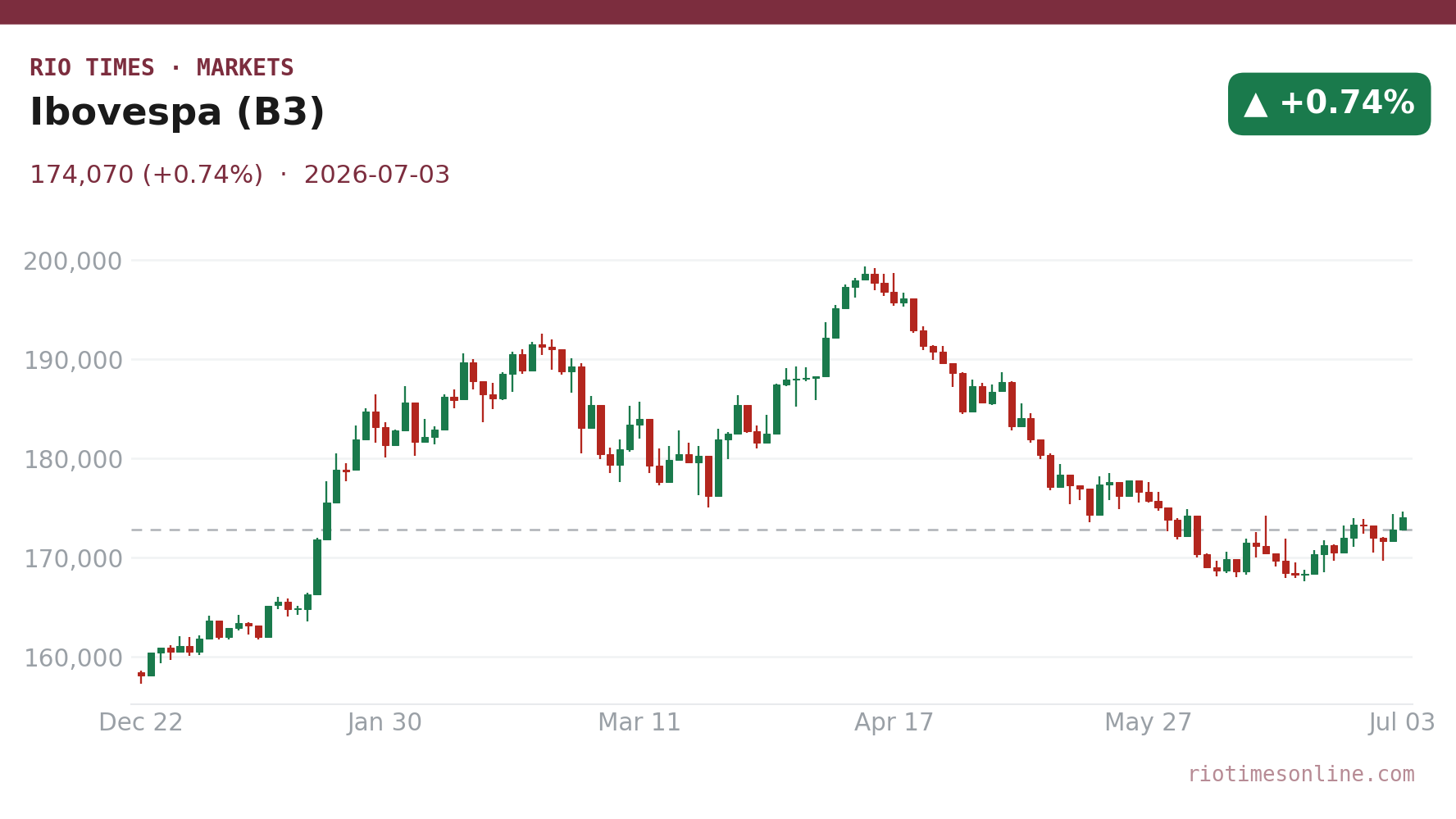
On a session thinned by Wall Street’s July 4th closure, the Ibovespa extended its rebound. The principal B3 index advanced 0.84% on Friday to 174,247.45 points, after moving between a low of 172,790.39 and a high of 174,664.35.
The index returned to its highest level since early June. It was driven by the reading that Brazil’s economic slowdown could open room for a fresh Selic rate cut in August, with the currency market moving in tandem.
Turnover was well down on a normal Friday. Financial volume totaled R$12.62 billion, and the lower turnover was attributed to the U.S. Independence Day holiday, which magnified the influence of domestic data over any cross-market steer.
The week closed positive too. The Ibovespa gained 0.45% on the week, trimmed June’s losses and extended its 2026 gain to 8.03%.
The evidence points to a market trading its own macro calendar rather than following Wall Street, which stayed shut all session. The Ibovespa’s gain tracked falling DI futures and a weaker industrial-output print far more closely than any external catalyst.
The real’s firming reflects continued foreign appetite for Brazilian carry even as growth data soften. Confidence is medium because the move rode thin, holiday-reduced turnover, and the variable to watch is whether Tuesday’s BCB Focus survey and the August Copom meeting validate the rate-cut bet already priced in.
02 The day’s numbers
| Measure | Level | Change | Read |
|---|---|---|---|
| Ibovespa | 174,247.45 pts | +0.74% | about 12.4% below the 52-week high of 198,657; range for the year 132,129–198,657 |
| Session range | 172,790–174,664 pts | — | Near-1,900-point intraday swing on holiday-thinned turnover |
| USD/BRL | 5.1686 | −0.66% | 7.5% below the 52-week peak near 5.59; range for the year 4.89–5.59 |
| S&P 500 (read-through) | 7,483 pts | +0.00% | Wall Street shut for Independence Day — no cross-market steer |
The headline numbers tell a story of a market recovering ground rather than breaking new highs. The Ibovespa was about 12.4% shy of its 52-week peak, underlining how far this rally still has to travel before testing the record set earlier in the cycle.
The real’s positioning is the more interesting tell for foreign desks. At 7.5% below its weakest point of the year, it has recouped much of the pressure seen in the spring, consistent with continued carry-trade demand even as growth momentum fades. Rio Times · Live Market Intelligence
Live Market IntelligenceBrazil — Live Market Board
Brazil — Live Market Board
Instrument Last Change YoY Prev. High Low Volume
IBOV
192,114.55
+2.63%
+21.85%
187,197.46
168,310
167,142
—
USD/BRL
5.16
+0.01%
-5.13%
5.16
5.18
5.14
—
SELIC
14.00%
—
—
—
—
—
PETR4
41.64
-0.05%
+35.19%
41.66
41.97
41.15
41,499,400
VALE3
72.97
+0.83%
+30.75%
72.37
73.54
72.66
17,658,000
ITUB4
38.60
-1.03%
+4.57%
39.00
39.34
38.39
29,487,800
BBDC4
16.85
+0.36%
+3.50%
16.79
16.90
16.67
19,416,900
BBAS3
19.37
+0.47%
+0.73%
19.28
19.44
19.16
11,069,200
B3SA3
14.26
-0.21%
+12.73%
14.29
14.47
14.11
33,037,800
ABEV3
14.89
-0.80%
+21.91%
15.01
15.07
14.81
16,453,100
WEGE3
47.59
+0.49%
+29.99%
47.36
48.08
47.36
3,364,600
PRIO3
59.14
-0.19%
+50.67%
59.25
59.81
58.74
3,325,600
SUZB3
41.33
+2.35%
-23.55%
40.38
41.48
40.35
3,914,900
RENT3
34.68
-0.09%
+0.84%
34.71
34.96
34.35
7,979,100
AZZA3
15.89
-2.63%
-53.76%
16.32
16.42
15.82
1,330,300
CSNA3
4.30
+0.47%
-42.65%
4.28
4.41
4.26
10,076,100
GGBR4
24.69
+2.19%
+51.38%
24.16
24.85
24.18
7,047,600
ENEV3
24.21
-1.38%
+70.49%
24.55
24.64
23.99
9,297,000
03 Why it moved — a soft factory print revived rate-cut bets
The proximate trigger was industrial production. May 2026 output fell 0.2% versus April, the year’s first negative print, and it landed just as traders were positioning for the next Copom meeting.
The first decline in industrial output since December 2025 reinforced the view that the sector’s stronger-than-expected 2026 run had reflected an international tailwind in fuel and iron-ore output rather than domestic strength. That points to a more challenging outlook for the domestically exposed cycle — precisely the kind of soft data that fixed-income desks read as room for easing.
That view showed up immediately in rates. DI futures — Brazil’s interbank rate contracts — fell across the curve on Friday in a correction from Thursday’s sharp rise, with the January 2028 contract down 13 basis points to 14.105% and the January 2035 contract down 8 basis points to 14.41%.
With New York closed, there was no US data or Fed chatter to compete for attention. So the domestic growth-versus-rates narrative simply had the field to itself for the day.
04 The day’s movers
| Driver | Level / Move | Change | Note |
|---|---|---|---|
| VALE3 | $119m turnover | +0.8% | Miner topped the most-traded list as iron-ore-linked names firmed |
| BPAC11 | R$117m turnover | +2.4% | BTG Pactual’s listed unit was the best-performing heavily traded name |
| PETR4 | $77m turnover | +0.8% | State oil major tracked a firmer real/Brent cross |
| ITUB4 | $82m turnover | +0.6% | Itaú led bank-sector flows as the rate curve eased |
| SBSP3 | $61m turnover | +1.5% | Sabesp extended a bounce after a broker swing-trade call |
| CSNA3 | domestic gainer | +4.3% | Steelmaker topped broad gainers alongside Usiminas (+2.5%) |
| MGLU3 | domestic gainer | +4.2% | Retailer rallied on hopes a lower Selic aids consumer names |
| ISAE4 | domestic loser | −4.3% | Power-transmission name led the losers’ board |
| MUTC34* | cross-listed BDR | +4.4% | A Brazilian Depositary Receipt on a foreign name — its move mainly reflects the real and the closed US tape, not a domestic result |
Turnover leadership stayed with the familiar names. Embraer was among the positive standouts after second-quarter aircraft delivery data, while ISA Energia led the fallers.
But the percentage gains belonged to cyclicals. Steel and retail both benefited from the rate-cut narrative, exactly the sectors most sensitive to a lower Selic.
One flag for foreign desks: MUTC34 is a cross-listed depositary receipt trading on B3, not a domestic operating company. So its 4.4% move should be read as a currency-and-US-tape effect rather than a signal about Brazilian corporate fundamentals.
05 The regional scoreboard
| Index | Country | Change |
|---|---|---|
| Ibovespa | Brazil | +0.74% |
| S&P Merval | Argentina | — |
| S&P/BMV IPC | Mexico | — |
| IPSA | Chile | — |
| COLCAP | Colombia | — |
Only the Ibovespa’s move is verified for this session. The live market board above carries the closes for the other four regional benchmarks.
Wall Street was shut and several Latin American markets kept shorter Friday hours around the US holiday. So cross-market comparisons for July 3rd are best treated with caution until confirmed prints are in.
06 The technical picture
The Ibovespa’s close at 174,247.45 sits comfortably within Friday’s own range of 172,790 to 174,664. The session high effectively acts as the near-term resistance traders will watch into next week.
Zoomed out, the index was about 12.4% below its 52-week high of 198,657 and well above its 52-week low of 132,129. That wide band leaves plenty of room either way, but keeps the index in recovery mode rather than at a fresh extreme.
On the currency side, USD/BRL’s Friday range of roughly 5.1653 to 5.2075 sits well inside its 52-week band of 4.89 to 5.59. The pair’s retreat toward the lower end is the technical counterpart to the equity rally, and a firmer real usually flatters Ibovespa dollar-adjusted returns for the desks that matter most to this readership.
With DI futures also easing across the curve, the path of least resistance into next week looks tilted toward continued, if modest, index strength. That is contingent on the data below confirming rather than contradicting Friday’s rate-cut narrative.
07 What to watch
- BCB Focus survey: Monday’s Focus readout will show whether economists mark down 2026 Selic expectations further after the industrial-output miss
- IGP-DI wholesale inflation: Tuesday’s July 7 print (prior 0.87%) is an early read on producer-price pressure ahead of August’s Copom decision
- Car sales and production: New car sales (consensus −7%) and car production (consensus −13%) data due July 7 will show how far the domestic cycle has cooled
- CFTC BRL positioning: Friday’s CFTC data had BRL speculative net positions at a prior reading of 43.7; a further build would corroborate the real’s resilience
Background: Brazil Stocks Rise as a Weak US Jobs Report Cools Fears of Higher Rates.
Background: Brazil Stocks Drift as US Sanctions Push the Dollar to a Three-Month High.
More: Brazil news in English, every day from The Rio Times.
Frequently Asked Questions
Why did the Ibovespa rise on July 3?
A weaker-than-expected May industrial production print reinforced bets on a further Selic rate cut in August, lifting rate-sensitive cyclicals such as steelmakers and retailers while DI futures eased across the curve.
What happened to the Brazilian real?
USD/BRL fell 0.66% to close at 5.1686, leaving the currency about 7.5% below its 52-week high, as foreign carry demand persisted alongside the rate-cut narrative.
Which stocks moved the most?
BPAC11 led actively traded names with a 2.4% gain on $117 million of turnover; CSNA3 (+4.3%) and MGLU3 (+4.2%) topped broader domestic gainers, while ISAE4 (−4.3%) led the losers.
Was Wall Street a factor in Friday’s session?
No — US markets were closed for the July 4th Independence Day holiday, which thinned Ibovespa turnover to roughly R$12.6 billion and left domestic data as the main driver.
This article was produced by The Rio Times’ automated newsroom system. How we use AI · Report an error · Editorial responsibility: Matthias Camenzind, Editor-in-Chief
LatAm Markets: Live Signals → — real-time movers, turnover leaders and FX across Latin America.