Brazil Markets: Ibovespa & the Real — July 24, 2026
Key Facts
- The Ibovespa slipped 0.46% to 176,724 points, breaking a recent steadier spell as a sharp drop on Wall Street soured the mood.
- The real weakened 0.58% to 5.0841 per US dollar, tracking a broader move against emerging-market currencies during the session.
- Heavyweight Vale and Petrobras managed modest gains, cushioning the index, but a wide swathe of industrial and financial shares fell.
- Trading volume concentrated in a defensive retreat, with the iShares BOVA11 ETF seeing heavy turnover as investors reduced single-stock risk.
- The Ibovespa now sits 11% below its 52-week high, reflecting how sticky double-digit interest rates continue to anchor equity valuations.
Today’s Focus
Brazil’s main stock index, the Ibovespa, fell 0.46% to 176,724 points on Thursday, dragged down by a broad risk-off wave that swept across global markets. The Brazilian real weakened 0.58% against the dollar to close at 5.0841, mirroring a global preference for the safety of the US currency.
The session’s decline was led by industrial and retail names, with WEG sliding 2.3% and Magazine Luiza sinking 4.1% as investors fretted over the impact of still-high domestic borrowing costs. Mining giant Vale and oil major Petrobras offered some defence, rising 0.8% and 0.9% respectively on firm commodity prices.
The negative mood was imported from New York, where the S&P 500 dropped 1.21%, rattling confidence in riskier assets from São Paulo to Santiago to Mexico City. The local move had little to do with Brazil’s own improving growth story — GDP expanded a solid 1.1% in the first quarter — and everything to do with foreign traders hitting the sell button.
What matters today. Global risk aversion overwhelmed Brazil’s positive domestic rate-cut narrative.

01 The session in one read
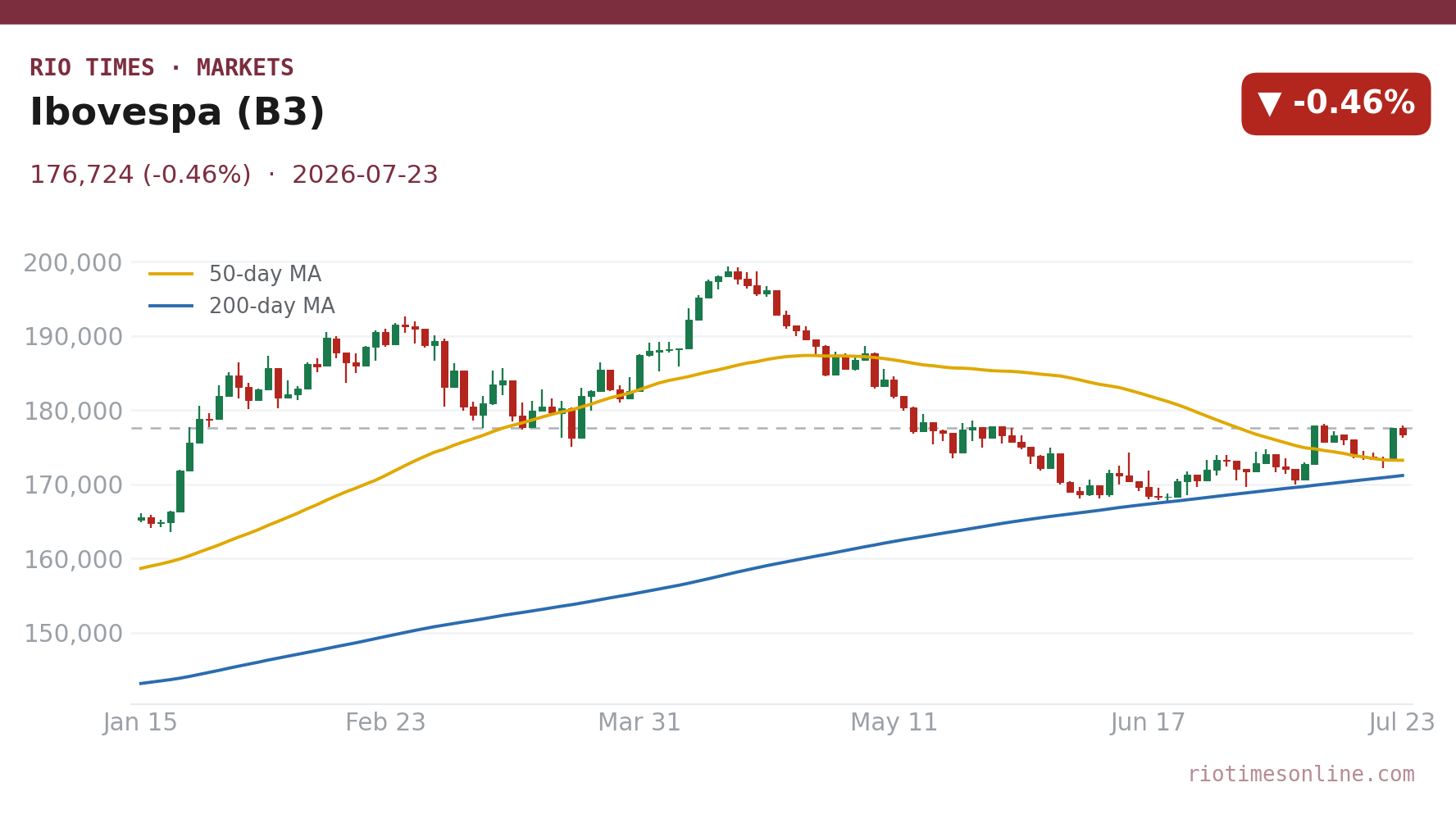
The São Paulo trading floor opened with a cautious tone and never found its footing, as a 1.21% tumble in the S&P 500 crushed risk appetite across the Americas. The Ibovespa fell 0.46% to 176,724 points, a move that was contained in size but broad in its reach — losing stocks outnumbered gainers by a wide margin.
Commodity heavyweights Petrobras and Vale held the line with modest gains, a reminder that Brazil’s core export engine is still running. But the rest of the index offered no shelter: industrial darling WEG gave back 2.3%, banks drifted lower, and retail names absorbed heavy blows, with Magazine Luiza dropping 4.1%.
The real fell to 5.0841 per dollar, not because of a specific local trigger, but because global investors reflexively sought the safety of the US currency. Brazil’s 14.25% benchmark Selic rate remains a powerful magnet for foreign bond inflows, yet that support evaporates quickly on days when fear dominates.
Thursday’s decline is a classic case of Brazil getting caught in a global downdraft rather than reacting to a homegrown problem. The modest gains in commodity-linked giants Vale and Petrobras, coupled with the lack of a rout in big banks, suggest domestic conviction is not collapsing — but the willingness to step in and buy the dip is missing while Wall Street is falling. The crucial variable to watch is whether US market volatility extends into Friday, which could trigger deeper stop-loss selling in the real and force the Ibovespa to test the 175,000-point floor.
02 The day’s numbers
| Measure | Level | Change | Read |
|---|---|---|---|
| Ibovespa | 176,724 | −0.46% | Retreat from recent steadiness |
| Session range | — | — | Not yet published |
| USD/BRL | 5.0841 | +0.58% | Real weakens on global risk-off |
| 52-week position | −11.0% vs high | — | High: 198,657; Low: 132,129 |
| Key technical level | 175,000 | — | Psychological round-number support |
The Ibovespa closed at 176,724 points, down 0.46%, putting it roughly 11% below its 52-week high of 198,657. The index is far above its 52-week low of 132,129, but it has struggled to sustain momentum above the 180,000 mark ever since the central bank began its slow, cautious rate-cutting cycle.
The real ended the session at 5.0841 per dollar, a 0.58% decline. It remains well off its 52-week low of 5.5901, underscoring that — despite the day’s weakness — the currency has been one of the better-performing emerging-market FX pairs in 2026, supported by Brazil’s towering real interest rates. Rio Times · Live Market Intelligence
Live Market IntelligenceBrazil — Live Market Board
Brazil — Live Market Board
Instrument Last Change YoY Prev. High Low Volume
IBOV
204,116.29
-1.15%
+21.85%
206,495.23
168,310
167,142
—
USD/BRL
5.16
+0.01%
-5.13%
5.16
5.18
5.14
—
SELIC
14.00%
—
—
—
—
—
PETR4
41.64
-0.05%
+35.19%
41.66
41.97
41.15
41,499,400
VALE3
72.97
+0.83%
+30.75%
72.37
73.54
72.66
17,658,000
ITUB4
38.60
-1.03%
+4.57%
39.00
39.34
38.39
29,487,800
BBDC4
16.85
+0.36%
+3.50%
16.79
16.90
16.67
19,416,900
BBAS3
19.37
+0.47%
+0.73%
19.28
19.44
19.16
11,069,200
B3SA3
14.26
-0.21%
+12.73%
14.29
14.47
14.11
33,037,800
ABEV3
14.89
-0.80%
+21.91%
15.01
15.07
14.81
16,453,100
WEGE3
47.59
+0.49%
+29.99%
47.36
48.08
47.36
3,364,600
PRIO3
59.14
-0.19%
+50.67%
59.25
59.81
58.74
3,325,600
SUZB3
41.33
+2.35%
-23.55%
40.38
41.48
40.35
3,914,900
RENT3
34.68
-0.09%
+0.84%
34.71
34.96
34.35
7,979,100
AZZA3
15.89
-2.63%
-53.76%
16.32
16.42
15.82
1,330,300
CSNA3
4.30
+0.47%
-42.65%
4.28
4.41
4.26
10,076,100
GGBR4
24.69
+2.19%
+51.38%
24.16
24.85
24.18
7,047,600
ENEV3
24.21
-1.38%
+70.49%
24.55
24.64
23.99
9,297,000
03 Why it moved — a US-driven risk rout
Thursday’s decline had a clear, single catalyst: a sharp sell-off on Wall Street. The S&P 500 tumbled 1.21%, and when the world’s most important equity benchmark sneezes, Brazilian markets catch a cold almost without exception. Fund managers and algorithms slashed exposure to emerging-market assets, hitting the real and Brazilian stocks simultaneously.
The domestic backdrop was actually encouraging. Brazil’s GDP grew 1.1% quarter-on-quarter in the first three months of 2026, and the central bank cut the Selic rate by 25 basis points to 14.25% in June, with more easing on the horizon. But none of that mattered in a session driven by a rapid de-risking on US exchanges.
The flow pattern was defensive: the BOVA11 ETF, a low-cost tracker of the Ibovespa, saw heavy turnover of $112 million as traders opted for the basket rather than betting on individual names. Meanwhile, high-multiple growth stocks and consumer-discretionary names bore the brunt of the selling, consistent with an environment where investors suddenly discount future earnings more aggressively.
04 The day’s movers
| Driver | Level / Move | Change | Note |
|---|---|---|---|
| VALE3 | $235m turnover | +0.8% | Iron-ore giant held firm |
| PETR4 | $213m turnover | +0.9% | Oil major benefitted from stable crude |
| SBSP3 | $206m turnover | −1.8% | Utility under selling pressure |
| ITUB4 | $189m turnover | −0.8% | Largest private bank edged lower |
| WEGE3 | $122m turnover | −2.3% | Industrial bellwether hit hardest |
| MGLU3 | — | −4.1% | Retailer Magazine Luiza among top losers |
The session’s most-traded name by turnover was Vale, which managed a 0.8% gain on $235 million in volume — a sign that domestic and international investors still view the iron-ore exporter as a relative safe harbour within Brazil. Petrobras followed closely, rising 0.9% on $213 million in turnover, supported by steady global crude prices.
The pain was concentrated in sectors exposed to the domestic economy and sensitive to interest rates. WEG, Brazil’s electrical-equipment and industrial-automation champion, slid 2.3% on $122 million of turnover, one of the larger point contributors to the index decline. Retailer Magazine Luiza plunged 4.1% as the spectre of a prolonged period of double-digit Selic rates dimmed the outlook for consumer credit and big-ticket purchases. Cross-listed trackers reflecting US tech names were among the session’s biggest percentage losers, but those moves mainly echoed the overnight US tape rather than local dynamics.
05 The regional scoreboard
| Index | Country | Change |
|---|---|---|
| Ibovespa | Brazil | −0.46% |
| IPC | Mexico | −1.56% |
| IPSA | Chile | −0.84% |
| Merval | Argentina | −1.78% |
| COLCAP | Colombia | −0.60% |
The risk-off wave rolled through every major Latin American market on Thursday. Mexico’s IPC bore the heaviest losses among the larger regional indices, tumbling 1.54%, while Argentina’s Merval — often volatile — shed 1.78%. Chile’s IPSA and Colombia’s COLCAP fell 0.84% and 0.60% respectively.
Brazil’s 0.46% decline made the Ibovespa the region’s best relative performer, a distinction it owes entirely to the cushion provided by its heavyweight commodity exporters. The synchronised nature of the selling confirms that local investors were reacting to a global macro impulse — a classic ‘risk-off’ day — rather than anything brewing in Brasília or on the domestic earnings calendar. The live market board above carries the final closing levels for all regional benchmarks.
06 The technical picture
The Ibovespa chart is starting to show signs of fatigue after the index failed to hold above the 178,000 area in recent sessions. Thursday’s close of 176,724 leaves it sitting just above the psychologically important 175,000 round-number support level — a threshold that has acted as a floor during minor pullbacks earlier this year.
A break below 175,000 would open the door to a test of the 170,000 region, where stronger buying interest emerged during the last significant dip. The index’s 52-week low of 132,129, set during a period of acute fiscal anxiety, remains far away, but the slope of the recovery has flattened considerably since the central bank began its hesitant easing cycle.
For the real, the 5.0841 close keeps it within a comfortable range against the dollar. The currency would need to weaken past 5.20 to raise eyebrows among the carry-trade community that has been a consistent source of demand for Brazilian assets. Barring a fresh escalation in global geopolitical tensions — the war in the Middle East remains a latent risk — the path of least resistance for USD/BRL is still moderately lower over the medium term.
07 What to watch
- Wall Street stability: whether the S&P 500 can arrest its slide on Friday will determine if emerging markets face a second day of indiscriminate selling.
- 175,000 support: a close below this level on elevated volume would signal that the pullback has further to run.
- Commodity divergence: Vale and Petrobras are acting as shock absorbers; a reversal in iron ore or crude would remove the last defence.
- Selic expectations: any shift in central bank forward guidance could rapidly reprice the rate-sensitive banking and retail sectors.
Background: Mubadala Deepens Its Bet on Brazil’s Medical Schools.
Background: Petrobras Diesel Subsidy Passes US$900 Million in 2026.
More: Brazil news in English, every day from The Rio Times.
Frequently Asked Questions
Why did the Ibovespa fall on Thursday?
A sharp 1.21% drop on Wall Street triggered a global risk-off move that hit emerging markets, overwhelming positive domestic factors like Brazil’s recent GDP growth and central bank rate cuts.
What does the weaker real mean for Brazil?
A weaker real makes imports more expensive, which can feed inflation, but it helps exporters like Vale and Petrobras by boosting the local-currency value of their dollar-priced sales.
Which stocks held up best?
Commodity giants Vale (+0.8%) and Petrobras (+0.9%) managed gains, acting as defensive anchors during the broad sell-off thanks to steady global iron ore and crude prices.
Is the market still far from its highs?
Yes, the Ibovespa sits 11% below its 52-week high of 198,657, reflecting how high domestic interest rates cap equity valuations despite economic improvement.
This article was produced by The Rio Times’ automated newsroom system. How we use AI · Report an error · Editorial responsibility: Matthias Camenzind, Editor-in-Chief
LatAm Markets: Live Signals → — real-time movers, turnover leaders and FX across Latin America.