Kidnapped Presidentialism: Brazil’s Lula Proposes 10- to 12-Year Supreme Court Terms
POLITICS · BRAZIL
Key Facts
- —The country Brazil votes for president, Congress and governors on Sunday 4 October 2026. President Luiz Inácio Lula da Silva is seeking a fourth term.
- —What happened In an online interview on Wednesday 30 September, Lula proposed fixed 10- to 12-year terms for Supreme Court justices, O Globo reported. Brasil 247 and Congresso em Foco reported him saying presidentialism “was kidnapped”.
- —The numbers The 2026 budget reserves about R$61 billion (about US$11.7 billion) for parliamentary amendments, the Senate news agency reported in December 2025. Lula’s claim that Congress holds 50 percent of the budget is not supported.
- —What it means for you Nothing changes before the vote. New rules for choosing justices, or fixed terms, would need a constitutional amendment passed by Congress, O Globo noted.
- —Still open No written proposal exists yet. Who would sit on the selection council, and whether the Congress elected on 4 October would back any reform, is unknown.
Brazil’s President Luiz Inácio Lula da Silva said on Wednesday that “kidnapped presidentialism” has handed Congress powers that belong to the executive. Four days before the first round of the election, he promised political and judicial reform.
Brasil 247 and Congresso em Foco both reported the “kidnapped” remark. O Globo, Metrópoles and CBN confirmed his Supreme Court proposals from the same interview, recorded for the Normose channel.

What Lula Means by Kidnapped Presidentialism
“Presidentialism was kidnapped,” Lula said, according to Brasil 247 and Congresso em Foco. He argued that Congress took over the regulatory agencies under the Bolsonaro government, filling them with business figures nominated by senators.
His sharper target was parliamentary amendments, the budget money individual lawmakers steer to their home regions. “There is no model in the world of Congress keeping 50 percent of the Union’s budget,” he said.
A deputy with R$60 million to R$70 million (about US$11.5 million to US$13.4 million) a year cannot fairly face a rival with nothing, he said. All conversions here use R$5.22 to the dollar on 30 September.
What the Budget Figures Show
Official numbers put the amendment share far below 50 percent. The 2026 budget of R$6.5 trillion (about US$1.25 trillion) holds about R$61 billion (about US$11.7 billion) for amendments, per the Senate news agency.
The squeeze shows up in the smaller pool the government can spend freely. O Globo reported on 16 September that amendments have reached up to 25 percent of that discretionary spending in recent years.
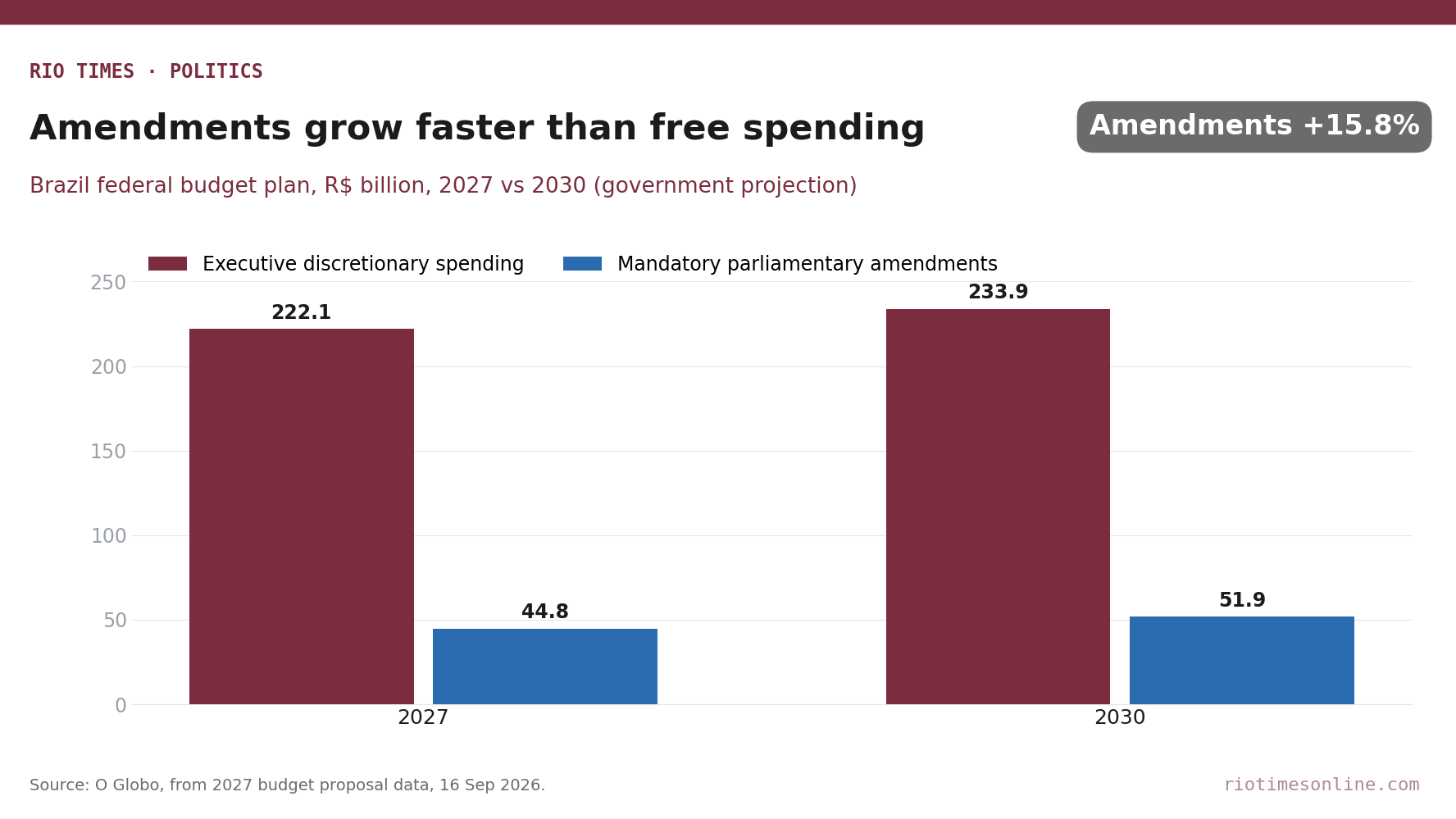
Government projections cited by O Globo show mandatory amendments rising 15.8 percent between 2027 and 2030. The executive’s own discretionary spending grows only 5.3 percent over the same period.
A Council and Fixed Terms for the Supreme Court
Lula said the Supreme Federal Court (STF), Brazil’s highest court, has “very low” credibility, O Globo and Metrópoles reported. He proposed a council to choose justices and fixed terms of 10 or 12 years.
Today the president nominates a justice, who needs the votes of at least 41 of the 81 senators. Justices then serve until compulsory retirement at 75, O Globo noted.
Lula first floated a selection council on Sunday, as Brazil’s Lula Says Presidents Should Not Pick Supreme Court Justices Alone reported. The 10- to 12-year figure is new, according to O Globo.
CBN said he has named the bar association, the bishops’ conference, unions and business groups as possible participants. The idea echoes Brazil’s Senate Front-Runners Back Term Limits for Supreme Court Justices.
Whoever wins the presidency will name four justices in the next term, CBN reported. Lula also said a justice cannot aim to be rich on a salary of R$46,000 (about US$8,800) a month, Brasil 247 reported.
Party Funds and Limits on Reform
He again rejected the public party and campaign funds he once defended, as in Lula Calls for Scrapping Brazil’s US$955 Million Public Campaign Fund. Some parties receive R$1 billion (about US$192 million) a year, he said.
He also acknowledged the limits of his plan. “If Congress elects an anti-reform majority, you don’t do it,” he said, adding that society could then apply pressure.
What Is Not Yet Known
Lula has not presented a written text, and no report says how the council would be composed. It is also unclear whether fixed terms would apply to sitting justices.
The budget and salary figures behind his kidnapped presidentialism charge rest on Brasil 247’s account alone, and no transcript has been published. The balance of the next Congress will be known only after Sunday’s vote.
Sources: Brasil 247, 30 September 2026; Congresso em Foco, 30 September 2026; O Globo, 30 September 2026; Metrópoles, 30 September 2026; CBN, 30 September 2026; O Globo, 16 September 2026; Agência Senado, 19 December 2025.
Read More from The Rio Times