Argentina’s Peso Holds Tight as Global Metals Rout Meets Local Policy Shake-Up
KEY POINTS
- USD/ARS held near 1,450.50 per $1 on the reference feed at 08:18 UTC, with the blue dollar quoted around 1,450/1,470 ARS—implying a premium of roughly 1.4% versus the screen rate, remarkably tight by Argentine standards.
- The main global driver remained the violent unwind in precious metals that began Friday, which triggered margin calls, forced liquidations, and a firmer dollar worldwide.
- Locally, Argentina’s chief statistician resigned Monday over a disagreement on inflation methodology timing, adding a policy wrinkle that markets absorbed without drama.
- Charts showed USD/ARS short-term overbought on the 4-hour timeframe, while the Merval remained in a structural uptrend despite losing nearly 3% into Friday’s close.
CURRENCY SNAPSHOT: PESO RESILIENT AMID GLOBAL RISK-OFF
Argentina opened February 3 with the peso holding steady across screens. On the reference feed used in the provided charts, USD/ARS traded near 1,450.50 per $1 around 08:18 UTC.
Local boards showed the official rate at approximately 1,465–1,470 per $1 on the sell side, while the blue dollar was quoted near 1,450 for purchase and 1,470 for sale.
That implies a blue premium of roughly 1.4% versus the benchmark screen level—extraordinarily contained by historical Argentine standards.

Alternative rails confirmed the narrow spreads. The MEP (dólar bolsa) sat near 1,453 per $1, while the CCL (contado con liquidación) was around 1,494 per $1.
The CCL–MEP spread, often the first stress signal when confidence cracks, remained stable. The market message: moving capital abroad still costs more than hedging locally, but the gap is not blowing out.
GLOBAL CATALYST: THE WARSH SHOCK AND METALS MELTDOWN
Friday’s precious metals rout extended into Monday’s Asian session, setting the tone for risk assets globally. Gold plunged as much as 10% in early Asian trading before clawing back to settle around 5% lower, extending its worst slump since 2013.
Silver suffered even more severely, dropping up to 16% on Monday after Friday’s record 28–31% single-day collapse—its worst since March 1980.
The immediate trigger was President Trump’s nomination of Kevin Warsh, a former Fed Governor known for hawkish views, to succeed Jerome Powell as Fed Chair when his term expires in May.
Markets rapidly repriced the Fed outlook, sending the dollar sharply higher and undercutting the “Fed independence risk” trade that had driven metals to nosebleed levels—gold had touched $5,594.82 per ounce and silver $121.64 before the reversal.
Strategists pointed to the mechanics of the selloff. CME Group announced margin requirement increases on COMEX gold and silver futures effective after Monday’s close, forcing leveraged traders to post additional collateral or liquidate.
One analyst described it as “volatility feeding on itself,” while another noted the trade had become “way too crowded.” A Shanghai-based trading head observed that “most buyers who were already sitting on profits had one foot out the door.”
The contagion spread beyond metals. Oil dropped roughly 4–5% as reports suggested Trump might pursue a deal with Iran.
Mining stocks globally took heavy losses, with London’s FTSE 100 initially dropping 80 points before stabilizing. The dollar index extended gains to a one-week high.
LOCAL CATALYST: STATISTICS CHIEF EXITS OVER METHODOLOGY DISPUTE
In a distinctly Argentine twist, the head of INDEC (the national statistics agency) resigned Monday morning. Marco Lavagna stepped down without public explanation, though Economy Minister Luis Caputo later clarified it stemmed from a disagreement over the timing of a planned inflation methodology overhaul.
“Marco had envisioned the implementation date now. And with the President we always had the vision that the change should be implemented once the disinflation process was totally consolidated,” Caputo told local radio.
The government announced it would shelve the new methodology, which would have weighted services (utilities, rent) more heavily while reducing food’s impact.
The Central Bank had warned the change would create “uncertainty” ahead of January’s inflation print, due next week. Caputo said monthly inflation is expected to come in around 2.5%.
Markets treated the news as a non-event—perhaps recognizing that delaying methodology changes signals the administration’s commitment to avoiding any perception of statistical manipulation, a sensitive issue given Argentina’s history with INDEC under previous governments.
TECHNICAL PICTURE: STRETCHED BUT NOT BROKEN
USD/ARS
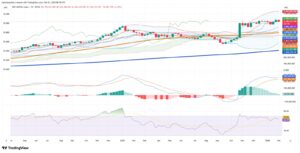
The 4-hour chart shows RSI near 80.79/75.26, firmly in overbought territory and suggesting short-term exhaustion risk even if the broader trend remains intact.
Daily RSI near 54.90/44.75 looks neutral, offering room for movement in either direction. Weekly RSI near 60.11/59.08 stays supportive of the medium-term peso depreciation trend.
Price action shows the pair consolidating after its January 2026 push toward record highs near 1,489–1,492. The current 1,446–1,452 range represents a modest peso recovery, though technicals suggest limited near-term upside for dollar strength without fresh catalysts.
S&P Merval
The index closed Friday near 3,106,672 points, down approximately 2.9% on the session after reaching all-time highs above 3,195,000 in late December.
The weekly chart shows RSI near 65.84/62.19, still consistent with a strong uptrend that is cooling. Daily RSI near 53.40/52.61 is neutral, while 4-hour RSI near 61.02/48.33 suggests consolidation rather than capitulation.
The Merval’s pullback fits the global pattern: when metals and commodities sell off violently, emerging market equities face spillover pressure as investors de-risk across asset classes.
The decline reflects portfolio rebalancing, not fundamental deterioration in Argentine corporate earnings or the reform trajectory.
POLICY CONTEXT: REFORM MOMENTUM INTACT
The government enters February with its reform agenda on track. The 2026 Budget passed the Senate in late December with a 46-25 vote, Milei’s first major legislative victory since taking office.
Labor reform debate begins this month, requiring negotiations with governors and unions. The Budget also authorizes foreign debt issuance, clearing a path for potential international market access as country risk approaches seven-year lows.
Economy Minister Caputo recently announced plans to accumulate up to $17 billion in reserves throughout 2026, addressing one of investors’ key concerns about Argentina’s thin foreign-reserve buffer.
Sovereign spreads have compressed sharply since the October midterm elections, with some analysts suggesting Argentina could return to international debt markets this year.
WHAT TO WATCH
Globally: The metals market needs to find a floor. Chinese trading desks return from Lunar New Year preparation in mid-February, and their buying (or lack thereof) will signal whether the selloff represents a healthy correction or something more structural. The Warsh nomination hearings will clarify the Fed’s policy direction.
Locally: January’s inflation print arrives next week. A reading around 2.5% would confirm the disinflation trend remains on track despite the methodology controversy. The labor reform debate in Congress will test whether Milei’s expanded political capital translates into legislative action.
SESSION WINNERS & LOSERS (Friday, January 31)
| TOP 5 GAINERS | ||
|---|---|---|
| Stock | Company | Change |
| TECO2 | Telecom Argentina | +3.4% |
| TRAN | Transener | +2.5% |
| ALUA | Aluar | +1.7% |
| YPFD | YPF | +1.6% |
| TXAR | Ternium Argentina | +1.2% |
| TOP 5 LOSERS | ||
|---|---|---|
| Stock | Company | Change |
| IRSA | IRSA | -3.3% |
| TGNO4 | TGN | -3.1% |
| COME | Comercial del Plata | -3.1% |
| CRES | Cresud | -3.1% |
| EDN | Edenor | -2.9% |
BOTTOM LINE
Argentina’s peso and equity markets are absorbing a global shock wave without breaking. The metals meltdown represents exactly the kind of forced deleveraging event that tests emerging market resilience, and so far the peso’s tight blue premium and the Merval’s orderly pullback suggest confidence in the reform trajectory remains intact.
The statistics chief’s departure adds headline noise but no fundamental change—if anything, the decision to delay methodology changes signals a government unwilling to risk credibility gains over timing disputes.
Short-term technicals warn against chasing the dollar at current levels, while the Merval looks like it’s consolidating strength rather than reversing trend.
The real test comes when external volatility settles and markets refocus on the domestic reform calendar—starting with labor reform this month and the January inflation print next week.
Related coverage: Brazil’s Morning Call | Argentina, the Country That Owes Half the World’s IMF Debt J This is part of The Rio Times’ daily coverage of Argentina affairs and Latin American financial news.
Live Market IntelligenceArgentina — Live Market Board
Rio Times · Live Market Intelligence
Argentina — Live Market Board
—
206,495.23
-0.86%
69,583.42
+0.47%
10,985.55
+0.54%
3,017,221
—
2,560.37
+1.07%
59,870.67
-0.52%
| Instrument | Last | Change | YoY | Prev. | High | Low | Volume |
|---|---|---|---|---|---|---|---|
| MERVAL | 3,017,221 | — | +30.51% | 3,022,485 | 3,042,365 | 2,991,150 | — |
| USD/ARS | 1,493 | +0.10% | +12.96% | 1,491 | 1,494 | 1,480 | — |
| YPF | 7,810 | +0.26% | +72.84% | 7,790 | 7,850 | 7,600 | 1,763,858 |
| GGAL | 6,980 | -0.78% | +1.82% | 7,035 | 7,115 | 6,920 | 1,564,062 |
| PAMPA | 5,115 | +0.69% | +26.70% | 5,080 | 5,140 | 5,000 | 721,190 |
| TXAR | 747.50 | -2.35% | +18.67% | 765.50 | 770.00 | 742.50 | 771,892 |
| ALUAR | 938.00 | -1.21% | +29.83% | 949.50 | 951.00 | 932.50 | 135,426 |
| TGS | 8,870 | -0.17% | +15.05% | 8,885 | 9,075 | 8,720 | 143,546 |
| CEPU | 2,156 | +1.84% | +28.36% | 2,117 | 2,165 | 2,086 | 404,146 |
| MIRGOR | 1,650 | -1.20% | -92.90% | 1,670 | 1,670 | 1,635 | 20,877 |
| COME | 40.93 | -0.73% | -30.47% | 41.23 | 41.60 | 40.50 | 4,258,884 |
| LOMA NEGRA | 3,130 | +0.08% | +5.80% | 3,128 | 3,205 | 3,090 | 182,992 |
| BYMA | 275.00 | -1.70% | +35.14% | 279.75 | 282.50 | 272.00 | 1,409,575 |
| TELECOM ARG | 4,233 | -0.70% | +55.19% | 4,263 | 4,335 | 4,160 | 31,896 |
| GLOBANT | 38.10 | -2.26% | -49.65% | 38.98 | 38.70 | 36.77 | 793,552 |
| MERCADOLIBRE | 1,870 | -3.59% | -20.71% | 1,940 | 1,927 | 1,870 | 329,640 |
This article was produced by The Rio Times’ automated newsroom system. How we use AI · Report an error · Editorial responsibility: Matthias Camenzind, Editor-in-Chief
In depth
Read More from The Rio Times