Argentina Signs Critical Minerals Deal With the U.S. in Washington’s Biggest Move Yet to Break China’s Grip
Key Points
- Every lithium battery in your phone, laptop, and electric car depends on minerals that China controls at every stage — from mine to magnet — and Argentina just signed a deal with the United States to change that.
- Argentina’s mining exports hit a record $6 billion in 2025, but the country sits on vastly more untapped wealth, including four of the world’s twelve largest undeveloped copper deposits — attracting up to $30 billion in potential investment.
- Indigenous communities and environmental groups warn this mineral rush is draining water from some of Earth’s driest landscapes and bypassing the rights of people who have lived there for centuries.
Two days before Argentina signed its minerals agreement with Washington, President Trump stood in the Oval Office and announced Project Vault — a $12 billion strategic reserve to stockpile the critical minerals that American factories, carmakers, and weapons manufacturers can no longer reliably source.
The reason is simple: China controls roughly 70% of global rare earth mining, over 90% of refining, and 94% of the permanent magnets inside everything from F-35 fighter jets to Tesla motors.
When Beijing restricted exports in 2024 and 2025, Ford had to pause production lines. The vulnerability was no longer theoretical.
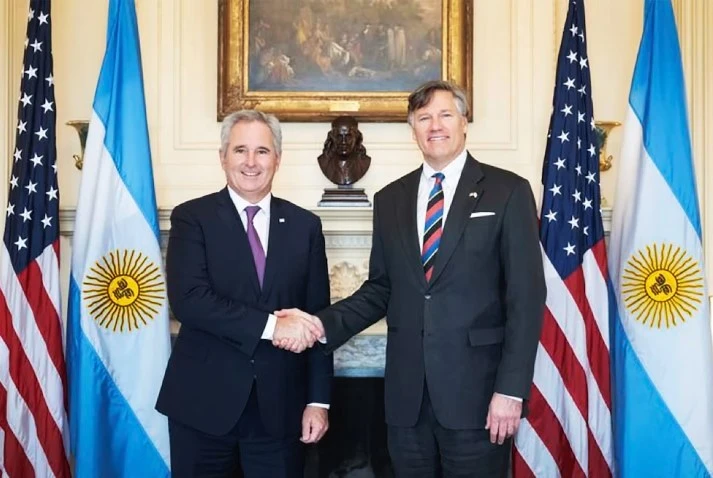
Enter Argentina. The country holds the world’s third-largest lithium reserves and sits within the Lithium Triangle — the South American region containing half of all identified global lithium deposits.
Production hit a historic 110,000 tonnes in 2025. But lithium is only part of the story. Major players like BHP, Rio Tinto, and Glencore are positioning to develop massive copper projects that could begin exporting by 2029.
Argentina’s government, under President Javier Milei, has rolled out aggressive investment incentives that have already attracted $16.7 billion in approved projects.
At the Washington summit — attended by 54 nations — Secretary of State Marco Rubio called Argentina “one of the global leaders” in critical minerals and praised its geology, processing experience, and strategic location in the Western Hemisphere.
Argentina’s lithium fuels global tension
The U.S. proposed a preferential trading bloc with price floors to counter Chinese market manipulation. Argentina is expected to join. But here is the part that rarely makes the headline. About 70% of Argentina’s lithium currently ships to China.
A pivot toward Washington means renegotiating that relationship with real economic consequences. And on the ground, the picture is more complicated still.
Lithium extraction evaporates roughly two million liters of water per tonne in high-altitude deserts where Indigenous Atacama and Kolla communities depend on the same scarce resource.
A 2025 international human rights study documented systematic failures to consult these communities. Courts have suspended permits.
Environmental lawyers describe an “express procedure” to weaken glacier protections — a reform heading to Argentina’s Senate on February 10 that could unlock or endanger Andean freshwater reserves depending on whom you ask.
Argentina has what the twenty-first century runs on. The world is now negotiating for access. What remains genuinely unresolved is whether the people and landscapes sitting on top of those resources will survive the transaction.
Download full report here.
Related coverage: Brazil’s Morning Call | Merval Slides for Sixth Straight Session as INDEC Crisis and This is part of The Rio Times’ daily coverage of Argentina affairs and Latin American financial news.
This article was produced by The Rio Times’ automated newsroom system. How we use AI · Report an error · Editorial responsibility: Matthias Camenzind, Editor-in-Chief
Read More from The Rio Times