Argentina Chaco Judiciary Strike Docks Pay Up to US$131

POLITICS · ARGENTINA
Key Facts
- —The country Argentina. Chaco, a northern province governed by Leandro Zdero, runs its own courts under the Superior Court of Justice (STJ), the provincial top court.
- —What happened Court staff who struck on 18 September were paid up to 200,000 pesos (about US$131) less on 30 September, El Destape and Chaco Ahora reported.
- —Who is involved The STJ, which ordered the cuts in Resolution 865/26; the Intergremial Judicial union front; and Governor Zdero, whose Bill 2141/26 sparked the dispute.
- —What it means for you Court services in Chaco were disrupted on strike days. Union surveys put adherence at 70 to 75 percent on 24 and 25 September, Litigio reported.
- —Still open Whether a second deduction hits October pay, whether unions call new strikes, and whether the legislature debates or shelves Bill 2141/26.
The Chaco judiciary strike in northern Argentina has moved from picket lines to payslips. Strikers from 18 September were paid up to 200,000 pesos (about US$131) less on 30 September, El Destape reported on Saturday.
Chaco Ahora and NEA HOY reported the same range, from 120,000 to 200,000 pesos (about US$79 to US$131) for one day. Dollar figures use 1,523 pesos to the dollar, the 2 October close.
What the provincial court ordered
Chaco’s Superior Court of Justice ordered the deductions in Resolution 865/26 after the 18 September stoppage. Strikers were identified from attendance records and office reports, according to El Destape and NEA HOY.
The court argued that staff who provided no service that day had no claim to that day’s pay. It added that a bill still under debate did not prove any breach by the employer, Perfil reported on 22 September.
The cuts appeared on payslips under code 000257. A second strike day, 25 September, may be docked in October because of payroll timing, El Destape and NEA HOY said.
Why court workers walked out
The dispute centres on Bill 2141/26, which Governor Leandro Zdero sent to the provincial Chamber of Deputies. It would create a pay guarantee, called “intangibility”, for judges and senior court officials.
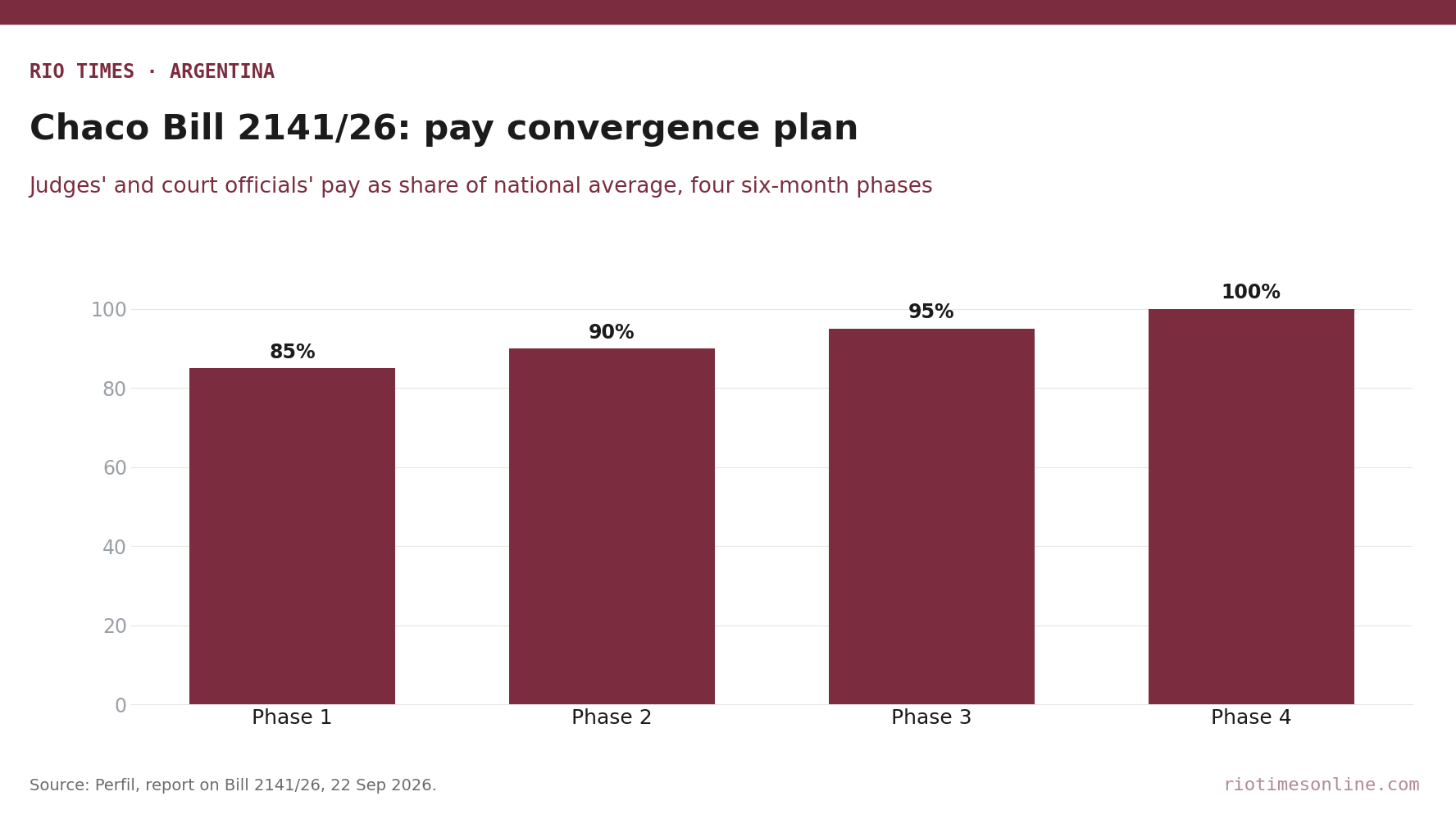
According to Perfil, their pay would converge on the national average in four six-month steps: 85, 90, 95 and 100 percent. Quarterly reviews would follow.
Unions say the plan breaks the percentage link in provincial Law 468-A that ties staff pay to judges’ salaries. They call the split “desenganche”, or decoupling, and want the bill shelved.
The STJ describes the bill as the executive’s response to a court ruling. Unions reject that framing, saying an ad hoc tribunal of judges who would benefit endorsed the scheme, Chaco On Line reported.
How far the Chaco judiciary strike reached
The Intergremial Judicial, a front of court unions, staged a walkout on 24 September and a full stoppage on 25 September. Its own surveys put adherence at 70 to 75 percent, Litigio reported on 26 September.
Unions called the deductions legally unfounded and plan legal action, Chaco Ahora reported. FESITRAJU, the national federation of court unions, denounced a “salary confiscation”. The unions also want Article 9 of Law 3424-A, which pegs judicial pay to the northeast regional average, applied to all court staff, not only judges.
On 30 September the unions also rejected a statement by the judges’ association backing the addition of court secretaries to the bill, Noticias Argentinas reported on Saturday. The unions say the scheme still rewards some ranks selectively.
The other side of the dispute
Supporters of the bill present it as a way to bring Chaco’s judicial pay closer to national levels. The STJ, for its part, has framed the deductions as the normal rule for days not worked.
Provincial Finance Minister Alejandro Abraam has rejected the unions’ decoupling reading and said the law linking staff pay to judges’ salaries would stay in force, Perfil reported.
No new stoppage had been announced in the reports reviewed. Zdero, who won the province from the Peronists in 2023, is the bill’s sponsor and has not commented in the reports reviewed.
What Is Not Yet Known
It is not known how many workers in the Chaco judiciary strike had pay docked, or the total withheld. Neither the STJ nor the unions have published those figures.
None of the reports reviewed mentions a scheduled legislative vote on Bill 2141/26 or a cost estimate. For background, see Opposition Wins in Argentina’s Chaco Province and Argentina Politics Explained, Who Holds Power in 2026.
Sources: El Destape, 3 Oct 2026; Chaco Ahora, 2 Oct 2026; NEA HOY, 2 Oct 2026; Perfil, 22 Sep 2026; Litigio, 26 Sep 2026; Chaco On Line, 30 Sep 2026; Noticias Argentinas, 3 Oct 2026.
This article was produced by The Rio Times’ automated newsroom system. How we use AI · Report an error · Editorial responsibility: Matthias Camenzind, Editor-in-Chief