Agribusiness Boom Offsets Drop in Container Flow at Port of Santos
RIO DE JANEIRO, BRAZIL – The port of Santos has been recording a drop in the flow of cargo containers in 2020 compared to the same period last year. However, the contraction does not figure in the overall data because it is being offset by the export boom in agribusiness, which is driving solid bulk freight to break records every month, mainly by sugar, corn, and soybean exports.
According to experts, the decline in the flow of containers is one of the economic impacts of the pandemic, which has reduced the activity level of industrial companies, household consumption, and, consequently, imports through seaports. The sectors that contributed most to this decline were the automotive and chemical sectors.
According to data from ANTAQ (National Agency of Aquatic Transport), the drop in handling has been occurring since March, when the decline in the public port reached 14.9 percent in long-distance containers compared to the same month last year. In the analysis between January and August 2020 over the same period in 2019, there was a 7.05 percent drop.

According to the agency, the port has been posting a continued reduction in its long-haul container handling. Nevertheless, it states that it is not possible to say that there is a downward trend, and the result is fully ascribed to the pandemic.
“We believe that the drop observed in the handling of cargo containers at the Port of Santos corresponds exclusively to conjunctural factors, and not to long-term structural factors,” says ANTAQ.
SPA’s Director of Operations Marcelo Ribeiro also sees the fact as circumstantial and punctual. The drop would be an effect of a depressed world economy in face of the pandemic scenario that changed the flow of containers. It in no way reflects the port’s capacity to receive this type of cargo, he says.
“It is the conjuncture. When you take the port data on exports and imports, you see that, ordinarily, you export 70 percent and import 30 percent of the cargo handled. But currently, it is exporting 74 percent and importing 26 percent, and this is a consequence of the conjuncture,” says Ribeiro.
The SPA says that the drop was expected and is consistent with the impact of the pandemic. However, it understands that the first four months proved the port’s resilience amid the pandemic, with growth in exports.
Professor Helio Halite, port consultant and professor at Santa Cecília de Santos University, is concerned with the decrease and its consequences.
“Container flow works as a thermometer of what adds the most value. The container productive chain provides greater opportunities and generates more jobs, producing another type of growth. We must be concerned about this drop,” says the professor.
The SPA (Port of Santos Authority) statistics show that in the fifth month of 2020, the worst moment of the pandemic in the country, there were 3.6 million tons of cargo in containers, against 3.9 million in the same period of the previous season, when there was no pandemic.
The data point to a decline in container handling at the port from the fifth month of the year compared the same months in 2019. There was no record of this type of annual retraction in the months of May since 2011.
In September 2020, the preview of the SPA statistics points to container flow of 344,000 TEUs (the standard Twenty-foot Equivalent Units), below the 386,000 of last year, but six percent higher than in August 2020, when it handled 323,000 TEUs.
Containers in the port of Santos typically carry components from the automotive, food and beverage, electronics, toys, clothing, agricultural products, and fertilizer industries, among other products. The origins and destinations are the most varied countries in the five continents, particularly China, the United States, and Europe.
Antônio Carlos Sepúlveda, president of Santos Brasil, ascribed the drop mainly to the impacts suffered by the automobile and chemical industries. “They are two of the main import items and suffered in the pandemic. There are full container imports dropping by 27 percent in August compared to last year,” he says.
Statistics from ANFAVEA (National Association of Automotive Vehicle Manufacturers) confirm the argument. In the first half of the year, vehicle production had an accumulated drop of 50.5 percent compared to the first six months of 2019. In April, the drop reached 99 percent compared to the preceding month and 99.4 percent compared to the same month last year.
According to ANTAQ, the drop observed in the handling of cargo containers is consistent with the adverse impact of the Covid-19 pandemic on the level of activity and consumption of families, particularly at the national level. The agency pointed out that the port of Santos concentrates the largest industrial park and the largest consumer market in the country.
“Let us not forget that the outbreak of Covid-19 in Brazil began in the state of São Paulo, which led the state government to immediately adopt strong measures to restrict the flow of people, the operation of trade and services, and demanding increased care in the operation of industries,” said ANTAQ in a statement.
According to IBGE (Brazilian Institute of Geography and Statistics) data, Brazilian industry has not yet returned to pre-crisis levels. In São Paulo, the country’s largest industrial pole, the percentage variation accumulated in the year to August showed an -11,1 percent drop.
Port consultant Helio Halite explains that the port handles 30 percent of the country’s containers, much of it cargo focused on São Paulo’s industrial production. With the industry impacted by the pandemic, the port complex also suffers the consequences.
“We are major importers of car parts. A good part comes from China and Asia for assembly in São Paulo”, says the professor. In addition, he pointed out that the port of Santos is susceptible to cargo transfer to other ports that have begun or expanded operations with containers, such as Paranaguá and Santa Catarina.
“Paranaguá has greatly increased exports of beef, pork, and poultry cargo and must have taken a little from the port of Santos. Santa Catarina too. This drop in container handling can be observed in the competition with Santos, which is attentive to this cargo flight and suffers with a natural logistic adjustment.”
According to ANTAQ, comparing January to August 2020 with the same period last year, there was a 9.3 percent reduction in container handling in TEUs in the entire port complex, excluding the result of DP World’s private terminal.
With the private terminal, the overall decline in the whole port was of 3.58 percent between January and August 2020 compared to the same period last year. This is because DP World alone experienced growth of over 33 percent, but because of a change in shipping services, with the addition of a new one much larger than the previous one.
“The comparative basis is different,” explains Fabio Siccherino, commercial and institutional relations director at DP World. Siccherino says that the terminal has noticed a monthly drop of between ten and fifteen percent on the volume of container handling. The pre-crisis level on containers is expected to recover only at the end of 2021.
The BTP (Brazil Port Terminal) is projecting the same. The terminal also registers a drop in container handling and stresses that this was the result of the deceleration of international trade because of the pandemic. The terminal recorded a 17 percent drop in imports and ascribes the retreat to the retraction in industrial production, a drop in consumption, and the rise in the dollar.
In relation to the statistical panels of the volume of cargo containers (in TEUs) exported and imported declared by the port facilities of Brazil as a whole, the country’s export containers had a reduction of 1.6 percent, while imports suffered a drop of 2.7 percent, declines lower than those recorded in Santos.
The contraction is not only occurring in Brazil. A report by Drewry, dedicated to monitoring the worldwide circulation of containers, points to an eight percent downturn in the second quarter of 2020. However, the result was considered better than the 16 percent previously projected.
Exports exploded despite pandemic
On the other hand, DP World’s private terminal offset its container losses with a high external sales volume. With the high dollar, which favors exports, the cellulose segment increased business with China, in particular, and with Asia, overall, which favored the terminal. It is expected to close the year handling nearly two million tons, more than double last year.
“It is a commodity where Brazil is competitive and has grown abnormally,” says Siccherino. He attributes the success on the sector to the new port’s railway modal, which brought competitiveness to cellulose abroad. “We designed a project to export this product and we are getting 100 percent by road,” he said.
The exceptional effects of the exports of raw materials or products linked to agribusiness was observed at the port as a whole.
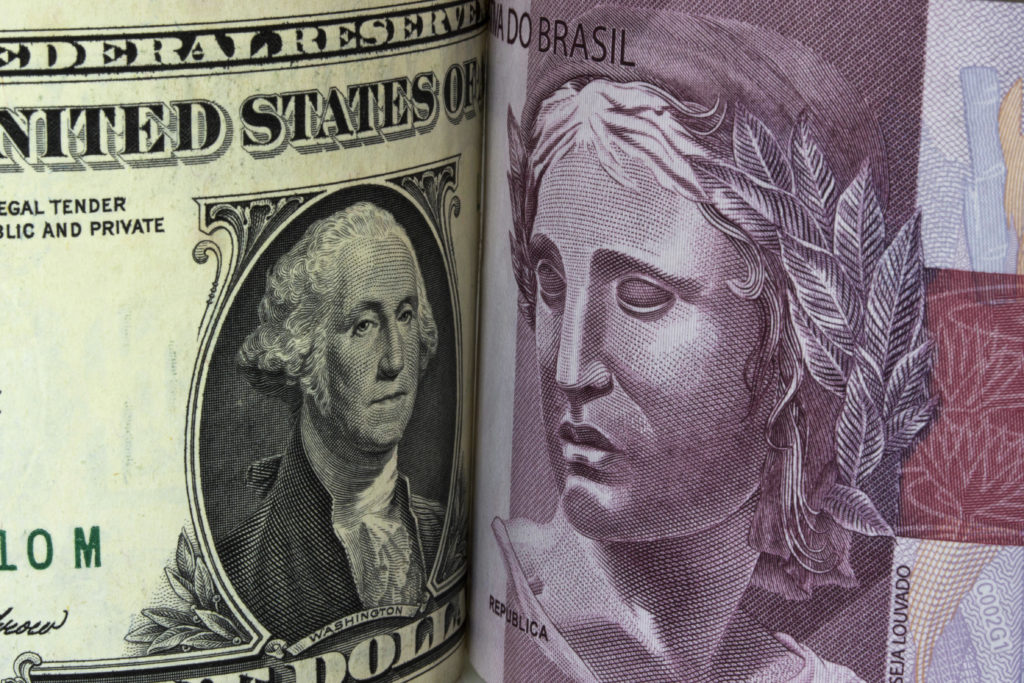
The exchange rate is a decisive factor, say experts. In February, the Brazilian Real rate against the dollar stood at around R$4,35, while in August the level reached R$5,46, serving as another important factor to inhibit imports.
Still in May 2020, according to SPA data, solid bulk goods increased exports from 5.1 million to 7.4 million tons.
The bulk came from agribusiness. In soybeans alone – Brazil is the crop’s largest exporter in the world – it was 3.8 million tons, much more than the 2.5 million in May 2019. Sugar almost doubled its export, rising from one million to 1.9 million.
In August, sugar posted a 140 percent increase, up from 1.1 million tons in 2019 to 2.7 million this year. Corn also recorded an increase, from 2.9 million to 3.4 million tons. In total, bulk solids increased circulation by two million tons, totaling 8.1 million – seven million in exports alone.
Antônio Carlos Sepúlveda, president of Santos Brasil, pointed out that this should be a trend for ports in the country, with ample growth in exports, mainly of agricultural raw materials.
“Brazil is unbeatable in this respect and will always remain strong. And it may continue growing because it can expand the planted area with no environmental problem, it has room for that, with a very big climatic advantage. Productivity is high”, he says.
“Everyone is affected by what is happening with the pandemic, it is a unique situation, but the trend is toward normalization, either through a vaccine or herd immunity. With increasingly less social isolation, the economy is becoming more like it was before,” he says.
Driven by the agribusiness results, the port of Santos recorded a total handling of 110 million tons in September, an increase of ten percent over the same period in 2019.
In the BTP, exports remained very heated despite the pandemic, so much so that in August they grew by two percent compared to August last year. In 2020 as a whole, there was a 35 percent increase. The terminal credits the result to agribusiness exports, such as sugar, coffee, cotton, and animal protein, which offset the general drop in imports and also the reduction in cabotage (coastal trade) flow.
For the remainder of the year, the BTP head points out that the outlook is for an improvement in the volume of imports, particularly from September, as a reflection of the resumption of major economic activities and also the improvement in retail sales expected for the end of the year. “Moreover, commodities exports continue to heat up, and should close the year at a new historical record,” he says.
Source: Folhapress
More: Brazil news in English, every day from The Rio Times.
This article was produced by The Rio Times’ automated newsroom system. How we use AI · Report an error · Editorial responsibility: Matthias Camenzind, Editor-in-Chief