T-MEC’s Longevity: A Shield Against Political Turbulence Until 2036
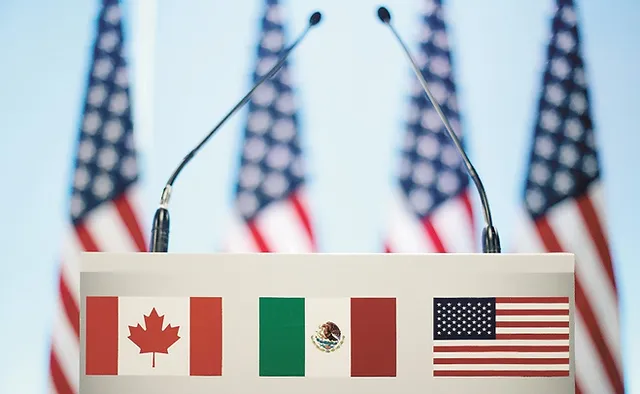
The North American trade agreement between Mexico, Canada and the U.S., T-MEC, stands resilient against potential political upheavals.
Its initial 16-year lifespan, stretching to 2036, safeguards the pact from immediate termination. This stability persists regardless of who occupies the White House.
The agreement’s first major checkpoint arrives in 2026. At this juncture, the three nations will review and potentially renew the treaty for another 16 years.
Each country can propose changes to the Free Trade Commission during this process. Renewal requires written confirmation from all three heads of state.
If achieved, T-MEC‘s lifespan automatically extends to 2042. This continuity provides a solid foundation for regional economic cooperation.
Should unanimous renewal prove elusive in 2026, the agreement doesn’t simply collapse. Instead, annual meetings commence, offering ten more opportunities to reach a consensus.
T-MEC’s Resilience Amid Political Change
This flexible approach ensures ongoing dialogue and stability. Sergio Gómez Lora, a key trade official, emphasizes the significance of the 2026 review.
He notes its timing coincides with leadership changes in Mexico and the United States. This adds complexity to the negotiations.
The U.S. formal renewal process begins in October 2025. The U.S. Trade Representative will seek public input and hold hearings on T-MEC’s performance.
This transparent approach allows for diverse perspectives to shape the agreement’s future. By January 2026, a comprehensive report will reach key U.S. congressional committees.
However, this document will evaluate T-MEC’s effectiveness and recommend future actions. It ensures lawmakers have a clear picture of the agreement’s impact.
T-MEC’s structure provides a decade of stability post-2026, even without immediate renewal. This buffer period allows for continued negotiation and adaptation.
It demonstrates the agreement’s built-in resilience to political shifts. The treaty’s design prioritizes long-term economic integration over short-term political whims.
In short, this foresight helps insulate North American trade from the potential volatility of election cycles. It provides businesses and investors with a more predictable environment.
Key Facts
— Deep Dive
— For the complete picture, read our in-depth guide: Mexico Economy 2026: GDP, Peso, Nearshoring, Banxico and Trade
More: Mexico news in English, every day from The Rio Times.
This article was produced by The Rio Times’ automated newsroom system. How we use AI · Report an error
Read More from The Rio Times