Suriname Lines Up US$850 Million in New Loans While Debt Exceeds Legal Cap

ECONOMY · SURINAME
Key Facts
- —The country Suriname, a former Dutch colony on South America’s north-east coast, expects its first offshore oil in 2028, according to the IMF (January 2026).
- —What happened The State Debt Plan 2027, submitted to parliament on 30 September 2026, lists about US$850 million in new loans in preparation: US$559 million foreign, US$291.5 million domestic.
- —The numbers Debt was 119.6% of GDP at end-June 2026 by the legal method, against a 60% ceiling. A newer GDP measure gives 74.5%. Debt service takes 23% of planned 2027 spending.
- —What it means for you Not all of it becomes debt in 2027, and some loans are only concepts. Investors should watch how much funds budget support rather than investment.
- —Still open Which loans will be signed, on what terms, and when parliament debates the 2027 budget. In January 2026 the IMF urged significant fiscal adjustment this year.
Suriname has more than US$850 million in new loans in preparation, according to the government’s State Debt Plan 2027. The plan reached the National Assembly (DNA, Suriname’s parliament) on Wednesday 30 September, together with the 2027 draft budget.
Starnieuws and GFC Nieuws reported the figures on 3 October. The new loans split into US$559 million from foreign lenders and US$291.5 million from domestic ones.
Who would lend the money
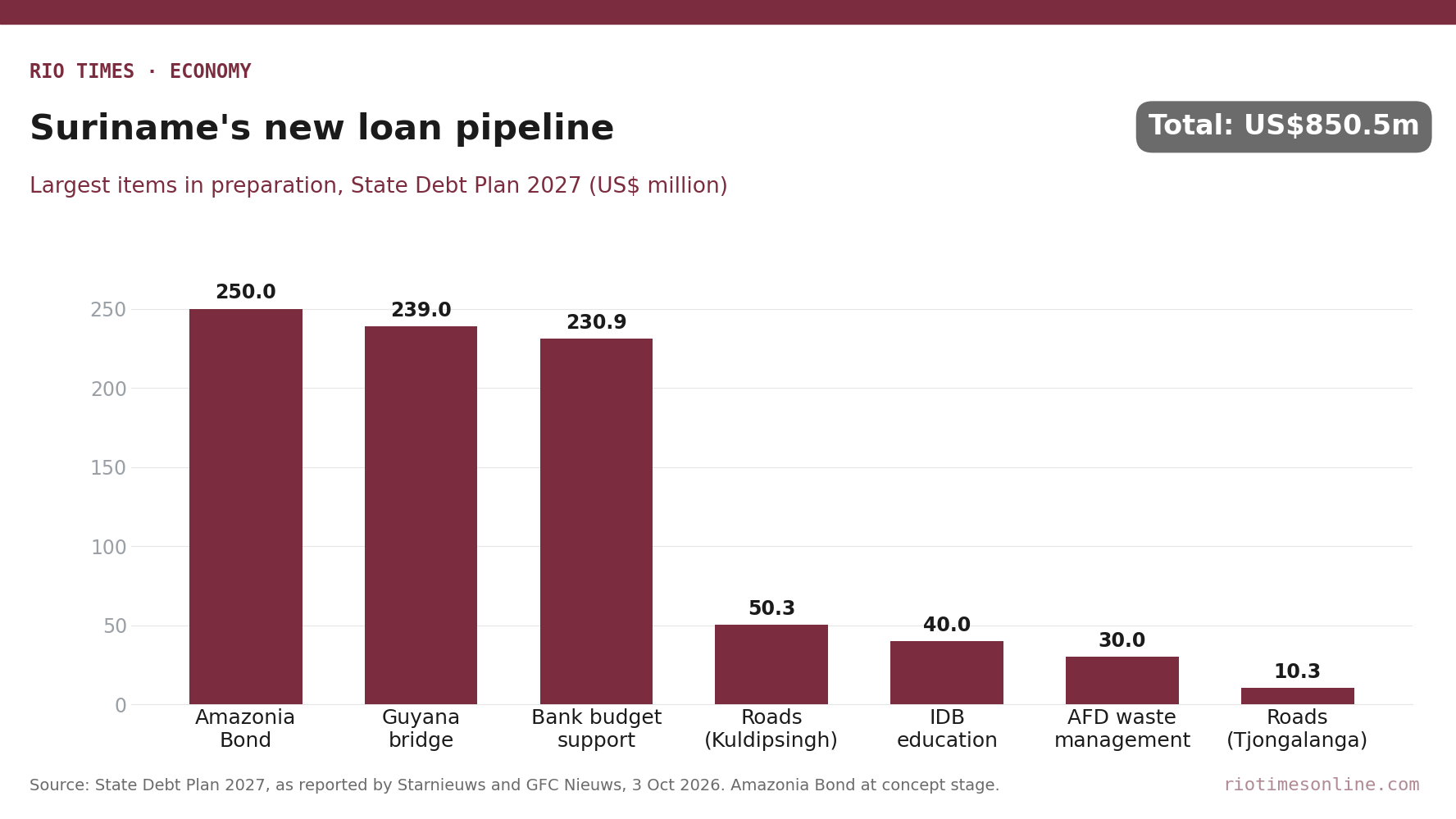
The largest foreign item is a US$250 million Amazonia Bond with the Inter-American Development Bank (IDB) and Enosis. The plan lists it at the concept stage.
China appears with US$239 million for the bridge between Suriname and Guyana, registered as in preparation. The IDB is down for US$40 million for school reforms.
A US$30 million request for waste management has gone to AFD, the French development agency. Neither outlet described any of these loans as signed or approved.
At home, the biggest item is US$230.9 million in budget support through local banks. Smaller sums cover roadworks by the contractors Kuldipsingh (US$50.3 million) and Tjongalanga (US$10.3 million).
Not all of it is new debt next year
The plan stresses that the new loans are not debt the state will take on or draw in full in 2027. Project loans are usually drawn over several years.
Suriname also had US$520.7 million undrawn on existing foreign loans as of June 2026. At most about US$195.7 million of that can be drawn in 2027, mostly from the IDB.
The borrowing would help cover a 2027 deficit of SRD 10.8 billion (about US$286 million at SRD 37.75 per dollar, 2 October). The government puts that near 4% of GDP: Suriname President Simons Uses Annual Address to Set 2027 Deficit at 4% of GDP.
A debt ratio twice the legal cap
By the legal calculation, debt stood at 119.6% of GDP at end-June 2026, down from 121.1% in March. The State Debt Act sets the ceiling at 60%.
That ratio uses the statistics bureau’s latest official GDP figure. A more recent GDP measure used for international reporting gives 74.5%.
An October 2025 amendment lets the state exceed the ceiling until 31 December 2027, Starnieuws reported. Debt service will absorb about 23% of planned 2027 spending, or US$433.6 million.
US$152.2 million of interest on the 2030 and 2035 global notes and a social bond already sits in escrow. That payment adds no burden to the 2027 budget.
What the IMF said
In late January 2026 the IMF’s board completed its annual Article IV review of Suriname. It estimated gross debt at 106% of GDP, mainly after a debt refinancing operation.
Directors welcomed progress under the IMF-supported programme that ended in March 2025. They also called for significant fiscal adjustment in 2026 after slippages in 2025.
The Fund expects offshore oil to push growth to around 30% in 2028. Much of that hope is already built into the debt: Suriname Bet Its Bondholders on Oil It Has Not Pumped Yet.
The question GFC Nieuws is asking
In an opinion column on 4 October, GFC Nieuws asked who will eventually pay the bill. It argued that borrowing for investment differs from borrowing to cover recurring deficits.
It singled out the bank budget support for most scrutiny. That is the outlet’s view, not a finding of the plan, which says unused credit lines will be reviewed and cancelled if no longer needed.
Neighbouring Guyana faces a similar debate as oil money arrives. See Guyana Borrowing Nearly Triples to About US$505 Million.
What Is Not Yet Known
The plan does not say how much of the deficit each funding source will cover, Starnieuws noted. Interest rates and maturities for the new loans have not been published.
No date has been reported for the DNA debate on the 2027 budget and debt plan. Neither outlet said which of them would need separate parliamentary approval.
Sources: State Debt Plan 2027 (Suriname Debt Management Office), as reported by Starnieuws (1 and 3 October 2026) and GFC Nieuws (3 October 2026); GFC Nieuws opinion column, 4 October 2026; Culturu, on the 2027 draft budget submission (30 September 2026); IMF Executive Board press release on the 2025 Article IV consultation, January 2026.
This article was produced by The Rio Times’ automated newsroom system. How we use AI · Report an error · Editorial responsibility: Matthias Camenzind, Editor-in-Chief
LatAm Markets: Live Signals → — real-time movers, turnover leaders and FX across Latin America.