Guyana Borrowing Nearly Triples to About US$505 Million

ECONOMY · GUYANA
Key Facts
- —The country Guyana, on South America’s north coast, has pumped oil since late 2019 and saves its oil income in the Natural Resource Fund (NRF), a sovereign wealth fund.
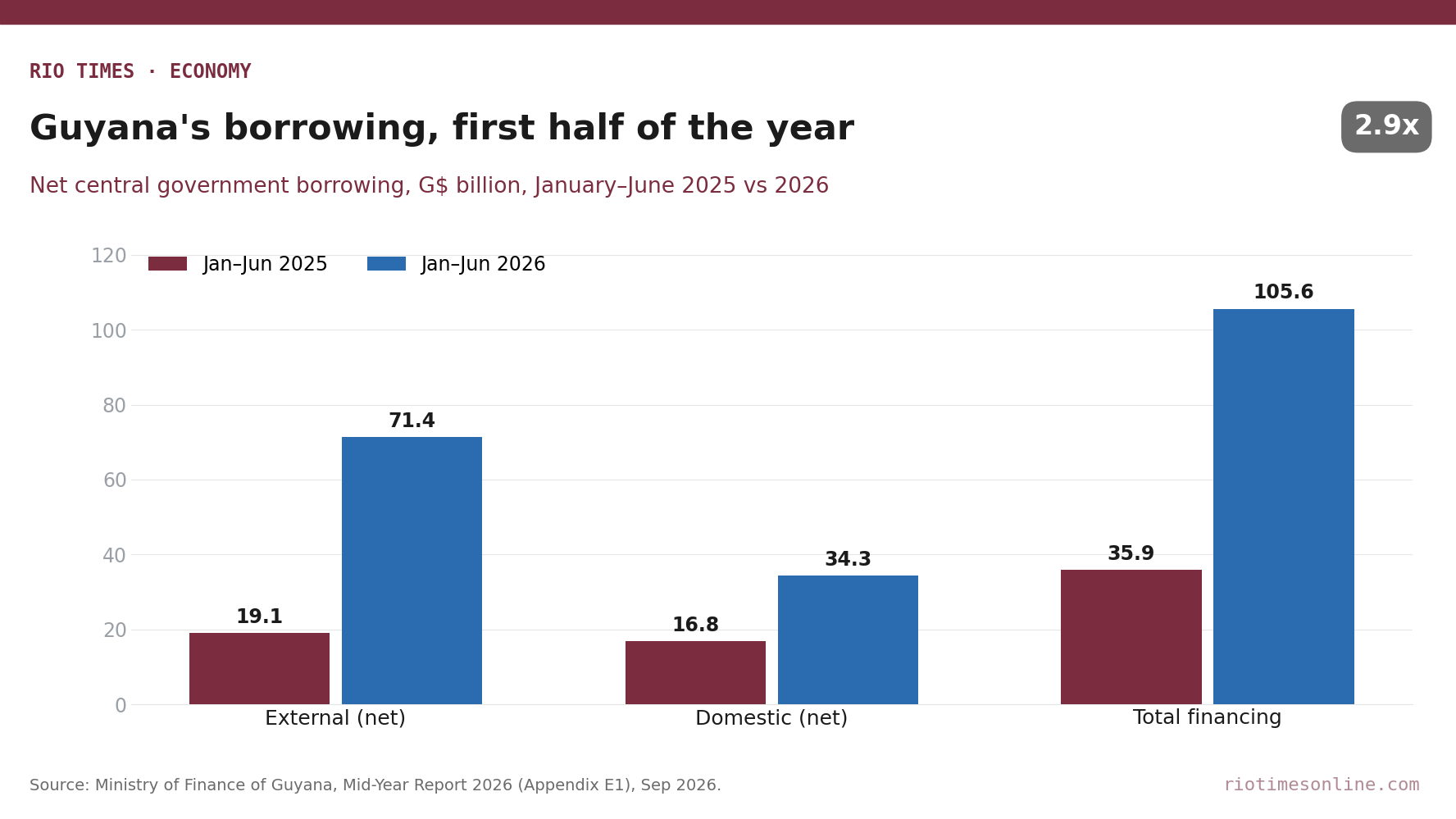
- —What happened Central government net borrowing reached G$105.6 billion (about US$505 million) in January–June 2026, against G$35.9 billion a year earlier, the Finance Ministry’s Mid-Year Report shows.
- —The numbers Net foreign borrowing rose from G$19.1 billion to G$71.4 billion, domestic from G$16.8 billion to G$34.3 billion. Public debt stood at US$8.57 billion at end-June 2026.
- —What it means for you Debt is moderate, at 28.6 percent of GDP at end-2025 by the ministry’s count. But first-half interest costs rose 53 percent year on year, to about US$66 million.
- —Still open The full IMF staff report for 2026 is not yet out. The ministry plans G$503.8 billion of borrowing for the year and expects debt of US$10.33 billion by December.
Guyana borrowing nearly tripled in the first half of 2026, according to the Ministry of Finance’s own Mid-Year Report. Net financing for the central government reached G$105.6 billion (about US$505 million), up from G$35.9 billion (about US$172 million) a year earlier.
Kaieteur News, a Georgetown daily, published a letter on Saturday 3 October by Charles Sugrim warning that oil wealth is at risk. His numbers match the ministry’s tables, though his conclusions are his own.
What the Mid-Year Report shows on Guyana borrowing
Net external borrowing, mostly loans from development banks and foreign governments, rose from G$19.1 billion to G$71.4 billion (about US$341 million). Conversions use G$209 per US dollar, the 2 October close.
Disbursements from abroad reached US$447.5 million, up from US$130.7 million a year earlier. Net domestic borrowing, largely through short-term Treasury bills, doubled from G$16.8 billion to G$34.3 billion (about US$164 million).
The gap reflects spending running ahead of income. Total central government spending rose 11.5 percent to G$599.8 billion (about US$2.87 billion), while current revenue slipped 0.7 percent.
That revenue figure includes transfers from the oil fund, which fell to G$212.1 billion from G$249.6 billion. Tax and other non-oil revenue actually grew 18.7 percent, to G$279.5 billion.
The case made in Kaieteur News
Sugrim writes that “borrowing tripled in a single year” and blames “runaway public expenditure.” He argues the country risks seeing its oil wealth “pledged away to banks and other creditors.”
He also says state borrowing has fuelled inflation and crowded out private investment. Those wider claims are his opinion and cannot be checked against the ministry’s tables.
Why the official measures still look moderate
Total public and publicly guaranteed debt stood at US$8.57 billion at end-June 2026, up from US$6.81 billion a year earlier. The ministry puts debt at 28.6 percent of GDP at end-2025, with debt service taking about 5.5 percent of revenue.
The oil fund held US$4.29 billion at end-June, after first-half withdrawals of US$1.02 billion. A Rio Times report in August noted that the Inter-American Development Bank (IDB) sees Guyana’s debt burden falling.
The International Monetary Fund (IMF) held its annual review mission in Guyana from 20 to 31 July. Its concluding statement assessed the risk of debt distress as low, as in 2025.
The statement also urged that a larger share of extra oil revenue be saved if prices stay high. Kaieteur News reported it on 4 August as praise for a “prudent borrowing strategy.”
Where the risk lies
The ministry expects public debt to reach US$10.33 billion by end-2026, a third higher than at end-2025. Its full-year financing plan was revised up to G$503.8 billion (about US$2.41 billion), from G$448.9 billion in the budget.
The first half therefore used about a fifth of planned Guyana borrowing for the year. On the ministry’s own plan, roughly G$398 billion more would be borrowed between July and December.
Foreign-currency debt rose 3.5 points to 38.6 percent of the total, raising exposure to exchange-rate swings. About 84 percent of domestic debt is Treasury bills, which must be rolled over within a year.
How fast withdrawals from the oil fund grow will shape how much of the gap borrowing must fill.
What Is Not Yet Known
The IMF’s full 2026 staff report, with its updated debt analysis, had not appeared on the Fund’s Guyana page by 3 October. It is also unclear how second-half borrowing will split between foreign lenders and local banks.
Oil prices will largely decide how quickly the oil fund grows against new debt. The end-2026 debt figure is a ministry projection, not an outturn.
Sources: Ministry of Finance of Guyana, Mid-Year Report 2026 (Sept 2026); Kaieteur News, letter by Charles Sugrim (3 Oct 2026); IMF staff concluding statement, 2026 Article IV mission (31 Jul 2026, via Caribbean News Global); Kaieteur News on the IMF statement (4 Aug 2026); Guyana Chronicle (2 Aug 2026); IMF, 2025 Article IV press release (7 May 2025).
Editorial responsibility: Matthias Camenzind, Editor-in-Chief · Editorial standards · Report an error
LatAm Markets: Live Signals → — real-time movers, turnover leaders and FX across Latin America.