Steel Wrap: Gerdau Rises as Brazil Tariffs Shield Long Steel
Key Facts
- Gerdau rose 1.81% to US$5.06 in New York, the strongest move among the region’s big steel names.
- CSN’s American depositary receipts added 1.64% to US$1.24, a modest bounce for the flat-steel producer.
- Ternium edged up 0.17% to US$58.10, reflecting steadier Mexican demand.
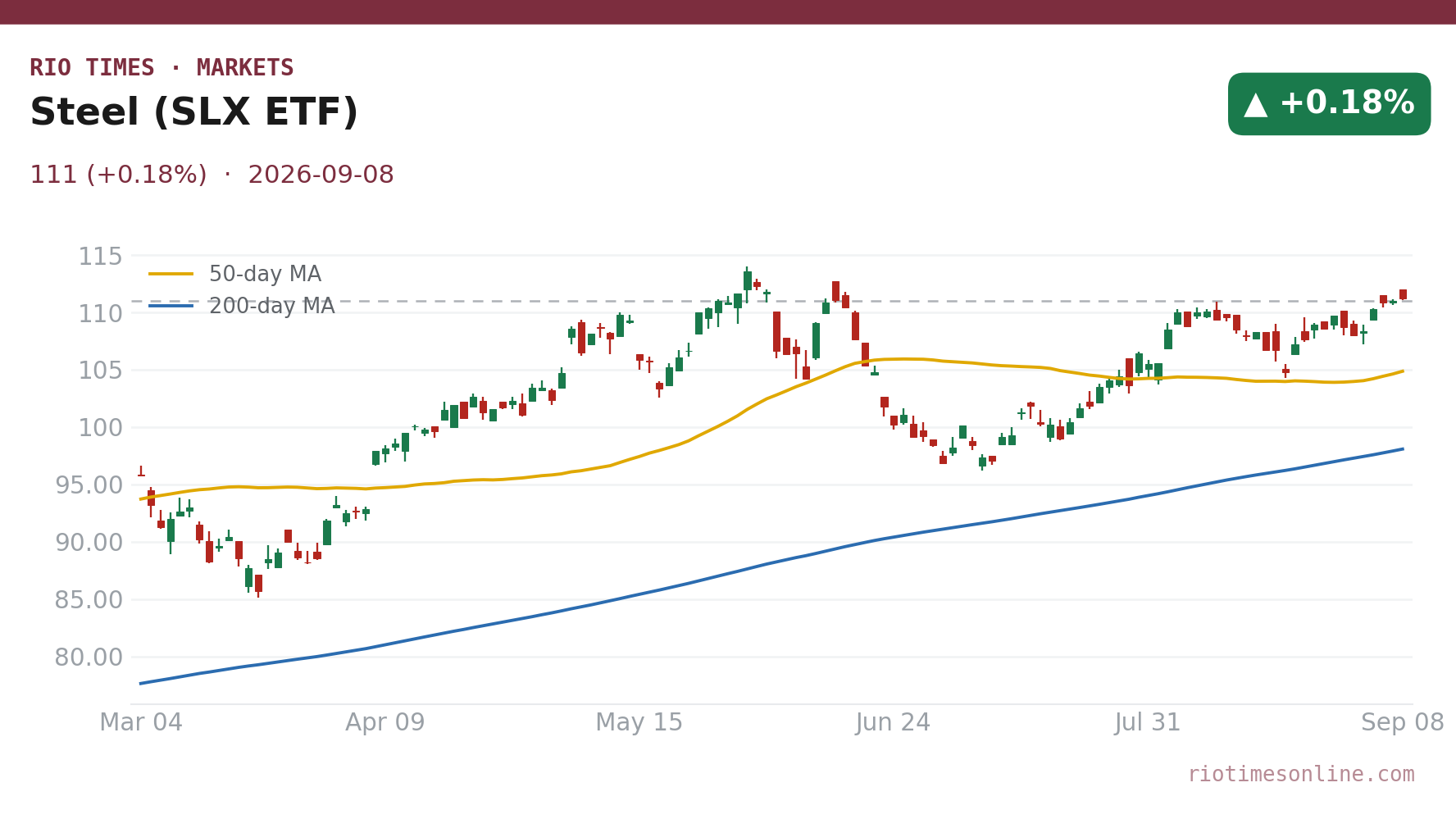
- The SLX steel-producers ETF gained 0.18% to US$111.19, a sign the global steel complex was broadly calm.
- Brazil’s 25% tariff on 23 steel products above quota runs through June 2027, aimed at Chinese flat steel.
- Mexico’s steel tariffs reach up to 50% on 1,463 tariff lines for non-free-trade partners, including steel.
Today’s Focus
Latin American steel shares were mixed but mostly firmer on Tuesday, September 8, 2026, as Brazil’s protectionist shield continued to favour long-steel producers such as Gerdau.
Gerdau’s New York shares climbed to US$5.06, while CSN’s ADRs rose to US$1.24 and Ternium inched up to US$58.10.
The regional story remains one of cheap Chinese imports meeting tariff walls: Brazil has a 25% duty on 23 steel products above quota, and Mexico’s tariffs on non-free-trade partners reach up to 50% on 1,463 tariff lines.
Demand is supportive but not robust; Brazil’s construction sector helps long steel, while flat steel pricing leaves CSN more exposed.
What matters today. Brazil’s tariff shield is propping up domestic long-steel producers even as import penetration stays historically high and Chinese flat steel remains a threat.
01 The session in one read
Latin American steel equities traded in a narrow band on Tuesday, September 8, 2026, with Gerdau leading the region’s big producers higher while CSN and Ternium posted more modest gains.
The moves were small but telling: investors are rewarding companies tied to Brazil’s construction-driven long-steel market and punishing those more exposed to flat steel and imports.
The SLX steel-producers ETF, a broad basket of global steel names, closed at US$111.19, a gain of 0.18% for the session.
The session’s small gains mask a market that is being supported more by trade policy than by surging consumption. Brazil’s construction demand is real and favours Gerdau, but first-half import penetration of 22.5% shows that even with tariffs in place, foreign steel is still finding a way in. Latin American apparent rolled steel consumption rose only 0.1% year on year in March 2026, so the region’s mills are fighting for share in a slow-growing market. Watch whether Brazil extends or tightens its quota system before the June 2027 expiry, because any relaxation would quickly hit domestic pricing.
02 The board
Gerdau’s New York-listed shares rose 1.81% to US$5.06, the strongest performance among the names tracked by The Rio Times. The move reflects investor confidence in Gerdau’s exposure to Brazil’s construction and infrastructure spending, which supports demand for long steel products such as rebar.
CSN’s American depositary receipts gained 1.64% to US$1.24, a modest recovery for the flat-steel producer that has been most vulnerable to cheap Chinese imports. Ternium edged up 0.17% to US$58.10, showing little volatility as Mexican demand remained steady.
| Asset | Level | Change |
|---|---|---|
| Steel (SLX ETF) | US$111.19 | +0.18% |
| Gerdau | US$5.06 | +1.81% |
| CSN (ADR) | US$1.24 | +1.64% |
| Ternium | US$58.10 | +0.17% |
Source: RT close, 2026-09-08. Where a commodity has no spot feed, an exchange-traded tracker or leading producer is shown as a labelled proxy.
Live Market IntelligenceThe live market board
Rio Times · Live Market Intelligence
Latin America — Cross-Market Board
| Instrument | Last | Change | YoY | Prev. | High | Low | Volume |
|---|---|---|---|---|---|---|---|
| IBOV | 187,366.84 | +1.20% | +21.85% | 185,147.15 | 168,310 | 167,142 | — |
| IPSA | 11,315.26 | -1.14% | — | 11,445.90 | 11,210 | 10,984 | 1,513,213,483 |
| IPC MEX | 65,010.39 | +0.44% | +12.17% | 64,727.54 | 66,121 | 65,405 | 108,886,187 |
| MERVAL | 3,075,982 | +1.36% | +30.51% | 3,022,485 | 3,042,365 | 2,991,150 | — |
| COLCAP | 2,569.47 | +0.15% | — | 9.04 | 9.05 | 9.02 | 4,133 |
| BVL PERÚ | 59,620.96 | +1.05% | — | — | — | — | — |
| USD/BRL | 5.16 | +0.01% | -5.13% | 5.16 | 5.18 | 5.14 | — |
| EUR/BRL | 5.95 | +1.01% | -5.83% | 5.89 | 5.98 | 5.94 | — |
| USD/MXN | 17.06 | -0.24% | -8.58% | 17.10 | 17.08 | 17.01 | — |
| USD/CLP | 913.98 | +0.04% | -5.67% | 913.65 | 915.11 | 906.68 | — |
| USD/COP | 3,140 | +0.03% | -22.04% | 3,139 | 3,141 | 3,105 | — |
| USD/PEN | 3.36 | -0.66% | -4.82% | 3.38 | 3.38 | 3.35 | — |
| USD/ARS | 1,493 | +0.10% | +12.96% | 1,491 | 1,494 | 1,480 | — |
| USD/UYU | 40.27 | +1.24% | +1.80% | 39.77 | 40.27 | 40.23 | — |
| USD/PYG | 5,939 | +1.68% | -19.54% | 5,841 | 5,939 | 5,925 | — |
| USD/BOB | 11.64 | -0.76% | +72.04% | 11.73 | 11.72 | 11.64 | — |
| USD/DOP | 58.34 | +1.25% | -3.44% | 57.62 | 58.34 | 58.04 | — |
| USD/CRC | 445.92 | +0.89% | -9.71% | 441.97 | 448.50 | 445.92 | — |
Live Company IntelligenceGerdau S.A — the full investor dossier
Valuation & profitability
Price & risk
$15.7852-wk high
$26.44
Revenue trend · 6y
Ownership
Dividend
03 What moved it
The dominant driver is Brazil’s tariff shield. A 25% tariff on 23 steel products above quota runs through June 2027, and five-year anti-dumping duties are in place on Chinese flat steel such as cold-rolled, hot-dip galvanised and pre-painted products.
These measures are designed to protect domestic mills from a wave of Chinese steel that has been redirected to Latin America after facing duties in the United States and Europe.
Yet the protection is not complete. Brazil’s first-half import penetration hit 22.5%, above historical norms, meaning foreign steel is still flowing into the country despite the tariffs.
In Mexico, the picture is calmer. Ternium has support from Mexican steel consumption growth of about 4% in 2026, while auto output remains roughly flat near 4 million units.
04 The Latin American read
For foreign investors, the Latin American steel trade is increasingly a story about policy rather than pure demand. Brazil’s construction sector is a genuine bright spot for long steel, but the overall regional demand picture is subdued.
Latin American apparent rolled steel consumption rose only 0.1% year on year in March 2026, while automotive output grew just 1.1% in the first four months of the year.
Mexico’s tariff regime, which reaches up to 50% on 1,463 tariff lines for non-free-trade partners, gives Ternium a shield of its own, though the Mexican market is less exposed to Chinese flat steel than Brazil.
05 The names to watch
Gerdau remains the region’s clearest beneficiary of Brazil’s construction demand and tariff protection on long steel. The company’s New York shares have been the most consistent performer among Latin American steel names.
CSN is the more vulnerable story. Its exposure to flat steel pricing leaves it exposed to Chinese import competition, even with anti-dumping duties in place.
Ternium appears the most balanced: it has Mexican demand growth, a tariff shield of its own, and less direct exposure to Chinese flat steel compared with its Brazilian peers.
06 The outlook
The next 12 months will test whether Latin America’s tariff walls are high enough to offset weak underlying demand and persistent import pressure. Brazil’s quota system expires in June 2027, and any political shift toward trade liberalisation would quickly change the calculus for domestic mills.
Mexico’s auto sector, still near 4 million units of annual output, offers a stable source of demand but little growth. The clearest risk remains Chinese steel finding new routes into both countries, forcing governments to choose between protection and cheaper steel for their own construction industries.
07 What to watch
- Brazil quota expiry: Watch whether Brazil extends or tightens its steel quota system before June 2027, as any relaxation would hit domestic pricing.
- Chinese import flows: Track monthly import penetration data, which remained historically high at 22.5% in the first half despite tariffs.
- Mexican auto output: Monitor Mexican auto production near 4 million units; any decline would directly weaken Ternium’s demand base.
- Construction spending: Watch Brazil’s construction and infrastructure outlays, the key demand driver for Gerdau’s long steel products.
Frequently Asked Questions
Why did Gerdau rise more than CSN?
Gerdau benefits from Brazil’s construction demand for long steel, while CSN is more exposed to flat steel pricing and Chinese imports.
How do Brazil’s steel tariffs work?
Brazil has a 25% tariff on 23 steel products above quota, running through June 2027, plus five-year anti-dumping duties on Chinese flat steel.
What is protecting Ternium in Mexico?
Mexico has tariffs up to 50% on 1,463 tariff lines for non-free-trade partners, including steel, and its auto sector produces about 4 million units annually.
Is Chinese steel still entering Latin America?
Yes. Brazil’s first-half import penetration was 22.5%, above historical norms, showing that Chinese steel is still finding its way in despite tariffs.
Market data: RT
This article was produced by The Rio Times’ automated newsroom system. How we use AI · Report an error
LatAm Markets: Live Signals → — real-time movers, turnover leaders and FX across Latin America.
Read More from The Rio Times