Seven out of Ten São Paulo Residents are Against Carrying Weapons
RIO DE JANEIRO, BRAZIL – The public’s repudiation of guns occurs despite the realization — shared by 76 percent of São Paulo citizens — that violence in the city has increased over the last year.
The survey, carried out in April in the São Paulo capital, shows that 73 percent are against flexibility in carrying weapons and 68 percent are against possession of firearms.
Those in favor represent 22 percent and 27 percent, respectively. About five percent did not know or did not respond to either case.

The right to possession is the authorization to keep a firearm at home or in the workplace. To carry a gun on the street, one must be an authorized carrier.
The response of São Paulo’s residents is in line with the evaluation of other Brazilians. Residents of the central and western neighborhoods, despite representing the share who feel the safest in the neighborhoods where they reside, are the most favorable to the carrying and possession of firearms by the population.
In other neighborhoods, the scenario is reversed. While 38 percent of central and thirty percent of western zone respondents say they are in favor of greater flexibility in gun possession, in the southern, eastern, and northern regions the figure drops to 22 percent, 27 percent, and 28 percent, respectively.
When considering the gender of respondents, 80 percent of women reported being against carrying — the rate among men is significantly lower, although it still represents a majority: 64 percent.
Jorge Abrahão, the coordinator of Rede Nossa São Paulo, believes that the diverging opinions reflect an urban scenario where, among the “most underserved” populations, there is a greater understanding that public security problems, “which they experience daily,” could not be solved by individual solutions.
“The reduction of this trend in more suburban areas is related to a greater collective notion, while higher-income areas tend to reason a little more individually,” he says.
According to Bruno Langeani, lawyer and manager of the Instituto Sou da Paz, arming of the population involves admitting “that it casts the responsibility for public security onto the population” and several national and international scientific studies question its effectiveness.
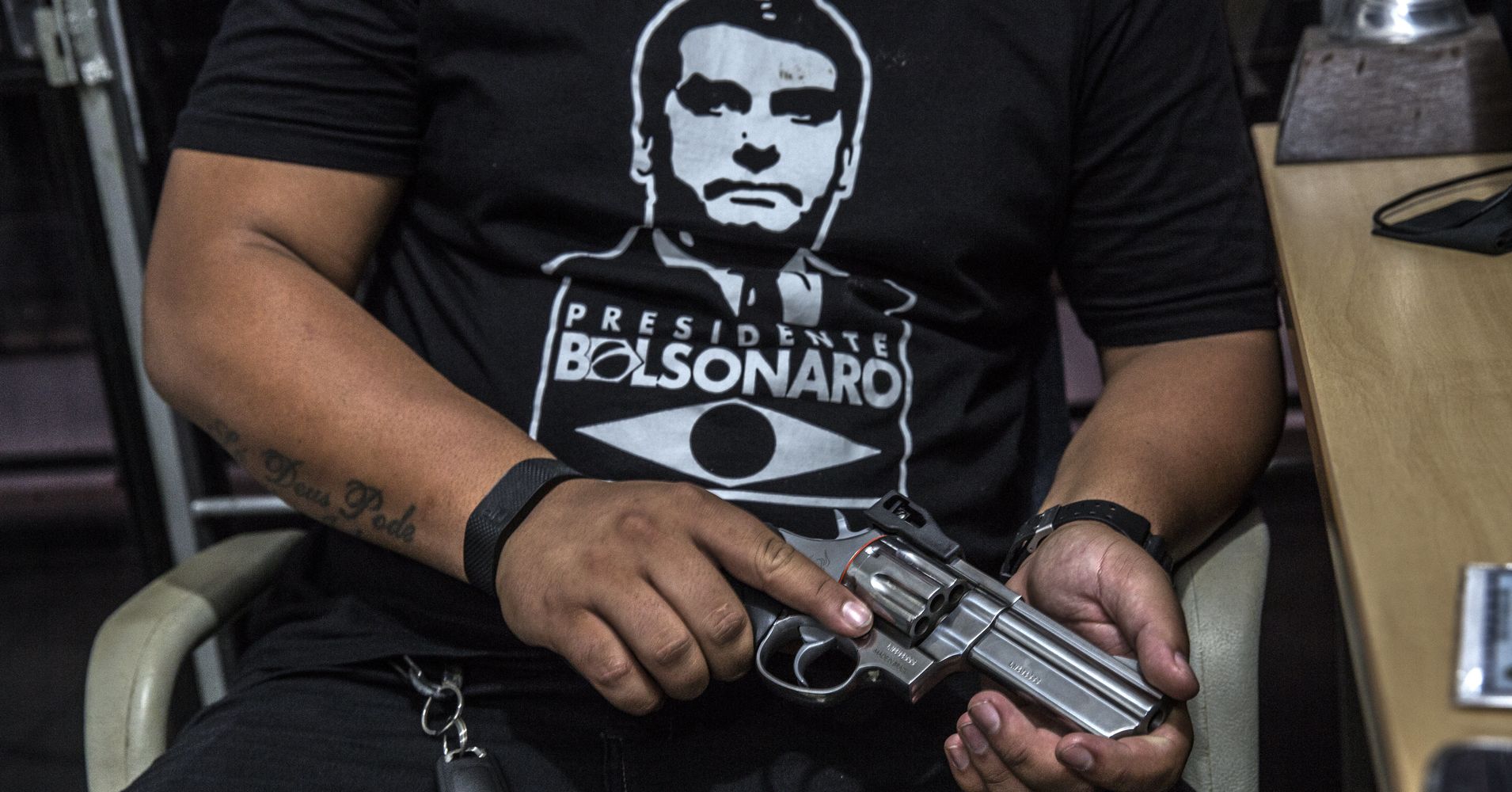
The Institute takes a stand against the weapons decrees published by President Jair Bolsonaro (PSL).

“In addition to having questionable value in terms of effectiveness, buying a firearm and passing all tests is expensive; the cost of a second-hand gun ranges from R$5,000 (US$1.250) to R$6,000 (US$1.500).”
So, when we consider the Brazilian scenario of an economy in recession, with millions of unemployed, the suburbs know that this option [the right to possess and to carry weapons] is not open to them because of the income issue, and we can also argue that this population is the one most exposed to lethal violence,” Langeani says.
The lawyer argues: “Even if there is a reduction in homicides in the state, we see that the suburban and poorer neighborhoods are the most vulnerable to crimes against life, and because they experience this daily, they know that a gun doesn’t provide protection. On the contrary, it brings with it greater risks of ending up in a tragedy.”
Although São Paulo served as an electoral platform for president Jair Bolsonaro, elected with pledges to ease the right to carry and possess firearms, Langeani believes that his election does not represent full adherence to Bolsonaro’s agenda by the majority of the population.
“The president himself gets quite confused about this, because having been democratically elected and having used the issue of weapons as a strong plank in his campaign platform, does not mean that everyone who chose this president concurs with his entire agenda,” says Langeani, who also points out that research like the one released today allows for dialogue with the government.
Ibope and Rede Nossa São Paulo interviewed 800 people in São Paulo from April 3rd to 23rd. The margin of error is three percentage points up or down.
More: Brazil news in English, every day from The Rio Times.
This article was drafted with automated assistance and reviewed before publication. How we use AI · Report an error · Editorial responsibility: Matthias Camenzind, Editor-in-Chief
Living in or visiting São Paulo? See this month's events and our São Paulo city guide with rents, safety and upcoming concerts.