Rio de Janeiro’s group hug marking “World Oceans Day”
Ocean’s Day was first declared as occurring on June 8th during the Global Forum in Rio de Janeiro in 1992, an event that was part of the United Nations Conference on Environment and Development (UNCED).
In 2008 the UN General Assembly officially designated June 8th “World Oceans Day.”
The need for this official UN recognition was reflected in the growing range of issues the idea encompassed.
It includes the implementation of the UN Convention on the Law of the Sea, maritime space, international shipping, maritime security, marine science and technology, marine biological diversity, the marine environment, sustainable development, climate change and regional and international cooperation.

It was widely believed that the awareness and action spurred by the observation of World Oceans Day would be crucial in all these areas.
However, it is fair to say that since that initial declaration, Rio de Janeiro has done virtually nothing to address the environmental calamity unfolding in the city’s environs.
Perhaps the most egregious shortcoming is the continuing failure to address the city’s alarming levels of water pollution.
Approximately 16 million people live in the Guanabara Bay drainage basin, but over half of the homes in the region remain unconnected to sewage treatment plants.
The waste they generate flows untreated into the bay. Urban runoff and industrial wastewater are also major causes of oceanic pollution.
Every day an estimated 150 metric tons of industrial wastewater – including that from pharmaceutical refineries and oil and gas terminals – flow into the waters of Guanabara Bay.
Consequently, beaches inside the bay, from Botafogo to Niteroi, are so polluted that they are no longer swimmable.
At the same time, marine wildlife has been catastrophically affected. Thousands of fish species, dolphins, and whales once frequented Guanabara Bay. Sadly, this is no longer true.
But this year, World Oceans Day was the occasion for several very different projects attempting to raise awareness regarding the problem of Rio’s polluted beaches and oceans and to launch constructive action to initiate change.
The first (covered earlier in the Rio Times) is the ‘Orla sem lixo’ (Trash-free Shore) pilot project, which aims, by installing a 200-meter containment barrier off selected beaches, to develop a sustainable and replicable response to plastic pollution.
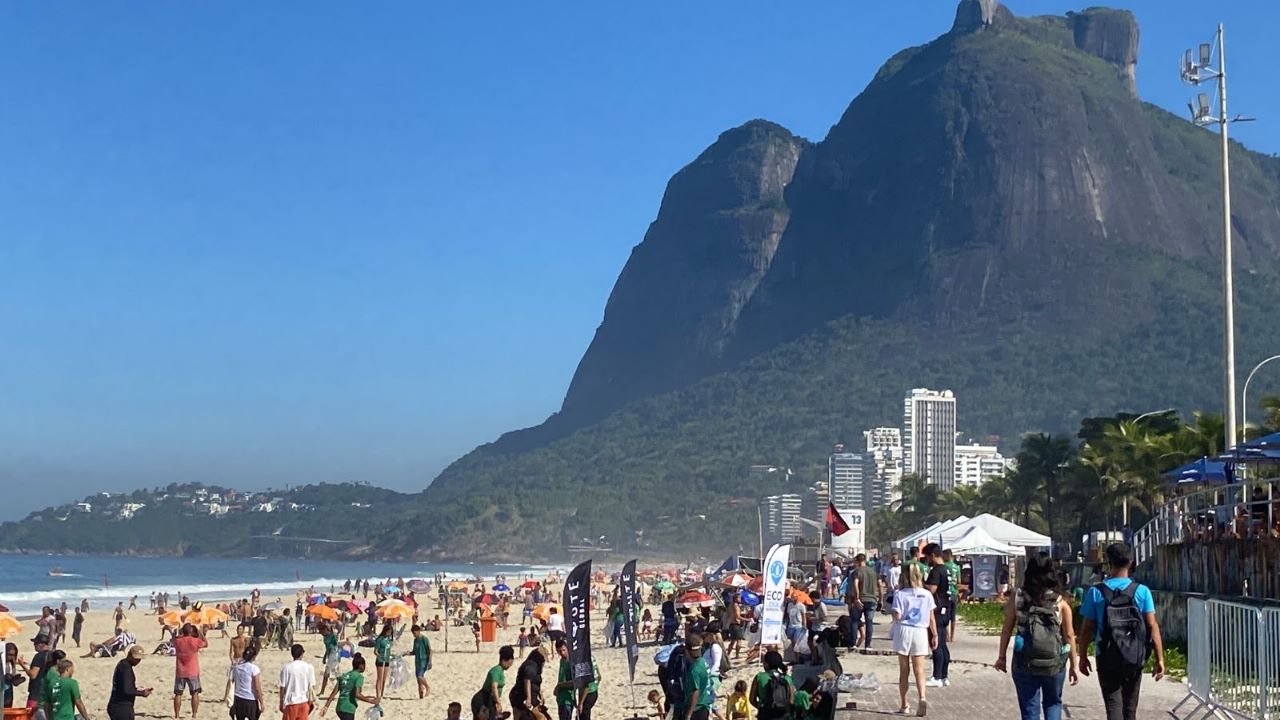
The second, essentially a kind of environmental flash mob, took place on São Conrado beach, very close to where the concept of Oceans Day was born. But it wasn’t just this historical proximity that made the location symbolic.
San Conrado represents a powerfully poignant microcosm of the city’s inequality and environmental unsustainability.
Bordering the waterfront are clusters of high-rise condos and gated complexes housing some of the city’s most wealthy, yet just meters away, climbing the surrounding hillside is Rocinha, Rio’s largest favela, a sprawling, largely self-built, low-income neighborhood that still lacks basic sanitation services.
As a result of this juxtaposition, São Conrado, arguably the city’s most beautiful and exclusive ocean beach, is – due to untreated sewage runoff – now one of its most polluted.
It was on this fraught stretch of sand, on this Oceans Day, that hundreds gathered to “embrace the ocean” a gesture designed to draw attention to the consequences of Rio’s neglect of its marine ecosystem.
Holding hands and forming a two-kilometer human chain, hundreds of activists and volunteers staged a symbolic group hug with the sea to mark the day.
But the mobilization was not an empty gesture; participants also gathered tons of rubbish from the beach’s sand. The vast majority was plastic waste.
Organizers were also keen to point out that the event was not only focused on the dire situation of just one beach in Rio.
Marcelo Farias, the founder of ‘Salvemos São Conrado’ (Save São Conrado), argued that, despite the localized nature of his movement, Oceans Day was chosen as a date to not just highlight the plight of one troubled urban beach but as a broader call to action, designed to encourage people everywhere to recognize the need to rescue oceans and preserve marine life across the planet.
Likewise, Bernardo Egas, former Secretary of the Environment for the Municipality of Rio de Janeiro and a committed environmentalist, also stressed the global context of the gesture.
Recalling the origins of Oceans Day, he said: “It was very important for Rio de Janeiro to keep driving the agenda, to lift this agenda in the world.”
“This kind of mobilization is important to raise the consciousness of people in Rio de Janeiro. We have the most beautiful landscape in the world and so we have to take care of it.”
The focal point of the mobilization, the somewhat performative Oceans Day hug, was over in a matter of minutes, but the image of so many people – organizers estimated close to 2000 – lined along the São Conrado waterline holding hands while staring out into the polluted surf – was a striking one.
Whether it will be enough to galvanize action and change minds and behaviors here and elsewhere is less clear.
Editorial responsibility: Matthias Camenzind, Editor-in-Chief · Editorial standards · Report an error
Living in or visiting Rio de Janeiro? See this month's events and our Rio de Janeiro city guide with rents, safety and upcoming concerts.