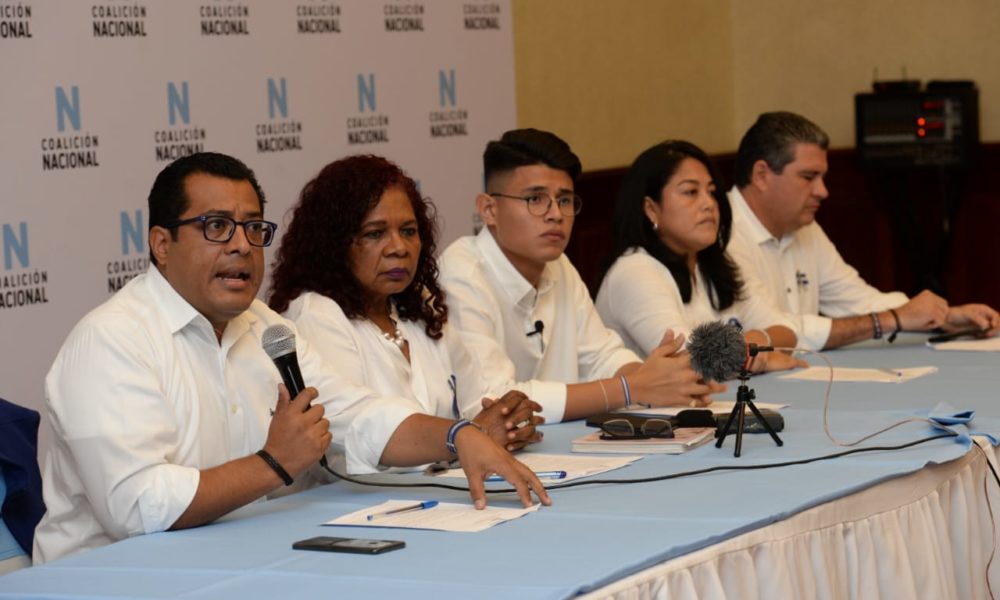
RIO DE JANEIRO, BRAZIL – Seven Nicaraguan organizations founded the “National Coalition” (Coalición Nacional) on Tuesday. This alliance is ruled by forces of the traditional right-wing and the oligarchy.

It is the “Liberal Constitutional Party” of politician Arnoldo Alemán, who is suspected of corruption and whose pact with Daniel Ortega helped him win the elections in 2007.
The “Broad Democratic Front” of politician Violeta Granera, a union of the “Movement for Nicaragua“, the “Independent Liberal Party” and the middle-class split of historical Sandinism, the MRS (Sandinista Renovation Movement).
The “Civic Alliance”, on the other hand, is represented by personalities such as the entrepreneur and member of the traditional oligarchy, Juan Sebastian Chamorro.
Another leading personality is Azahálea Solís of the “Autonomous Women’s Movement”. Since 2007, this movement has been supported, first politically and later financially, by the USA, so that – from the perspective of the US Embassy – socialist political projects such as those in Venezuela or Bolivia could not gain a foothold in Nicaragua.
In the media, the most visible representatives of the “Blue and White National Unity”, which is also part of the coalition, are the above-mentioned politician Granera and Felix Maradiaga. From 1997 to 2006, he was a senior staff member in the Ministry of Defense in the Enrique Bolaño government.
Maradiaga is considered to have excellent connections in the world of entrepreneurship and with the political elite of the USA. He has worked for the Coen Group, which is close to the Coen family of oligarchs.
In addition, he has worked as a consultant for organizations in the fields of politics and economics, including the US political foundation National Democratic Institute.
Part of the UNAB is the “networking of social movements”. It consists of over 60 groups and organizations, including their networks. Within this movement, a partly leftist discourse combined with liberal values can be perceived.
In view of its positive stance on the ouster of Morales in Bolivia, as well as its close cooperation with the political right-wing and the oligarchy, it is unclear to what extent this association truly feels committed to left-wing or democratic politics.
Other members of the National Coalition include parties such as the Democratic Restoration Party (PRD), the Yatama indigenous party, and the Medardo Mairena farmers’ movement.
It does not include the prominent leader of the anti-canal movement, Francisca Ramirez, and the Citizens for Freedom party, which was victorious in several districts in recent local elections.
According to Wilfredo Miranda Aburto of the Confidential opposition media, the common concerns of the National Coalition are “the restoration of political freedoms, the release of political prisoners and electoral reforms leading to free and transparent elections”. However, in parallel, the Coalition has historically been in line with Violeta Barrios de Chamorro.
Chamorro defeated the FSLN in the 1990 elections with a united opposition. The reason was a population worn down by the Contra rebel groups and sanctions, who wanted peace at all costs.
Chamorro’s policy was characterized by harsh neoliberal reforms, mass layoffs in the public sector and the decline of the health and education systems. After three years in office, 70 percent of Nicaraguans found themselves in extreme poverty and 60 percent of the active population was unemployed.
Whether such a political spectrum could succeed in winning the presidential elections in November 2021 is questionable. According to polls by M&R Consulting (September 2019), Daniel Ortega would achieve a share of votes between 37.5 percent (secure votes) and 52.5 percent, the opposition parties between only between 3.1 and 11.2 percent.
The opposition is trying to offset the lack of approval at home by support abroad. A strategy in this respect is to incite the population against the government by imposing sanctions. An example of this is the US sanctions imposed in December against the oil company Petronic, whose task was to ensure affordable fuel prices for transport.
The right-wing opposition also recently called on members of the European Parliament to increase the pressure of sanctions on Nicaragua.
However, a resolution proposed by Bündnis 90/Die Grünen in November 2019 to temporarily exclude Nicaragua from the association agreement with the European Union did not achieve a majority.
Sanctions, which are often justified in this country by reference to the human rights situation and democratic deficits, are met with sharp rejection outside the right-wing opposition spectrum in Nicaragua. Trade unions, representatives of small business or the municipal movements reject foreign sanctions as an infringement of the country’s sovereignty.
In a press release in this respect, six major social organizations in Nicaragua criticize an opposition “which is prepared to destroy the national economy in order to achieve political goals without taking into account the impact on the population”.
Instead of trying to gain legitimacy through the actions of other countries, it should instead limit its struggle to the political level, as is customary “in civilized countries”.
More: Latin America news in English, every day from The Rio Times.
This article was produced by The Rio Times’ automated newsroom system. How we use AI · Report an error · Editorial responsibility: Matthias Camenzind, Editor-in-Chief