Hormuz Shock Sends Crude Surging; Petrobras, YPF Rally
Key Facts
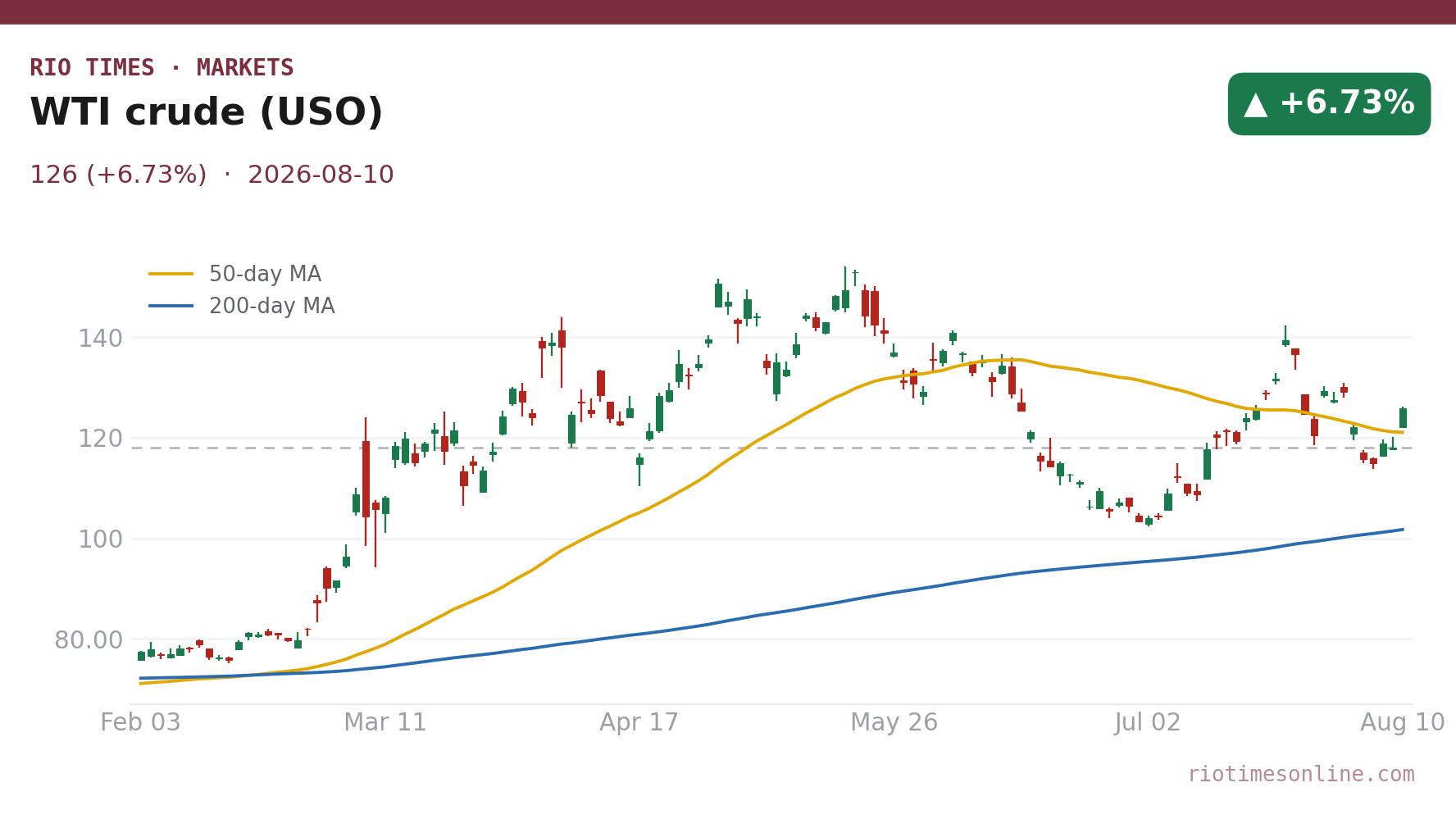
- USO settled at US$125.92, a single-session surge of 6.73%, as the shipping meltdown at the Strait of Hormuz showed no sign of easing and a US-Iran diplomatic opening collapsed.
- Shipping transits through the Strait of Hormuz remained severely disrupted on Monday morning, even as Iran and Oman reportedly edged closer to a side deal, leaving a physical barrel shortage firmly priced in.
- Bank of America warned oil could climb into winter without a Hormuz reopening, flagging severe shortages already visible in diesel, gasoline and global natural gas markets.
- Argentina’s YPF jumped 3.62% to US$50.94, riding the global price spike as Vaca Muerta’s light crude becomes an ever more prized Atlantic Basin substitute for lost Middle Eastern barrels.
- Petrobras gained 2.06% to US$18.33 and Ecopetrol added 1.61% to US$17.05, with Colombia simultaneously reviving oil and gas blocks after a four-year renewables-only push.
- Iraq raced to reopen its northern pipeline through Turkey as an alternative to the blockaded Strait, an existential shift for Baghdad as over 90% of its budget depends on oil exports historically shipped through Hormuz.
Today’s Focus
The oil-tracking fund USO ripped 6.73% higher on Monday, settling at US$125.92 after hopes for a swift US-Iran peace deal over the Strait of Hormuz disintegrated. Iran released six conditions that President Trump immediately rejected, extinguishing any near-term prospect of reopening the world’s most critical oil chokepoint.
Bloomberg data showed Hormuz shipping transits remained largely paralysed through Monday morning, and Bank of America’s commodities desk explicitly warned prices could keep climbing into winter. BofA flagged severe, already-visible shortages in diesel, gasoline and natural gas, noting the market would need roughly ten times more available tankers to stabilise flows.
For the big Latin American producers, Monday’s price action was a blistering tailwind after a volatile year. Petrobras settled at US$18.33, YPF at US$50.94 and Ecopetrol at US$17.05, all drawing aggressive buying from international investors who now view South American crude as an urgent Atlantic Basin substitute.
What matters today. The Strait of Hormuz logistics breakdown has flipped Latin America’s oil patch from a political headache into an indispensable short-term supply fix for global refiners.
01 The session in one read
Monday delivered one of the sharpest crude repricings of the year after a weekend of collapsed diplomacy left the Strait of Hormuz effectively shut. The US-traded WTI tracking fund USO surged 6.73% to settle at US$125.92, as six Iranian conditions for a thaw were made public and immediately dismissed by President Trump, killing the peace premium that had briefly capped prices.
For those who watch Latin America closely, the move was a signal: every barrel the region can pump is now extraordinarily valuable, and shares of Petrobras, YPF and Ecopetrol all surged on foreign inflows chasing Atlantic Basin supply away from the paralysed Persian Gulf chokepoint.
Monday’s 6.73% spike in USO was not speculative froth; it was the direct repricing of physical barrels that are unable to transit a still-paralysed Hormuz after Iranian conditions for peace were thrown out in Washington. Bank of America’s explicit warning that diesel and gasoline shortages are already here removes any doubt that this rally reflects a consumption-side scramble, not mere headline-chasing. The variable to watch is any confirmed restart of Iraqi Kirkuk-Ceyhan flows through Turkey, which would mark the first meaningful alternative export route opening since the crisis began.
02 The board
USO printed US$125.92, up 6.73% and embedding a stark physical scarcity premium, while the Brent-tracking BNO fund jumped a matching 6.78% — a synchronized surge across both crude benchmarks. YPF closed at US$50.94, leaping 3.62% in a single session as Vaca Muerta’s growth story caught fire with global allocators. Petrobras settled at US$18.33, adding 2.06%, while Colombia’s Ecopetrol edged up 1.61% to US$17.05, a notable show of strength as Bogotá signals a return to oil and gas licensing after a four-year pause.
| Asset | Level | Change |
|---|---|---|
| Oil tracker (USO) | US$125.92 | +6.73% |
| Petrobras | US$18.33 | +2.06% |
| Ecopetrol | US$17.05 | +1.61% |
| YPF | US$50.94 | +3.62% |
Source: RT close, 2026-08-10. Where a commodity has no spot feed, an exchange-traded tracker or leading producer is shown as a labelled proxy.
Live Market IntelligenceThe live market board
Rio Times · Live Market Intelligence
Latin America — Cross-Market Board
| Instrument | Last | Change | YoY | Prev. | High | Low | Volume |
|---|---|---|---|---|---|---|---|
| IBOV | 183,476.86 | -0.27% | +21.85% | 183,965.91 | 168,310 | 167,142 | — |
| IPSA | 11,255.90 | -0.39% | — | 11,299.82 | 11,210 | 10,984 | 1,513,213,483 |
| IPC MEX | 64,992.23 | +1.13% | +12.17% | 64,264.16 | 66,121 | 65,405 | 108,886,187 |
| MERVAL | 2,893,751 | -1.57% | +30.51% | 3,022,485 | 3,042,365 | 2,991,150 | — |
| COLCAP | 2,584.72 | -0.95% | — | 9.04 | 9.05 | 9.02 | 4,133 |
| BVL PERÚ | 59,934.37 | +1.27% | — | — | — | — | — |
| USD/BRL | 5.16 | +0.01% | -5.13% | 5.16 | 5.18 | 5.14 | — |
| EUR/BRL | 5.95 | +1.01% | -5.83% | 5.89 | 5.98 | 5.94 | — |
| USD/MXN | 17.06 | -0.24% | -8.58% | 17.10 | 17.08 | 17.01 | — |
| USD/CLP | 913.98 | +0.04% | -5.67% | 913.65 | 915.11 | 906.68 | — |
| USD/COP | 3,140 | +0.03% | -22.04% | 3,139 | 3,141 | 3,105 | — |
| USD/PEN | 3.36 | -0.66% | -4.82% | 3.38 | 3.38 | 3.35 | — |
| USD/ARS | 1,493 | +0.10% | +12.96% | 1,491 | 1,494 | 1,480 | — |
| USD/UYU | 40.27 | +1.24% | +1.80% | 39.77 | 40.27 | 40.23 | — |
| USD/PYG | 5,939 | +1.68% | -19.54% | 5,841 | 5,939 | 5,925 | — |
| USD/BOB | 11.64 | -0.76% | +72.04% | 11.73 | 11.72 | 11.64 | — |
| USD/DOP | 58.34 | +1.25% | -3.44% | 57.62 | 58.34 | 58.04 | — |
| USD/CRC | 445.92 | +0.89% | -9.71% | 441.97 | 448.50 | 445.92 | — |
03 What moved it
The proximate trigger was the collapse of US-Iran diplomacy: Iran tabled six conditions that the White House called a non-starter, and any thought of an imminent ceasefire window vanished. Bloomberg shipping data showed Hormuz transits still heavily disrupted on Monday morning, confirming the physical bottleneck was not easing despite backchannel Oman-Iran talks.
Bank of America deepened the bull case by issuing a winter warning: without a Hormuz fix, refined product shortages in diesel and gasoline are already materialising, and the tanker fleet would need to grow tenfold to normalise flows. Iraq, meanwhile, scrambled to reopen its Turkey-bound Kirkuk-Ceyhan pipeline to find an escape route for over 90% of budget-dependent crude exports, adding a frantic logistical backdrop.
04 The Latin American read
Brazil’s pre-salt and Petrobras loaded at US$18.33 are being re-rated as a deepwater hedge against Middle Eastern disruption, with the government unlikely to interfere in pricing while the global emergency persists. Guyana’s Exxon-led Stabroek ramp-up is a silent giant in the background, pushing ever more light sweet crude into the Atlantic market just as Hormuz-bound cargoes vanish.
Argentina’s YPF hit US$50.94, and Vaca Muerta’s pipeline takeaway constraints are suddenly being viewed differently: any molecule that can reach a tanker at Bahía Blanca commands a staggering premium. In Colombia, the new de la Espriella administration’s return to auctioning oil and gas blocks after four years of renewables-only policy signals that ideology is bending to price reality, giving Ecopetrol’s US$17.05 close a political backstop no one priced six months ago.
Mexico’s Pemex remains the sad outlier: heavily indebted, losing refinery runs and unable to boost output fast enough to make full use of this price windfall, though every additional exported barrel still generates desperately needed hard currency for the Treasury.
05 The names to watch
Petrobras at US$18.33 is the liquidity favourite: foreign fund managers who cannot buy local Brazilian shares are bidding the New York-traded common stock aggressively as the safest deepwater mega-producer with spare export capacity. YPF at US$50.94 is the leveraged play: a 3.62% daily move shows how tightly the Argentine name is linked to any incremental oil price news, and the Vaca Muerta pipeline build is a 2027 catalyst that is now being pulled forward in analysts’ models.
Ecopetrol at US$17.05 offers a reopening optionality that barely existed before Monday, as Bogotá’s new drilling permits and gas-block auctions restore an exploration runway few international investors had in their spreadsheets.
06 The outlook
The crude strip is now pricing a prolonged Hormuz closure, and Bank of America’s explicitly flagged diesel and gasoline shortages move the debate from ‘if’ to ‘how high.’ Iraq’s Turkey pipeline gambit and any Iran-Oman naval de-escalation are the only two short-term pressure relief valves visible. Until one of them opens, every Latin American producer with a functioning export terminal is a direct beneficiary, and USO near US$126 is a number that attracts momentum as much as it frightens policymakers in Brasília, Buenos Aires and Bogotá.
07 What to watch
- Iraq-Turkey pipeline restart: Baghdad is desperate to reopen Kirkuk-Ceyhan now; any confirmed flow would be the first meaningful non-Hormuz outlet and could cap the USO rally.
- Bank of America winter scenario: BofA explicitly tied further price gains to heating-season diesel and gasoline shortages, making refinery-run data the best leading indicator of the next leg.
- YPF and Vaca Muerta takeaway news: At US$50.94, YPF is pricing the old-pipe bottleneck; any permitting or financing breakthrough on the Vaca Muerta Sur pipeline would add a structural growth layer.
- Colombia licensing rounds: Ecopetrol at US$17.05 now has a re-rating catalyst from de la Espriella’s oil-and-gas pivot; the scale and timing of new block awards will tell if this can stick.
Background: Braskem Bond Tender Rejected Amid $9.4B Debt Crisis.
Frequently Asked Questions
Why did oil jump so sharply on Monday?
A potential US-Iran peace deal over the Strait of Hormuz collapsed after Iran issued six conditions and President Trump rejected them outright, while shipping data confirmed Hormuz transits remained severely disrupted.
What drove Petrobras shares to US$18.33?
Petrobras gained 2.06% as global funds hunted for deepwater Atlantic producers that can substitute for missing Middle Eastern crude, and Brazil’s pre-salt exports face no logistical chokepoint.
Why is Argentina’s YPF suddenly up 3.62% in a single session?
YPF closed at US$50.94 because Vaca Muerta’s light oil is the most direct Atlantic Basin replacement for Persian Gulf barrels, and the price spike supercharged the economics of every incremental Neuquén well.
Is Colombia really restarting oil drilling?
Yes. Colombia’s new de la Espriella government has pledged to reopen oil and gas blocks after Petro’s four-year renewables-only policy, a reversal that gave Ecopetrol’s 1.61% gain to US$17.05 an extra political endorsement.
This article was produced by The Rio Times’ automated newsroom system. How we use AI · Report an error
LatAm Markets: Live Signals → — real-time movers, turnover leaders and FX across Latin America.
Read More from The Rio Times