Mexico’s Michoacan state plunged into deep crisis by narcos
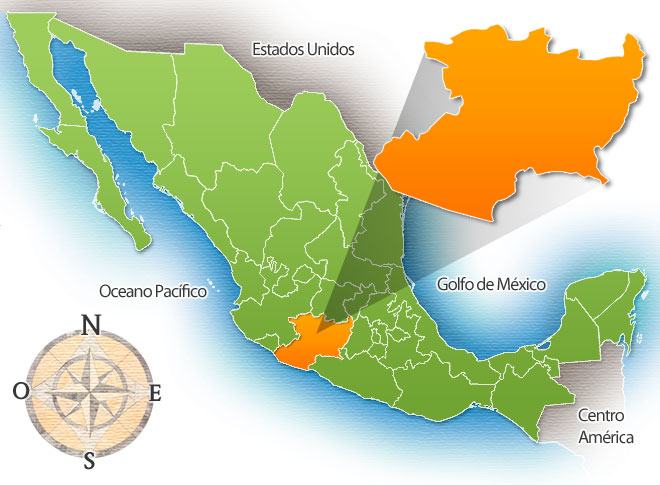
RIO DE JANEIRO, BRAZIL – Clashes between at least nine drug cartels have plunged the Mexican state of Michoacán into a serious crisis of violence due to the dispute over the production and trafficking of drugs such as marijuana and methamphetamine, as well as natural resources and minerals.
With just 4.8 million inhabitants, Michoacán is the sixth state in the country with the highest number of intentional homicides due to the unrelenting struggle between cartels, making it one of the epicenters of violence in Mexico.

A total of 34,554 intentional homicides were recorded in Mexico in 2020, a figure virtually identical to the record 34,681 crimes committed in 2019.
In the western state of Michoacán, 2,433 intentional homicides were reported, the sixth most violent state in the country after Guanajuato, Baja California, Mexico State, Chihuahua, and Jalisco.
The violence unleashed in Michoacan has worsened in recent years with the emergence of six cartels from the defunct self-defense groups that, after undermining the Knights Templar, also allowed the entry of the Jalisco Cartel – New Generation (CJNG), according to data from the Michoacan government’s intelligence services.
The CJNG is headed by Michoacan native Nemesio Oseguera Cervantes “El Mencho,” the most wanted drug trafficker in the United States and Mexico.
MICHOACAN, CRADLE OF DRUG TRAFFICKING
The Attorney General’s Office (FGR) has identified nine drug cartels currently operating in the various regions of Michoacan, including in its border areas with the states of Colima, Guerrero, Jalisco, Guanajuato, Queretaro, and the State of Mexico.
The drug gangs are the CJNG, La Nueva Familia Michoacana, La (former) Familia Michoacana, Los Caballeros Templarios, Tepalcatepec Cartel, Los Reyes Cartel, Los Correa Cartel, Zicuirán Cartel and El Camaleón Cartel.
The New Michoacan Family – mostly of ex-self-defense groups and ex-templars – is supported by two armed groups that call themselves Los Viagras and Blancos de Troya.
Lorena Cortés Villaseñor, president of the civil association “Comunidad Segura”, pointed out on Wednesday that Michoacán has abandoned crime prevention and the recovery of the social fabric, which has allowed young people to fall into the world of alcoholism and drugs, as a preamble to joining criminal organizations.
For Lorena Cortés Villaseñor, Michoacán faces a serious humanitarian crisis derived from a wave of violence that grew due to the historical neglect of the federal and state governments.
The specialist in public security and crime prevention explained to Efe that it is incomprehensible that Michoacán lives in a permanent governmental crisis.
“This armed conflict, crime, and violence crisis have to do with the historical oblivion to the factors of protection to the population, mainly to young people,” she added.
“And it has to do with the lack of access to health, education, sports, and culture. It has been a historical lag that has turned Michoacán into fertile ground for crime; it is a breeding ground for the culture of illegality,” he said.
Cortés Villaseñor, who worked in the crime prevention areas of the former Michoacán Attorney General’s Office (now Attorney General’s Office) and the State Public Security Secretariat, warned that more and more young people are joining the ranks of organized crime due to alcohol abuse, drug use, unwanted pregnancies and dropping out of school.
“As long as the Mexican State and the Government of Michoacán do not address these risk factors, we will continue to live this ‘long Michoacán night’ of violence, and this humanitarian crisis that has left thousands and thousands of displaced people, registering ‘ghost communities’ as they are left without inhabitants,” he said.
Miguel Estrada, the chronicler of Apatzingán, who has investigated the origins of the drug trafficking phenomenon in Michoacán, detailed that the modernization of the Michoacán countryside favored the production of marijuana and later poppy.
“The Balsas River Commission modernized the Michoacan countryside and between 1947 and 1963 opened irrigation systems for the commercial cultivation of cotton, lemon, and melon,” he mentioned.
He added that the operation of the hydraulic infrastructure occupied the construction of a land communication network that, in three periods, counted with the construction of 707 kilometers of highways, works that together facilitated drug production and trafficking.
“In August 1959, the Army records this date as historical in the fight against drug trafficking by seizing in the municipality of Aguililla 300 kilos of marijuana, and at the end of the same year, a person is captured with 8 kilos 200 grams of opium gum. Drug trafficking had just begun,” concluded Estrada.
More: Mexico news in English, every day from The Rio Times.
Editorial responsibility: Matthias Camenzind, Editor-in-Chief · Editorial standards · Report an error