Mexico Markets: IPC & the Peso — August 5, 2026
Key Facts
- The S&P/BMV IPC closed up 0.20% at 66,833 points, clawing back a fraction of recent losses in a session driven by a surge in mining shares.
- The peso strengthened 0.47% to 17.26 per dollar, putting it within striking distance of its 52-week high as falling US yields eased pressure on emerging currencies.
- Grupo México was the day’s standout, jumping 3.2%, thanks to firmer copper prices and robust risk appetite flowing through the metals complex.
- Cemex tumbled 2.5% to rank as the session’s biggest drag, knocked by profit-taking after a recent rally and lingering concerns over its US construction exposure.
- Trading was thin and choppy ahead of Banxico’s rate decision, with investors reluctant to make big bets before the central bank’s imminent verdict.
Today’s Focus
Mexico’s benchmark S&P/BMV IPC — the main gauge of the country’s largest listed companies — inched up 0.20% to 66,833 points on Tuesday, breaking a two-day losing streak. The session belonged to the miners, as Grupo México (GMEXICOB) surged 3.2% and helped offset a sharp 2.5% drop in building-materials giant Cemex.
The peso, meanwhile, was the real star of the region. It firmed 0.47% to 17.26 per US dollar, a level that leaves it around 8.3% below its 52-week high and firmly in the stronger half of its annual range. A dip in US Treasury yields overnight had given emerging-market currencies some room to breathe, and the peso proved one of the chief beneficiaries.
The mood on the floor was cautious rather than euphoric. With Banxico — Mexico’s central bank — due to announce its latest interest-rate decision this week, few traders wanted to be caught offside. The consensus is that Banxico will hold rates at 6.5%, but any hint about the timing of a first cut could jolt markets.
What matters today. A rising IPC disguised a cautious session ahead of Banxico’s rate call, while the peso’s glide towards its one-year high signalled that foreign capital is still comfortable betting on Mexico’s carry trade.

01 The session in one read
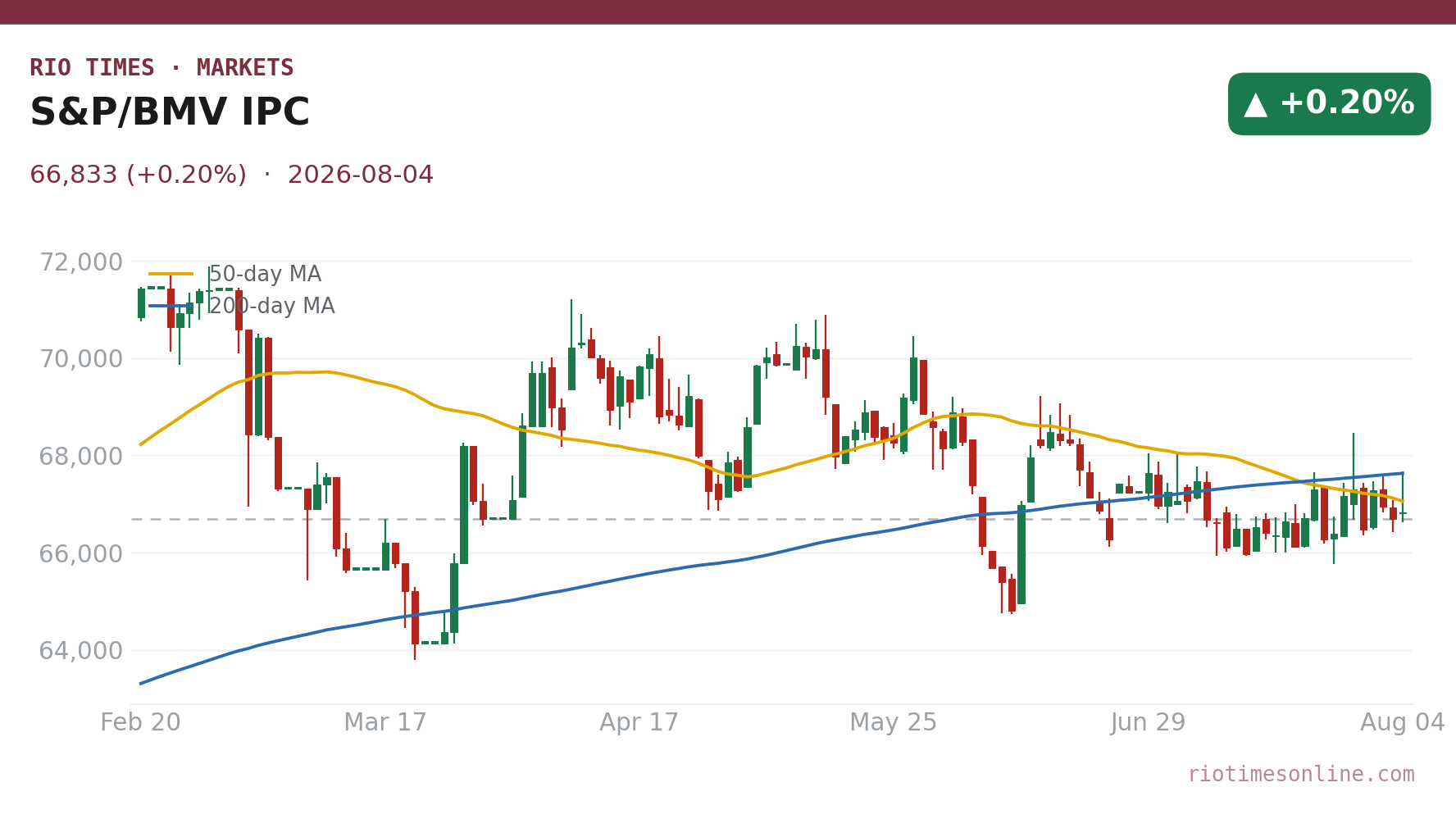
Mexico’s stock market shook off a sluggish morning to close modestly higher on Tuesday, with the S&P/BMV IPC — the country’s benchmark equity index — adding 0.20% to settle at 66,833 points. The advance was never truly in doubt, but it was also never especially convincing, reflecting a market holding its breath ahead of the coming central-bank decision.
The real fireworks were in the currency market. The peso strengthened 0.47% to close at 17.26 per US dollar, flirting with a level not seen since mid-July and extending a quiet rally that has made it one of Latin America’s standout performers this quarter. The move came as US bond yields ticked lower, reducing the relative allure of dollar-denominated assets and giving emerging-market currencies a gentle tailwind.
Sector by sector, the picture was mixed. Mining stocks led the charge, with Grupo México climbing 3.2% on the back of firmer copper prices. Consumer names were steady rather than spectacular, while the airports group — normally a reliable barometer of tourism sentiment — slipped, with ASUR losing 1.2%. The heaviest anchor was Cemex, the cement and building-materials producer, which slumped 2.5% in what traders described as a bout of profit-taking after recent gains driven by infrastructure hopes.
The session’s pattern — miners up, cement and airports down — looks more like a tactical rotation than a broad-based vote of confidence. Grupo México’s jump is clearly tied to the copper price, which makes it a US-cyclical play, while the dip in airports like ASUR and GAP suggests the market is marking down tourism names after a strong run. Volumes were concentrated in a handful of names, with América Móvil, Cemex and Grupo México accounting for the bulk of turnover. The peso’s march towards the 17.13 support line is the variable that could flip the narrative: a break below would unleash a wave of peso bullishness that lifts the whole equity board, but a bounce towards 17.50 would warn that the rally is tired. Watch Banxico’s statement when it lands — specifically, any shift in language on core services inflation.
02 The day’s numbers
| Measure | Level | Change | Read |
|---|---|---|---|
| S&P/BMV IPC | 66,833 | +0.22% | Modest bounce; still 6.7% below 52w high of 71,601 |
| Session high (IPC) | — | — | — |
| Session low (IPC) | — | — | — |
| USD/MXN (peso per dollar) | 17.26 | −0.47% | Peso strengthens; 8.3% below 52w high of 18.83 |
| 52-week high (IPC) | 71,601 | — | Index trades well below its 2026 peak |
| 52-week low (IPC) | 57,072 | — | Index sits comfortably above its year low |
| Key technical level (USD/MXN) | 17.13 | — | 52-week low acts as critical support for the pair |
IPC — Source: RT close, 2026-08-04. Figures rendered directly from the feed.
The IPC finished Tuesday at 66,833 points — a gain of just 0.20% that leaves the index nursing a 6.7% decline from its 52-week high of 71,601. The session range was not available in the verified scan, but the close near the day’s upper bound suggests buyers gained the edge in the final hour. The index remains entrenched in a broad band between roughly 58,100 and 71,600 that has defined the Mexican equity market for much of 2026.
The peso’s closing level of 17.26 puts it squarely in the stronger half of its annual range. The 52-week low for USD/MXN — which corresponds to the peso’s strongest point — stands at 17.13, a level that now acts as a formidable support line. A clean break below that would signal a new leg of peso strength and likely draw in momentum-seeking traders. For now, the currency is consolidating just above that threshold, with Banorte strategists noting late-session hedging flows around the 17.25 area. Rio Times · Live Market Intelligence
Live Market IntelligenceMexico — Live Market Board
Mexico — Live Market Board
Instrument Last Change YoY Prev. High Low Volume
IPC MEX
63,375.93
-0.78%
+12.17%
63,873.32
66,121
65,405
108,886,187
USD/MXN
17.06
-0.24%
-8.58%
17.10
17.08
17.01
—
WALMEX
48.07
-0.62%
-14.38%
48.37
48.65
48.02
10,781,446
GMEXICO
223.28
+0.35%
+73.59%
222.50
226.18
222.17
1,325,556
FEMSA
201.19
-0.24%
+25.67%
201.67
206.71
199.56
750,706
CEMEX
19.32
+0.89%
+19.10%
19.15
19.35
19.04
14,327,054
GFNORTE
193.98
+1.18%
+14.36%
191.71
195.79
191.83
1,579,115
BIMBO
60.98
-0.96%
+11.89%
61.57
61.46
60.29
1,048,115
TELEVISA
9.71
+0.21%
+12.78%
9.69
9.75
9.60
577,851
AMX
19.80
-0.95%
+12.53%
19.99
20.05
19.70
58,058,525
GAP
366.23
+0.43%
-21.21%
364.68
370.85
362.82
226,946
ASUR
275.04
+1.25%
-15.28%
271.64
275.08
271.31
15,451
OMA
233.50
+0.62%
-6.48%
232.06
235.00
230.62
555,693
KOF
188.04
+0.86%
+18.94%
186.44
188.56
185.52
425,273
GRUMA
252.90
+0.11%
-21.85%
252.61
254.74
250.36
90,048
KIMBER
39.74
+0.43%
+8.85%
39.57
40.09
39.33
490,551
AMX ADR
23.38
-0.23%
+22.25%
23.43
23.49
23.06
1,347,445
03 Why it moved — miners lift, Cemex drags, and the peso steals the show
The IPC’s 0.20% rise was a story of two heavyweights pulling in opposite directions. On the plus side, Grupo México — the country’s largest mining conglomerate and a major copper producer — surged 3.2%, its best single-day performance in weeks. The catalyst was a broad rally in industrial metals, with copper prices climbing overnight on optimism that US infrastructure spending would stay robust even as the Federal Reserve keeps rates elevated.
Grupo México was not alone. Grupo Carso (GCARSOA1), the mining and industrial conglomerate, topped the leaderboard with a 3.4% gain, riding the same sector-wide lift. Together, the two heavyweights injected enough momentum to prevent the broader index from slipping into the red.
Yet the gains were heavily offset by Cemex, which tumbled 2.5% in heavy turnover. Traders linked the drop to a convergence of factors: profit-taking after a two-week rally, lingering nervousness about the pace of US construction activity, and a technical breakdown below a short-term moving average that triggered automated selling.
The peso’s 0.47% strengthening was the session’s most consequential macro signal. A decline in the US 10-year Treasury yield — down 1.28% to 4.619% — made dollar assets marginally less attractive, prompting a nudge of capital towards higher-yielding emerging-market currencies. Mexico, with a benchmark rate of 6.5%, remains one of the highest-yielding options in the developing world, and that carry-trade appeal continues to underpin peso demand.
04 The day’s movers
| Driver | Level / Move | Change | Note |
|---|---|---|---|
| Grupo México (GMEXICOB) | Top gainer | +3.2% | Turnover MXN 40m; copper-price tailwind |
| Cemex (CEMEXCPO) | Top loser | −2.5% | Turnover MXN 28m; profit-taking after rally |
| América Móvil (AMXL) | Heaviest traded | −0.4% | Turnover MXN 1,498m; index heavyweight drags |
| Grupo Carso (GCARSOA1) | Biggest domestic gainer | +3.4% | Mining and industrial conglomerate rally |
| Walmex (WALMEX) | Steady consumer name | −0.1% | Turnover MXN 30m; flat ahead of Banxico |
| Femsa (FEMSAUBD) | Consumer bellwether | −0.2% | Turnover MXN 27m; muted session |
| Banorte (GFNORTEO) | Banking proxy | −0.2% | Turnover MXN 38m; rate-decision jitters |
| GAP (GAPB) | Airport operator | +0.9% | Pacífico airports buck sector weakness |
| ASUR (ASURB) | Airport operator | −1.2% | Southeast airports among worst performers |
Turnover was dominated by América Móvil, the telecoms giant controlled by the Slim family, which saw MXN 1,498 million change hands even as the stock slipped a modest 0.4%. The name is so heavily weighted in the IPC — it typically commands around 12-14% of the index — that even a slight dip acts as a brake on the broader market. Cemex was the second-most-traded holding by value, a sign that the 2.5% sell-off reflected genuine institutional repositioning rather than a few large block trades.
The domestic gainers list was topped by Grupo Carso, another Slim-controlled industrial and mining conglomerate, which climbed 3.4%. Coca-Cola FEMSA (KOFUBL), the bottling arm, rose 1.2%, suggesting that consumer staples are finding a bid at these levels. On the losing side, beyond Cemex, the real-estate names stood out: FMTY14 (Fibra MTY) dropped 1.9% and Vesta shed 1.4%, hinting at mild rotation out of property exposure ahead of the rate decision.
05 The regional scoreboard
| Index | Country | Change |
|---|---|---|
| S&P/BMV IPC | Mexico | +0.22% |
| Ibovespa | Brazil | −0.06% |
| IPSA | Chile | −0.48% |
| MERVAL | Argentina | −2.61% |
| COLCAP | Colombia | −0.42% |
Mexico stood nearly alone in positive territory across Latin America on Tuesday. Brazil’s Ibovespa — the main stock index traded on the São Paulo exchange — dipped 0.06% to 177,895, weighed down by profit-taking in commodity-linked names ahead of Brazil’s own central-bank rate decision. Chile’s IPSA was the second-weakest performer among the tracked indices, slipping 0.48% as mining gains were swamped by weakness in retail and utility stocks.
Argentina’s Merval tumbled 2.61%, the worst in the region, as investors continued to reassess the pace of disinflation and the sustainability of the crawling-peg exchange-rate policy. Colombia’s COLCAP shed 0.42%, with the peso there plunging 3.47% to 3,242 per dollar — a move tied to local fiscal jitters rather than any global driver. The live market board above carries the full closes for all five indices, updated as sessions settle.
06 The technical picture
The IPC is stuck in a holding pattern. At 66,833, the index is hovering roughly midway between its 52-week low of 57,072 and its high of 71,601, and has spent much of the past month drifting sideways in a 65,500-to-68,000 channel. The 65,500 level has served as a reliable floor during three pullbacks since June, and a break below it would open the door to a test of the psychological 64,000 zone — a level that chart-watchers identify as the next major support.
On the upside, the 68,000-to-69,000 band remains the hurdle to clear. Each rally towards that zone since May has been met with selling, suggesting that institutional investors are using strength to reduce exposure. The 200-day moving average, a widely followed trend indicator, sits near 67,200, meaning Tuesday’s close leaves the index just below it. A decisive move above 67,200 on above-average volume would be the first technical signal that the range-bound trade is resolving to the upside.
For the peso, the technical set-up is cleaner. USD/MXN is compressing between the 17.13 support — the 52-week low — and the 17.50 resistance line that has capped several bounces since early July. TradingView analysts note a broadening triangle pattern forming on the daily chart, a formation that often precedes a sharp breakout. The direction of that breakout is likely to be determined by the Banxico statement: a hawkish hold that stresses core-inflation risks could push the pair below 17.13 and trigger a stop-loss cascade, while a dovish hint could send it back to 17.50 in a single session.
07 What to watch
- Banxico rate decision (Aug 6): Markets expect a hold at 6.5%, but the tone on core inflation and the forward path is what will swing the peso and rate-sensitive stocks like Banorte and Walmex.
- USD/MXN 17.13 support test: A break below the peso’s 52-week high would draw momentum traders and could spark a rapid move towards 17.00, lifting the entire equity complex.
- Cemex stabilisation: After the 2.5% drop, the stock is sitting on its 50-day moving average. A bounce or breakdown from here will set the tone for the materials sector.
- US initial jobless claims (Aug 6): A labour-market surprise could shift the global rate narrative instantly, reversing the bond-yield move that helped the peso strengthen on Tuesday.
More: Mexico news in English, every day from The Rio Times.
Frequently Asked Questions
What is the S&P/BMV IPC?
It is Mexico’s main stock-market index, tracking the 35-or-so largest and most-traded companies listed on the Mexican Stock Exchange. It is calculated jointly by S&P Dow Jones Indices and the BMV.
Why did the Mexican peso strengthen on August 4?
The peso firmed 0.47% to 17.26 per dollar largely because US Treasury yields fell, making dollar assets slightly less attractive and pushing capital towards higher-yielding emerging-market currencies like Mexico’s, where the central-bank rate is 6.5%.
Why did Cemex fall 2.5%?
Traders pointed to profit-taking after a recent rally in the cement producer’s shares, combined with some nervousness about the outlook for US construction — a key market for the company — and a technical break below a short-term moving average.
Does a rising IPC mean Mexico’s economy is doing well?
Not necessarily. The IPC can move on global factors — like commodity prices or US rate expectations — that are separate from Mexico’s domestic economy. However, over longer periods, it tends to reflect confidence in the country’s corporate profits and policy environment.
This article was produced by The Rio Times’ automated newsroom system. How we use AI · Report an error
In depth
LatAm Markets: Live Signals → — real-time movers, turnover leaders and FX across Latin America.
Read More from The Rio Times