Key Facts
— — President Sheinbaum used the 88th anniversary of Mexico’s oil expropriation to announce a new petroleum advisory commission chaired by Cuauhtémoc Cárdenas, the 91-year-old son of the president who nationalized the industry in 1938
— — Mexico still imports roughly 75% of its natural gas, making domestic production the government’s next strategic priority alongside renewable energy expansion
— — Pemex reported a 13% debt reduction in one year and now refines 1.3 million barrels per day, but production has fallen to its lowest level since 1980
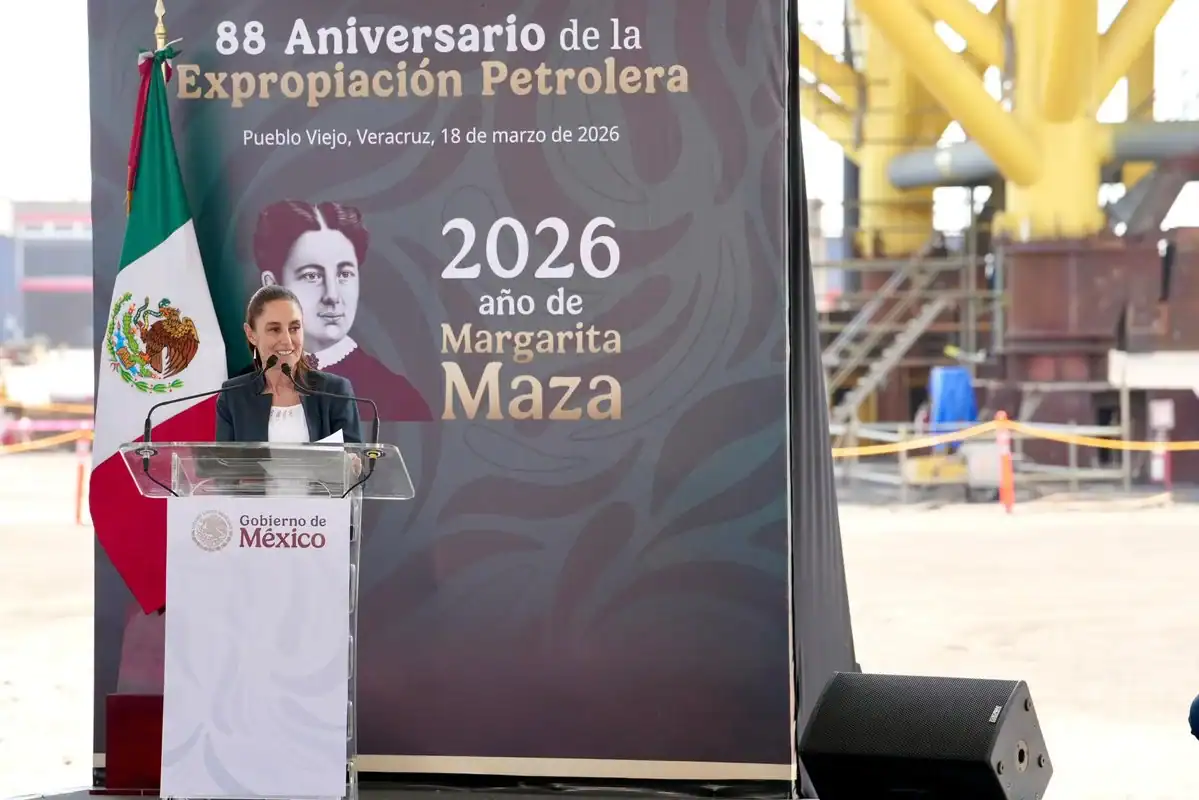
Mexico’s energy strategy took a symbolic and practical turn on March 18 when President Claudia Sheinbaum used the 88th anniversary of the oil expropriation to lay out the country’s next priorities: reducing natural gas imports and expanding renewable sources. The Rio Times, the Latin American financial news outlet, reports that the Mexico energy vision outlined at a Pemex complex in Pueblo Viejo, Veracruz, combined nationalist rhetoric with an acknowledgment that the state oil company’s future depends on diversifying beyond crude.
Sheinbaum announced the creation of a Petroleum Advisory Commission to guide strategic decisions within Pemex, chaired by 91-year-old Cuauhtémoc Cárdenas Solórzano — the son of Lázaro Cárdenas, the president who nationalized Mexico’s oil industry in 1938. Pemex director Víctor Rodríguez Padilla said the commission would analyze national and international trends in hydrocarbons and issue recommendations on the company’s direction.
The Gas Problem at the Heart of Mexico Energy Policy
The headline figure is striking: Mexico imports approximately 75 percent of the natural gas it consumes, almost entirely from the United States. Sheinbaum acknowledged that while her administration has reduced gasoline imports through new and upgraded refineries — including the Olmeca refinery at Dos Bocas and the acquired Deer Park facility in Texas — gas dependency remains the country’s most significant energy vulnerability.
For a government that frames energy independence as a matter of national sovereignty, the reliance on piped gas from Texas creates a structural contradiction. Pemex’s own gas production has declined for years, and the company wasted 8.7 percent of its output through flaring and venting during the previous administration. New CEO Rodríguez has pledged 99.9 percent gas utilization by 2030.
Progress and Contradictions at Pemex
Sheinbaum highlighted several improvements: Pemex reduced its debt by 13 percent in the past year, nearly completed payments to suppliers, and now refines approximately 1.3 million barrels of crude daily into gasoline and diesel. Fertilizer production rose 25 percent in 2025, and the Energy Ministry noted that total Pemex debt has fallen 19 percent from its 2018 peak.
But the production picture tells a different story. Pemex’s output fell to 1.63 million barrels per day in 2025, the lowest since 1980, as legacy fields like Ku-Maloob-Zaap and Cantarell continue their long decline.
The company’s total financial obligations still exceed $100 billion, making it the world’s most indebted energy firm. The government allocated $14.1 billion to Pemex debt service in the 2026 budget.
Sovereignty as Strategy and Constraint
The Cárdenas appointment carries more symbolism than operational power — the commission is advisory, not executive. But in a country where energy policy is inseparable from national identity, the gesture signals that the Sheinbaum administration intends to keep state control at the center of its approach even as it acknowledges the need for gas production, renewable investment, and private partnerships to fill the gaps that Pemex alone cannot close.
Whether the balance between sovereignty and pragmatism holds will depend on how quickly Mexico can develop domestic gas fields, scale solar and wind capacity, and attract investment under rules that keep Pemex in the driver’s seat. The anniversary speech offered a vision, but the numbers — 75 percent gas imports, declining oil output, and a $100 billion debt load — define the scale of the challenge ahead.
This article was produced by The Rio Times’ automated newsroom system. How we use AI · Report an error · Editorial responsibility: Matthias Camenzind, Editor-in-Chief
Read More from The Rio Times