Latin America Defense Monitor — June 2–6, 2026
Saturday, June 6, 2026 · Issue #13
A quick weekend check-in on the military and security stories moving across Latin America and the Caribbean.
The Short Version
This is a short weekend update covering June 2–6, in between our regular weekly issues. Three stories stand out.
What’s new since last issue: Bolivia’s push for more military powers has now cost a cabinet minister his job and produced a second, more detailed bill. The US anti-cartel campaign has also spread from South America into Central America — Guatemala is now named, and Honduras is reportedly next.
At a Glance — This Week’s Moves
Six countries, one card each. Green means a step forward in capability or enforcement; burgundy flags a risk to watch.
Sources: Infodefense, Defense.com, Zona Militar, Zona Defense, The New York Times, Infobae, AFP, EFE, France 24, La Nacion, La Tercera, El Colombiano, Emisoras Unidas, Expansion, and argentina.gob.ar.
What Changed Since Last Issue
Where each thread stood in Issue #12, and where it stands now.
Buying & Building
It was a quiet few days for big purchases, which is normal for a short weekend issue. Brazil cleared paperwork to buy heavy US supply trucks, and Chile’s air force floated a plan to streamline pilot training.
Early June · Brazil
Brazil clears the way to buy heavy US supply trucks
Brazil’s Army has finished the paperwork to buy HEMTT trucks — big eight-wheeled vehicles that haul fuel, parts, and recovery gear for armored units. The trucks, made by Oshkosh and used widely across NATO armies, will support Brazil’s Guarani armored vehicle fleet.
The purchase fills a long-standing gap. Until now, those units lacked the heavy supply backbone needed to keep operating far from base — especially across the Amazon and Pantanal frontiers.
Early June · Chile
Chile’s air force looks to combine its pilot-training programs
Chile’s air force chief, General Arturo Merino, says the service may bring its tactical-flight and light-attack training together at a single base. The goal is to simplify how pilots train before they join the combat fleet.
It would group aircraft like the A-29 Super Tucano and A-36 Toqui under one roof, cutting costs and standardizing the path. The plan fits Chile’s wider modernization, and follows the first time a Chilean tanker refueled US aircraft in mid-air, back in April.
On the Ground & At Sea
Two operations defined the period. Bolivia’s police and military reopened blocked roads to La Paz, and Argentina’s coast guard chased an illegal Chinese fishing boat out of its waters.
June 3–5 · Bolivia
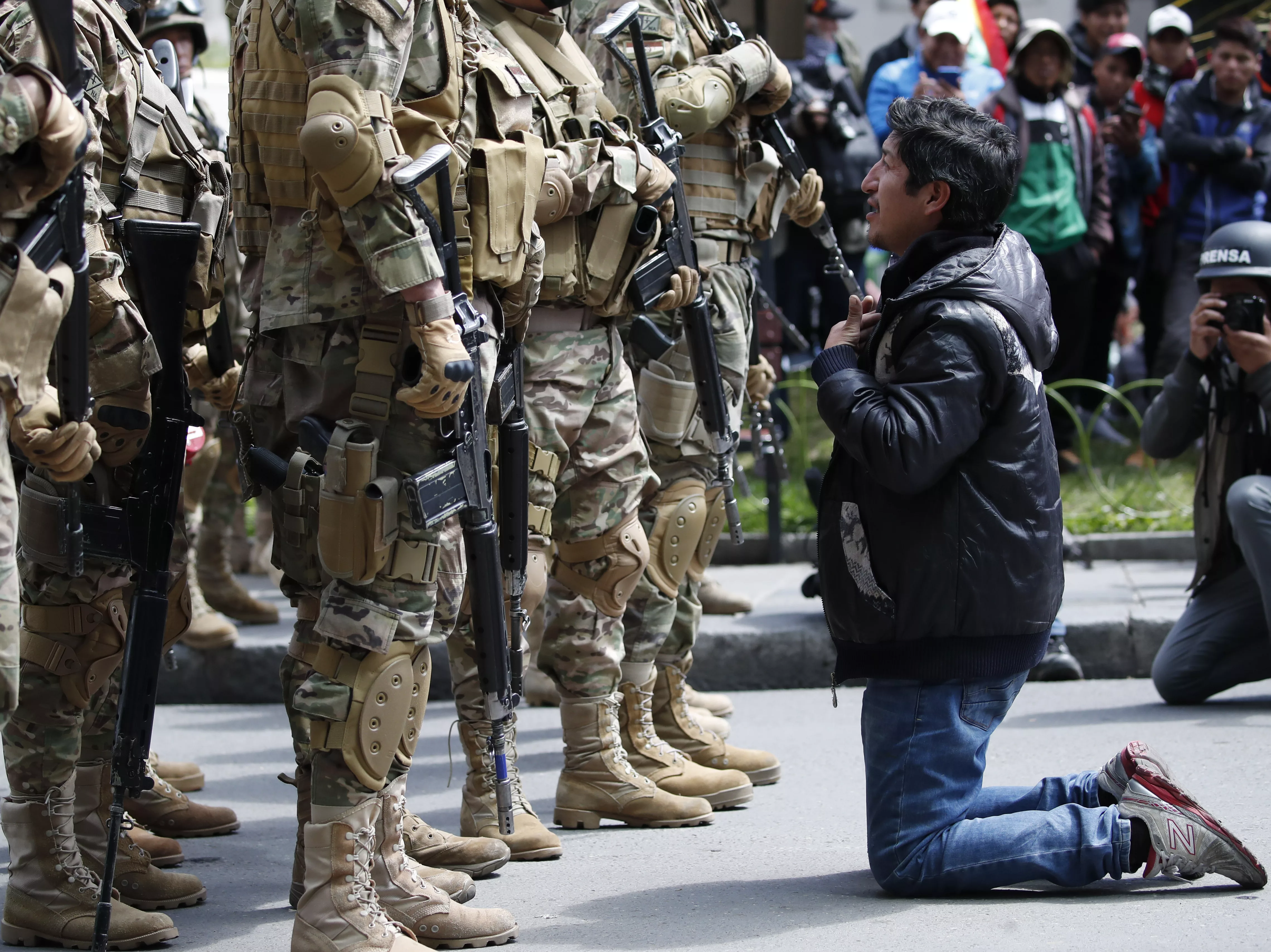
Police and troops reopen a key bridge and the road to La Paz
On June 3, a combined force of 500 police and 500 soldiers reopened the Parotani bridge near Quillacollo. That reconnected Cochabamba to markets in Oruro and La Paz after a damaging blockade.
On June 5, they cleared another route south of La Paz to get food moving again to the capital and nearby El Alto. Both cities had faced more than a month of shortages.
The human cost has been heavy. Government figures say seven people died for lack of timely medical care, and the wider toll is put at ten.
Prices of meat and some vegetables doubled in La Paz markets, and the city organized open-air chicken sales as residents queued from midday. The Beni and Pando regions remain under a declared humanitarian emergency.
Around May 31 · Argentina
Argentina’s coast guard chases an illegal Chinese fishing boat out of its waters
An Argentine coast guard cutter, the Mantilla, pursued a Chinese-flagged boat fishing illegally inside Argentina’s offshore waters off Patagonia’s Golfo San Jorge. The boat had switched off its satellite tracking — a classic sign it should not have been there.
The chase follows tougher new rules that let radar evidence count more heavily when fining offenders. China’s distant squid-fishing fleet is the main pressure on these waters, and the reason Argentina is buying new patrol planes.
Policy & Politics
This is where the biggest moves happened. The US anti-cartel campaign pushed into Central America, Bolivia’s crisis cost its defense minister, and the Cuba pressure campaign drew its first serious critique.
May 28 onward · Guatemala / United States
A reported US–Guatemala deal to strike cartels — and Guatemala City’s denial
The New York Times reported on May 28 that Guatemala had agreed to joint anti-cartel operations with the US on Guatemalan soil, citing three people familiar with the talks. President Bernardo Arevalo reportedly accepted “air strikes and other military actions” on a May 19 call with US War Secretary Pete Hegseth, with operations possibly starting in June.
The report framed it as part of a wider US military push in the region, and as a way to pressure Mexico — described as the real goal. Guatemala pushed back the same day.
The government denied approving any foreign military operations on its territory. But it confirmed asking the US to “cooperate in operations led by Guatemalan security forces” against drug traffickers, and that Arevalo and Hegseth spoke on May 19.
The Pentagon would not confirm any future operations, but noted Guatemala belongs to Trump’s 18-country “Shield of the Americas” security group. At a June cabinet meeting, Hegseth said the US is “going to war against the cartels.”
If the operations go ahead, Guatemala would be the second country in the region — after Ecuador — to allow joint US military action against criminal groups inside its borders.
June 2–3 · Bolivia
Bolivia’s defense minister resigns; Paz sends a new military-powers bill
Defense Minister Mauricio Salinas resigned on June 2, under heavy pressure over the protest crisis that has gripped Bolivia since May 1. President Rodrigo Paz swore in Ernesto Justiniano as the new minister on June 3.
The same day, Paz sent Congress a new bill to set rules for declaring a state of exception and to “strengthen” the armed forces against the blockades. It is separate from last issue’s law: that one lifted the cap on using the military, while this one lays out how a state of exception would actually work.
Paz said the bill is written “under the logic of humanitarian action” to avoid “arbitrary interpretations,” and he has not ruled out declaring a state of exception soon. He still framed the government as open to talks: “We do not raise our hand to strike, but rather extend it for dialogue.”
June 2 · Cuba
US pressure on Cuba deepens — but the “what next” question hangs
A June 2 France 24 analysis put its finger on the weak spot in the US pressure campaign on Cuba, which the White House calls “accelerationism.” The approach copies the Venezuela playbook — an indictment (of Raul Castro, May 20), an economic squeeze (240+ new sanctions and an oil cutoff), and a Navy deployment (the USS Nimitz in the Caribbean).
But two things make Cuba different. There is no obvious person lined up to lead the country if the government fell, and a 1962 US law (Helms-Burton) bars the president from normalizing relations by decree — even as a carrot.
Economists at CEPR warn the sanctions are already costing children’s lives, and that more pressure could spark a wave of migration in June and July as blackouts and summer heat peak. Cuba’s President Miguel Diaz-Canel warned that an intervention would cause “a bloodbath.”
No military operation has been announced. The things to watch are clear: the Nimitz’s movements, any Senate vote, more legal action, and any incident at sea.
The Big Powers
Outside powers stayed mostly on the sidelines. The US drove events, China showed up only as the target of Argentina’s coast guard, and Russia and South Korea did nothing reportable in the five-day window.
Pushing into Central America
The US extended its anti-cartel campaign to Guatemala (reported), pressured Honduras, and kept Mexico as the strategic target. It also deepened pressure on Cuba with 240+ sanctions and the USS Nimitz offshore, and threw new support behind Bolivia’s government.
The target, not the player
No port calls, no arms sales, no military meetings. China’s only footprint was its distant fishing fleet — one boat of which Argentina’s coast guard intercepted.
Quiet again
No new arms deals, training agreements, or reported weapons shipments to Venezuela, Cuba, or Nicaragua. Its continued silence while its old ally Cuba is under maximum US pressure is itself the story.
Nothing new
No new contracts or deliveries this period. Its FA-50 pitch in Peru and tank offers in Brazil are still in talks, with no fresh milestone.
What to Watch — June 7–13
Guatemala — do the joint US anti-cartel operations actually start? The Times placed possible action “next month,” and any first strike or signed agreement would make Guatemala the second country after Ecuador to allow it.
Bolivia — how Congress handles the new state-of-exception bill, and whether Paz declares one. The new defense minister’s first moves will show if the government shifts from clearing roads to a tougher crackdown.
Cuba — the risk of a migration surge, and any move by the Nimitz. CEPR flags June–July as the danger window as blackouts and heat build, so any ship movement or sea incident is the key warning sign.
Honduras and Mexico — how they respond to US pressure. Whether Honduras follows Guatemala’s path, and whether Mexico’s Sheinbaum holds her sovereignty line, will shape what comes next.
Chile — Salitre 2026, a big multinational air exercise at Antofagasta. Build-up will be visible in the second week of June, with Chile’s new F-39E jets the thing to watch.
Frequently Asked Questions
Did Guatemala agree to joint US military strikes against cartels?
The New York Times reported on May 28, 2026 that President Bernardo Arevalo accepted “air strikes and other military actions” on a May 19 call with US War Secretary Pete Hegseth, possibly starting in June. Guatemala publicly denied approving any foreign operations on its soil, but said it had asked the US to help with operations its own forces would lead — which would make it the second country after Ecuador to allow such action.
Why did Bolivia’s defense minister resign in June 2026?
Mauricio Salinas resigned on June 2, 2026, amid the protest and road-blockade crisis that has gripped Bolivia since May 1 and sparked calls for President Rodrigo Paz to step down. Paz swore in Ernesto Justiniano the next day and sent Congress a new bill to govern states of exception and strengthen the military’s role; the crisis has been linked to ten deaths, seven of them from a lack of timely medical care.
What is the “accelerationism” strategy toward Cuba?
“Accelerationism” is how a senior White House official described the US pressure campaign on Cuba: 240+ new sanctions, an oil cutoff, the May 20 indictment of Raul Castro, and the USS Nimitz in the Caribbean, all meant to push the government to collapse. A France 24 analysis flagged two catches — there is no clear successor lined up, and a 1962 US law bars normalizing relations by decree.
What happened with the Argentine coast guard and the Chinese vessel?
An Argentine coast guard cutter, the Mantilla, chased a Chinese-flagged boat fishing illegally inside Argentina’s offshore waters off the Golfo San Jorge in late May or early June 2026. The boat had switched off its satellite tracking, and the case reflects tougher new enforcement rules and the illegal-fishing pressure behind Argentina’s new patrol-plane purchase.
Sources & Method
This weekend edition draws on Spanish-language defense and political outlets (including Infodefense, Defense.com, Zona Militar, and Zona Defense), official government releases (Argentina’s coast guard and government, the Bolivian Presidency, and the US War Department / Southern Command), and major press (The New York Times, Infobae, AFP, EFE, France 24, La Nacion, La Tercera, El Colombiano, Emisoras Unidas, Expansion, Excelsior, Ambito, Gestion, and Diario Las Americas). Event timelines were cross-checked against primary reporting.
The High, Med, and Low markers reflect the editor’s judgment on how important each item is, not a source consensus. This is a short interim issue between our regular weekly editions, focused on what is new since Issue #12 (May 24–June 1).
This article was produced by The Rio Times’ automated newsroom system. How we use AI · Report an error · Editorial responsibility: Matthias Camenzind, Editor-in-Chief