Key Facts
- Gold breaks higher, topping $4,342 an ounce and pulling silver with it to near $63.50, as the dollar softens and traders seek a hedge against a complex week of US housing data and Treasury auctions
- The real gains against a falling dollar, with the greenback back below 5.09 reais, yet the Ibovespa closed sharply lower on Friday, ignoring Wall Street’s strength in its fourth straight negative session
- Mexico’s IPC index led the region’s main gauges, adding 0.82% before the open of a week that brings a critical reading on Mexican industrial production, expected to rebound from a contraction
- Argentine and Colombian gauges slipped, with the Merval down 0.45% while Colombia’s exchange stayed shut for the Battle of Boyacá holiday, as traders brace for Colombia’s fresh inflation print and await any fresh signals from Buenos Aires on its IMF programme
- The US treasury is set to auction three-year notes, a test of global appetite for yield that will feed directly into the cost of dollar funding across Latin American corporates and sovereigns
Today’s Focus
Brace for a moody morning in São Paulo. The local market decoupled badly from Wall Street on Friday, and the pre-open scan shows little overnight to suggest the mood will flip. Gold’s surge above $4,342 an ounce and a softer dollar normally provide a tailwind for emerging markets, but Brazil has its own demons today.
Today’s main event is the BCB’s weekly Focus survey, out at 8:25 am São Paulo time. It is the first read on where economists see inflation and the Selic after last week’s cut to 14.00%. The bigger set-piece waits until Tuesday, when the full July IPCA and the Copom minutes both land. The market expects the July IPCA near 0.1% on the month, keeping the annual rate close to the central bank’s 3.0% target. That prospect of cooling inflation is already baked into the view that the Selic will keep grinding lower, and it has not been enough to steady the Ibovespa.
Regionally, eyes will swivel north to Mexico’s industrial production numbers and south to Colombia’s overnight inflation reading. With the S&P 500 kissing its 52-week high and US housing data on the docket, the global tape is asking whether Latin America can catch the breakout or will continue charting its own, more cautious, course.
What matters today.Whether the Focus survey and a softer dollar can stop the Ibovespa’s four-day slide remains uncertain.
Traders may hesitate to re-engage with a market down more than 13% from its 52-week high.
| Instrument | Level | Session |
|---|---|---|
| Ibovespa (Brazil) | 172,513 | -1.73% |
| S&P 500 (US) | 7,758 | +0.62% |
| USD/BRL | 5.0815 | -0.57% |
| USD/MXN | 17.1335 | -0.52% |
| USD/CLP | 912.75 | -0.34% |
| USD/COP | 3,159 | -0.70% |
| USD/ARS | 1,499 | -0.05% |
Latin American markets — Source: RT close, 2026-08-07. Figures rendered directly from the feed.
01 The overnight tape in one read
Gold is glowing. The precious metal surged 2.11% to a striking $4,342 an ounce, dragging silver 2.94% higher with it to near $63.50. This is not a quiet safe-haven drift—it is a muscular rally that speaks of a weakening dollar, with the DXY index slipping further below 100, and of bond traders sensing the end of restrictive policy.
US equity futures are picking up where Friday’s cash session left off. The S&P 500 closed 0.62% higher to touch its 52-week high of 7,758, and the Nasdaq Composite added a sturdy 1.30%, buoyed by a rotation into large-cap tech. The Dow Jones Industrial Average, however, posted a more modest 0.28% gain, suggesting the rally is not entirely broad-based.
A key test arrives today when the US Treasury auctions three-year notes. With the 10-year yield holding at 4.651%, this will gauge whether global investors, including the large Latin American institutions that park reserves in US paper, still find value at these levels. The API’s weekly crude supply snapshot late in the day will give a directional cue for Petrobras shares.
The evidence is mixed. The external backdrop is benign: the VIX is subdued at 14.9, the DXY dollar index is weakening, and commodities from gold to silver are charging. But the domestic signal from Friday’s B3 session was unequivocally negative, led by heavy turnover drops in retail and financial names. Unless this week’s IPCA and Copom minutes deliver a hawkish surprise that slows expectations of rate cuts—a counterintuitive hope for equity bulls—the path of least resistance may still be lower for the Ibovespa. The variable to watch is the volume on the first hour of trade in ITUB4 and PETR4; a rotation back into these heavyweights on strong turnover would signal that local funds have decided Friday was an overreaction.
02 The board before the open
| Instrument | Level | Change | Read |
|---|---|---|---|
| S&P 500 | 7,758 | +0.62% | At 52-week high — gathering no dust |
| Gold | $4,342 | +2.11% | Rallying hard on dollar weakness |
| VIX | 14.9 | −1.65% | Complacency or calm, but not fear |
| DXY | 99.539 | −0.39% | Slipping, a quiet tailwind for EM FX |
| US 10Y | 4.651% | −0.64% | Yields drifting lower, soothing nerves |
A placid external board greets the Latin American open. The fear gauge, the VIX, is down to a whisper at 14.9, reflecting a US equity complex that sailed higher on Friday without the usual anxiety. With the dollar index falling back, the cost of servicing hard-currency debt for the region quietly improves.
The gold breakout is the stand-out feature. A close above $4,300 an ounce will turn heads in Mexico City and Lima, where mining names carry a heavy weighting. The question at the open is whether the IPC and the Peruvian BVL, which gained 0.74% on Friday, can translate the commodity tailwind into further gains while Brazil struggles for traction. Rio Times · Live Market Intelligence
Live Market IntelligenceLatin America — Cross-Market Board
Latin America — Cross-Market Board
Instrument Last Change YoY Prev. High Low Volume
IBOV
183,476.86
-0.27%
+21.85%
183,965.91
168,310
167,142
—
IPSA
11,255.90
-0.39%
—
11,299.82
11,210
10,984
1,513,213,483
IPC MEX
64,651.92
+0.60%
+12.17%
64,264.16
66,121
65,405
108,886,187
MERVAL
2,893,751
-1.57%
+30.51%
3,022,485
3,042,365
2,991,150
—
COLCAP
2,584.72
-0.95%
—
9.04
9.05
9.02
4,133
BVL PERÚ
59,934.37
+1.27%
—
—
—
—
—
USD/BRL
5.16
+0.01%
-5.13%
5.16
5.18
5.14
—
EUR/BRL
5.95
+1.01%
-5.83%
5.89
5.98
5.94
—
USD/MXN
17.06
-0.24%
-8.58%
17.10
17.08
17.01
—
USD/CLP
913.98
+0.04%
-5.67%
913.65
915.11
906.68
—
USD/COP
3,140
+0.03%
-22.04%
3,139
3,141
3,105
—
USD/PEN
3.36
-0.66%
-4.82%
3.38
3.38
3.35
—
USD/ARS
1,493
+0.10%
+12.96%
1,491
1,494
1,480
—
USD/UYU
40.27
+1.24%
+1.80%
39.77
40.27
40.23
—
USD/PYG
5,939
+1.68%
-19.54%
5,841
5,939
5,925
—
USD/BOB
11.64
-0.76%
+72.04%
11.73
11.72
11.64
—
USD/DOP
58.34
+1.25%
-3.44%
57.62
58.34
58.04
—
USD/CRC
445.92
+0.89%
-9.71%
441.97
448.50
445.92
—
03 What the data shows — a sharp retail sell-off and a flight from banking blue chips
| Stock | Move | Turnover | Note |
|---|---|---|---|
| LREN3 | −8.1% | R$1.32bn | Largest loser, a rout in retail |
| FLRY3 | +9.7% | R$303m | Outlier gain; health services bid |
| PETR4 | — | R$4.00bn | Turnover king, but price under water |
| ITUB4 | — | R$1.04bn | Heavy volume drop in the banking bellwether |
| BBSE3 | −6.3% | R$320m | Insurance giant swept up in financials sell-off |
The proprietary scan of Friday’s B3 trading reveals concentrated, painful selling. Retailer Lojas Renner (LREN3) was clubbed, falling 8.1% on a massive R$1.32 billion in turnover—nearly a quarter of the volume of market giant Petrobras PN. That is not a rotation; that is an exit.
The pain spread deep into financials. Insurance heavyweight BB Seguridade (BBSE3) dropped 6.3%, and the turnover leaderboard was dominated by the preferred shares of Petrobras (PETR4) and Itaú Unibanco (ITUB4), both moving on huge volumes in a falling tape. The rare green shoots were in health diagnostics, with Fleury (FLRY3) surging 9.7%, a defensive pocket in a very red screen.
04 Brazil and the currencies
The Brazilian real starts the week on a firmer footing, with the dollar quoted at 5.0815 reais, a drop of 0.57% on Friday. Across the region, it was a uniformly softer dollar story. The Mexican peso strengthened, the Colombian peso gained 0.70%, and the Chilean peso firmed by 0.34%.
But the real’s gain did nothing to soothe the Ibovespa, which slumped 1.73%. The board shows Brazil’s equity benchmark up about 7% so far this year but 13.2% below its 52-week high. The decoupling between a strengthening currency and a sinking stock index often signals doubt about the growth outlook, not just rates.
Tuesday brings a dual release, the full July IPCA at 9:00 am and the Copom minutes at 8:00 am São Paulo time. It will either validate the market’s bet on further Selic cuts or introduce a note of caution. The consensus expects monthly inflation near 0.1%, which would keep the rolling 12-month rate around 4.5%, inside the central bank’s tolerance band. The minutes from last week’s Copom meeting will be parsed for dissent. A unanimous vote to cut to 14.00% would reinforce the view that the Selic is on a steady downward trajectory; any mention of fiscal risk or sticky services inflation, however, could abruptly reverse the currency’s recent strength.
05 The regional setup
| Index | Country | Change |
|---|---|---|
| IPC (Mexbol) | Mexico | +0.82% |
| IPSA | Chile | −0.17% |
| Merval | Argentina | −0.45% |
| COLCAP | Colombia | closed (holiday) |
| BVL | Peru | +0.74% |
Mexico outperformed, as the IPC—Mexico’s main stock index—climbed 0.82% to 66,939, and the peso strengthened. However, the index remains 6.5% below its 52-week high, and this week’s industrial production reports will test the manufacturing thesis. A rebound is expected after a weak prior month, and a positive print could give the IPC the momentum to close that gap.
Argentina’s Merval, measured in local currency terms, slipped 0.45%, with the official peso rate barely budging at 1,499 to the dollar. The underlying story is the massive gap between that managed rate and the freely floating parallel rate, which distorts all equity valuations. Colombia’s exchange was closed on Friday for the Battle of Boyacá holiday, leaving the COLCAP at its Thursday close of 2,350.44 while traders awaited the overnight CPI print, which is expected to show annual inflation running hot at 6.2%.
06 The technical picture
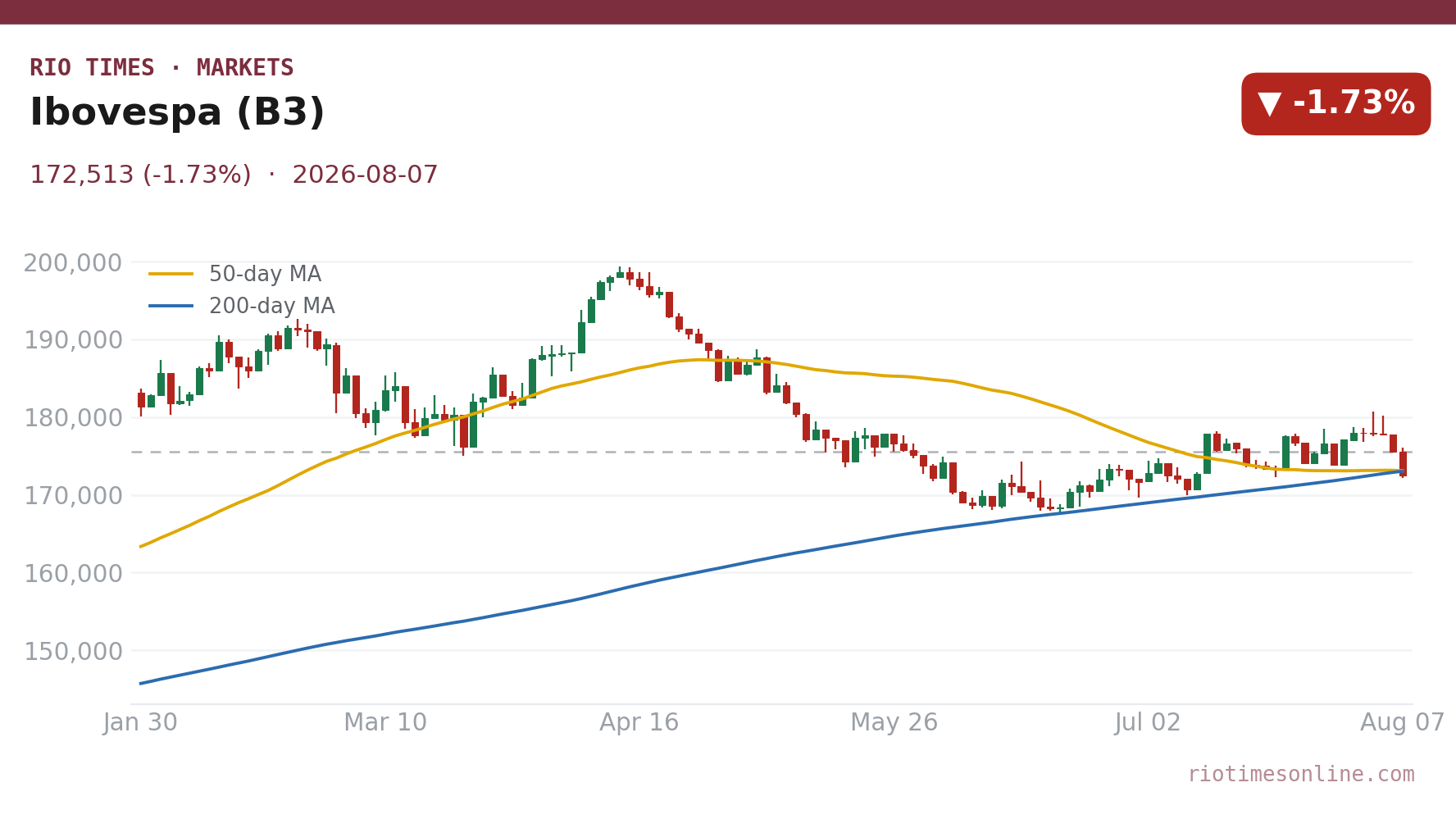
The Ibovespa’s chart has deteriorated. Four straight down days, a 1.73% drop on the last session, and a close at 172,513 put the index dangerously close to a retest of lower support. With the 52-week range stretching from 134,432 to 198,657, the rally from the depths has clearly stalled; the next few sessions will determine if this is a consolidation or a rollover.
The S&P 500, by contrast, is a picture of strength, bumping its head on the flat top of its 52-week range at exactly 7,758. The low VIX reading suggests options traders see no reason to bet on turbulence, but the divergence with Brazilian equities is stark—the correlation has broken, and local factors, not US sentiment, now dominate the Bovespa’s path.
Gold’s technical breakout above the psychologically crucial $4,300 level is a regional signal. For Mexican and Peruvian miners, this is a revenue upgrade in real time. Watch the IPC’s materials sector for a catch-up trade; it underperformed the metal on Friday, and a delayed reaction at the open could set the tone for the week.
07 What to watch
- Brazil July IPCA (Tuesday): The 9:00 am release sets the tone for Selic expectations; any number above 0.2% month-on-month could trigger a harsh re-rating of Brazilian equities and a short squeeze in the real
- Copom minutes (Tuesday): The Banco Central do Brasil’s narrative on the balance of risks is crucial—any mention of a slower pace of cuts will destabilise the crowded consensus long-BRL trade
- Mexico industrial production: A consensus-topping rebound would cement Mexico as the region’s manufacturing darling and pull foreign inflows away from Brazil into the Mexbol
- US 3-year note auction: Strong demand would signal that global investors are comfortable with current dollar yields, keeping a lid on EM borrowing costs and supporting Latin American sovereign bonds
Frequently Asked Questions
Why did Brazil fall so hard on Friday when everything else rose?
The Ibovespa dropped 1.73% in a broad-based domestic sell-off led by retail and financials, even as the S&P 500 hit a record. The decoupling shows local concerns about consumer strength and the pace of Selic cuts are outweighing the benign global mood.
Is the gold rally good for Latin American markets?
Yes, contextually. A weaker dollar eases debt service burdens, and higher gold and silver prices directly boost the earnings of the region’s major mining exporters, which are concentrated on Mexico’s IPC and Peru’s BVL indices.
What is the Copom and why do its minutes matter?
The Copom is the monetary policy committee of the Brazilian central bank. The minutes explain the thinking behind its rate decision. With the Selic just cut to 14.00%, every signal about the future path of rates moves the real and the valuation of Brazilian stocks.
How does Colombian inflation affect the region?
Colombia’s overnight CPI is expected at 6.2% annually, well above target. A higher-than-forecast print could put upward pressure on the Colombian peso and the local bond market, reminding regional investors that not all Andean economies are in the same disinflationary cycle as Brazil.
This article was produced by The Rio Times’ automated newsroom system. How we use AI · Report an error
LatAm Markets: Live Signals → — real-time movers, turnover leaders and FX across Latin America.
Read More from The Rio Times