Brazil’s Ibovespa Could Hit 185,000 by Year-End, Says Itaú BBA
Brazil · Business
Key Facts
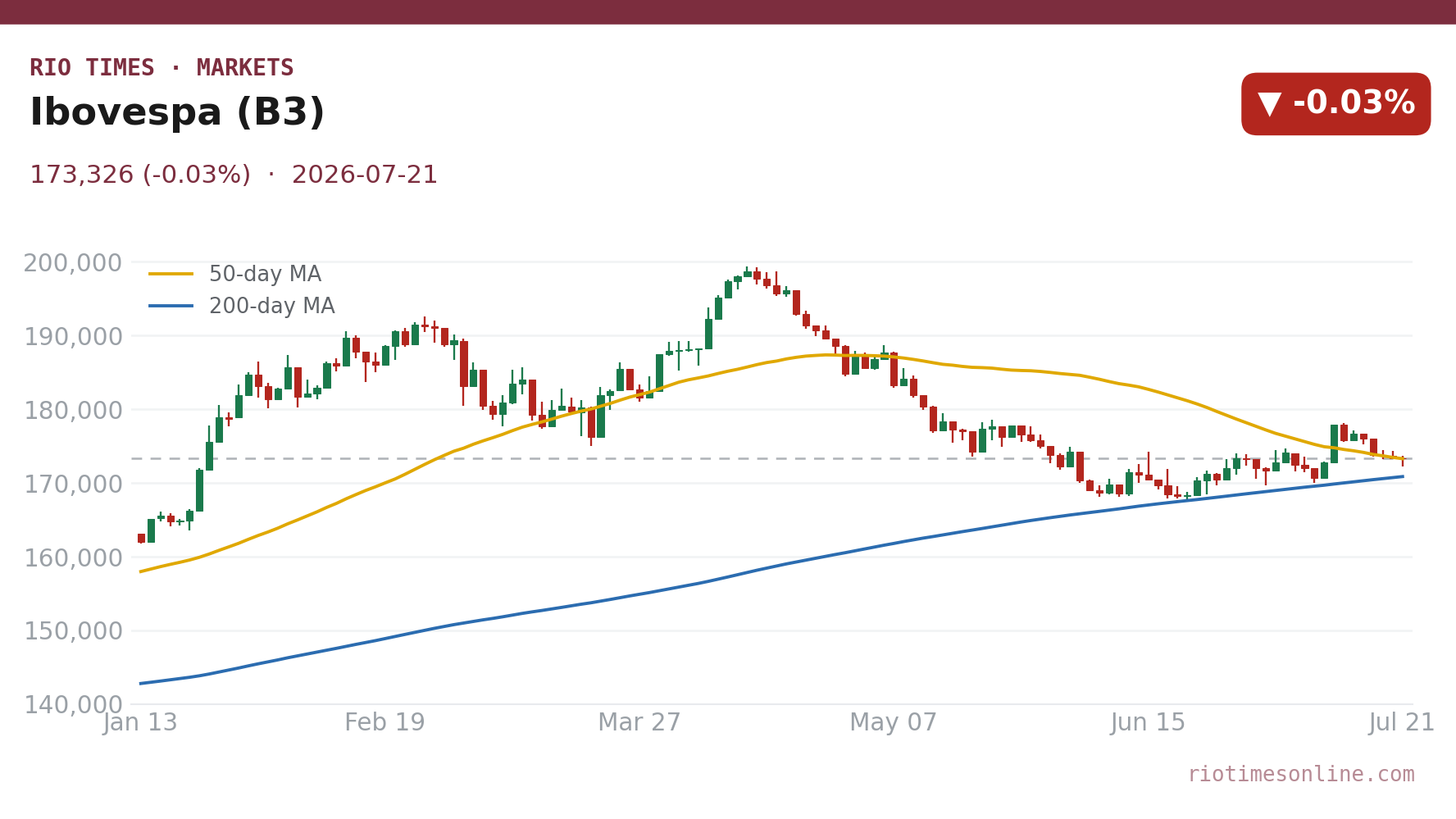
—Current Ibovespa level. The index closed near 173,326 points on July 21, 2026.
—Implied upside. The 185,000 target suggests a gain of roughly 6.7% by year-end.
—Brazilian interest rate. The Selic base rate stands at 14.25%, with an August decision pending.
—Year-to-date rally. The Ibovespa had already surged about 29% in 2026 by late July.
—US dollar exchange rate. The Brazilian real traded at 5.07 per US dollar on July 21, 2026.
Brazil’s benchmark Ibovespa stock index closed near 173,326 points on July 21, 2026, and the research team at Itaú BBA, the investment banking arm of Brazil’s largest private-sector bank, sees room for a climb to 185,000 by year-end. That target implies an upside of about 6.7% from the latest close, a modest gain that reflects a market already digesting a powerful rally.
A Target Is a Forecast, Not a Promise
A bank’s index target is a snapshot of what its strategists believe is probable under a base-case scenario. It is never a guarantee, and the path from here to there is rarely a straight line.
Itaú BBA’s 185,000 call on the Ibovespa represents roughly a 6.7% advance from the 173,326 level recorded on July 21. For a foreign investor, that is a single-digit return in a market that has already surged about 29% year over year.
Such forecasts are built on assumptions about interest rates, corporate earnings, and global capital flows. When any of those inputs shift, the target can quickly become outdated, which is why professional investors treat these numbers as a starting point for their own analysis rather than a trading instruction.
What ‘Quality Names’ Actually Means
The bank favors a quality-biased approach rather than a simple bet on the broad index rising. In plain English, ‘quality names’ are companies with strong balance sheets, reliable cash flows, and durable competitive advantages.
These firms tend to weather economic slowdowns better than highly indebted or cyclical peers. Recent market leadership has come from financials, while consumer discretionary and some healthcare shares have lagged behind.
The preference for quality signals a degree of caution. When strategists tilt toward defensive characteristics, they are often acknowledging that the easy gains from a broad-based rally may already be priced in, and that stock selection matters more than simply being in the market.
Live Market IntelligenceBrazil — Live Market Board
Rio Times · Live Market Intelligence
Brazil — Live Market Board
+2.63%
192,114.55
+2.63%
64,531.68
+1.10%
10,916.57
+0.08%
2,767,663
+0.32%
2,515.02
-0.59%
59,751.67
+0.18%
| Instrument | Last | Change | YoY | Prev. | High | Low | Volume |
|---|---|---|---|---|---|---|---|
| IBOV | 192,114.55 | +2.63% | +21.85% | 187,197.46 | 168,310 | 167,142 | — |
| USD/BRL | 5.16 | +0.01% | -5.13% | 5.16 | 5.18 | 5.14 | — |
| SELIC | 14.00% | — | — | — | — | — | |
| PETR4 | 41.64 | -0.05% | +35.19% | 41.66 | 41.97 | 41.15 | 41,499,400 |
| VALE3 | 72.97 | +0.83% | +30.75% | 72.37 | 73.54 | 72.66 | 17,658,000 |
| ITUB4 | 38.60 | -1.03% | +4.57% | 39.00 | 39.34 | 38.39 | 29,487,800 |
| BBDC4 | 16.85 | +0.36% | +3.50% | 16.79 | 16.90 | 16.67 | 19,416,900 |
| BBAS3 | 19.37 | +0.47% | +0.73% | 19.28 | 19.44 | 19.16 | 11,069,200 |
| B3SA3 | 14.26 | -0.21% | +12.73% | 14.29 | 14.47 | 14.11 | 33,037,800 |
| ABEV3 | 14.89 | -0.80% | +21.91% | 15.01 | 15.07 | 14.81 | 16,453,100 |
| WEGE3 | 47.59 | +0.49% | +29.99% | 47.36 | 48.08 | 47.36 | 3,364,600 |
| PRIO3 | 59.14 | -0.19% | +50.67% | 59.25 | 59.81 | 58.74 | 3,325,600 |
| SUZB3 | 41.33 | +2.35% | -23.55% | 40.38 | 41.48 | 40.35 | 3,914,900 |
| RENT3 | 34.68 | -0.09% | +0.84% | 34.71 | 34.96 | 34.35 | 7,979,100 |
| AZZA3 | 15.89 | -2.63% | -53.76% | 16.32 | 16.42 | 15.82 | 1,330,300 |
| CSNA3 | 4.30 | +0.47% | -42.65% | 4.28 | 4.41 | 4.26 | 10,076,100 |
| GGBR4 | 24.69 | +2.19% | +51.38% | 24.16 | 24.85 | 24.18 | 7,047,600 |
| ENEV3 | 24.21 | -1.38% | +70.49% | 24.55 | 24.64 | 23.99 | 9,297,000 |
The Macro Picture Behind the Ibovespa Target
Brazil’s central bank, the Banco Central do Brasil, has kept the Selic base rate at 14.25%. Market desks are split on whether the Copom, the monetary policy committee, will deliver a final 25-basis-point cut to 14.00% at its August meeting or hold steady.
Inflation remains the gatekeeper. Analysts are watching the Focus survey closely, and any rise in the 2026 IPCA inflation median above 4.80% would reduce the odds of further easing.
Higher rates keep money parked in fixed-income investments, which compete directly with equities.
The Focus survey is a weekly poll of private-sector economists published by the central bank. It is one of the most closely watched indicators in Brazil because it shapes expectations for where monetary policy is heading.
When the median inflation forecast drifts higher, the Copom typically becomes more reluctant to cut rates, which in turn caps enthusiasm for stocks.
Risks That Could Derail the 185,000 Call
The Brazilian real strengthened to about 5.07 per US dollar on July 21, but the currency remains sensitive to global risk sentiment. A souring of the U.S. bond market or a disappointing Treasury auction could weaken the real and pressure the Ibovespa.
Without a fresh domestic rate catalyst, the index is tethered to external shocks. A higher-for-longer Selic and any inflation surprise are the main local threats that could keep the index below the 185,000 mark.
Another risk worth watching is the trajectory of commodity prices. Brazil’s stock market has a heavy weighting in resource-exporting companies, so a downturn in global demand for iron ore or oil would ripple through the index regardless of what happens with domestic interest rates.
What This Means for Expats and Foreign Investors
For an expat or foreign investor with capital in Brazil, a 6.7% projected upside in the Ibovespa must be weighed against the opportunity cost of holding local fixed-income assets. With the Selic at 14.25%, government bonds still offer a high real return with considerably less volatility than stocks.
Currency risk is another layer to consider. Even if the index climbs to 185,000 points, a weakening of the Brazilian real against the US dollar could erase those gains when converting profits back to a home currency.
The real at 5.07 per dollar leaves little room for comfort if global risk appetite sours.
This dual calculation, local returns minus currency moves, is the central math for any cross-border investment. A stock market that rises 6.7% in reais but sees the currency depreciate by a similar margin delivers a flat result in dollar terms, which is why many foreign participants hedge their exposure or compare equity returns directly against the yield on local sovereign debt.
What Happens Next for the Ibovespa
The immediate focus for investors is the Copom’s August decision on the Selic rate. A cut to 14.00% would be a positive signal for equities, lowering the appeal of fixed-income alternatives and potentially drawing more domestic capital into the stock market.
Beyond the rate decision, the market will be scanning the Focus survey’s inflation projections and any signals from the U.S. Federal Reserve.
For the Ibovespa to reach 185,000, Brazil likely needs a calm global backdrop, contained inflation expectations, and at least one more nudge lower in domestic interest rates.
The interplay between the Federal Reserve and emerging markets is a well-worn dynamic. When US. rates rise or look set to stay elevated, capital tends to flow out of riskier markets and back into dollar-denominated assets.
The question hanging over the second half of 2026 is whether the Fed will signal a shift that either supports or undermines the appetite for Brazilian equities. Another open question is whether the Copom’s August decision, whatever it turns out to be, will mark the end of the current easing cycle or leave the door open for further moves later in the year.
What is the Ibovespa?
The Ibovespa is the benchmark stock index of B3, the São Paulo-based stock exchange. It tracks the performance of the most actively traded shares in Brazil and is the main gauge of the country’s equity market health, widely followed by local and international investors.
How realistic is the 185,000 target?
It implies a 6.7% gain from late July levels, which is plausible if inflation stays contained and global conditions remain supportive. However, a target is a forecast, and risks like sticky interest rates or external shocks could easily alter the outcome, especially after the index has already rallied nearly 29% this year.
What does Itaú BBA mean by quality names?
Quality names are companies with low debt, steady earnings, and strong market positions. They are favored because they tend to hold up better when economic growth is uncertain or interest rates stay high, offering a defensive tilt within a market that still faces macro headwinds.
Frequently Asked Questions
Sources: Itaú BBA.
This article was produced by The Rio Times’ automated newsroom system. How we use AI · Report an error · Editorial responsibility: Matthias Camenzind, Editor-in-Chief