Indonesia Plans to Cut State Firms From 1,000 to 250
Indonesia · ECONOMY
Key Facts
—The target: President Prabowo Subianto wants to cut state-owned entities from more than 1,000 to about 250 within two years.
—The scale: More than 750 entities would be closed, merged, or consolidated under the plan.
—Progress so far: Around 240 to 250 entities had already been closed, merged, or consolidated by mid-2026.
—The savings: Prabowo has claimed overhead savings of about Rp 50 trillion, roughly US$3.0 to 3.1 billion.
—The vehicle: Danantara, Indonesia’s state asset fund, is coordinating much of the consolidation.
—The context: State-owned enterprise assets stood at roughly US$572 billion in 2023, about 42 percent of gross domestic product.
Indonesia state firms are facing their biggest restructuring in decades as President Prabowo Subianto moves to slash the sector from more than 1,000 entities to about 250, eliminating or consolidating more than 750 firms.
What Prabowo announced on Indonesia state firms
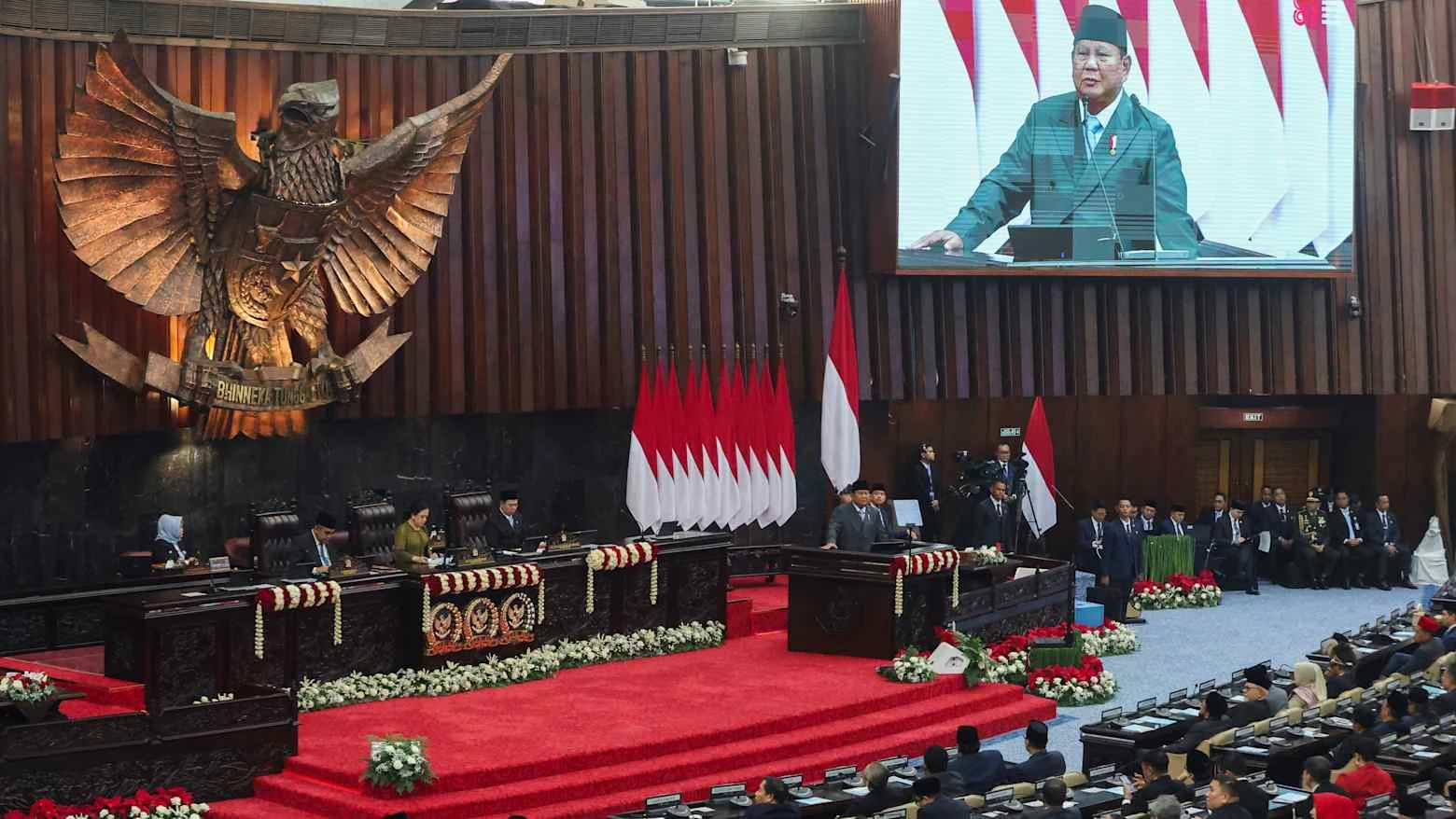
President Prabowo Subianto told the 2026 Indonesian Science, Technology, and Industry Convention in Jakarta that the government wants to reduce state-owned enterprises from more than 1,000 to about 250. He asked for the cleanup to be completed within two years, according to state news agency ANTARA.
State broadcaster RRI reported that Prabowo said the government has already closed more than 200 state-owned entities. Other reports quoting the president put the figure at around 240 to 250 entities closed, merged, or consolidated by mid-2026.
ANTARA also carried a stronger version of the goal, with Prabowo saying up to 800 underperforming state-owned enterprises could be dissolved. The president described the end goal as dissolving “800 state companies, more or less.”
The money at stake in the consolidation
Prabowo has claimed overhead savings of about Rp 50 trillion, roughly US$3.0 to 3.1 billion, from the restructuring so far. He has also pointed to possible future savings of Rp 70 to 80 trillion, or roughly US$4.2 to 4.9 billion, by the end of 2026.
The state-owned enterprise sector is enormous by emerging-market standards. The US State Department’s 2025 investment climate report puts Indonesian state-owned enterprise assets at around US$572 billion in 2023, equivalent to about 42 percent of gross domestic product.
Indonesia’s state firms contributed 21.9 percent of total fiscal receipts in 2023 when dividends, taxes, and non-tax payments are combined, up from 15 percent in 2022, according to reporting quoting Minister of State-Owned Enterprises Erick Thohir. Dividends from state firms reportedly more than doubled to Rp 81 trillion in 2023, equivalent to about US$5 billion.
Danantara and the politics of control
The institutional vehicle matters as much as the headline target. Danantara, Indonesia’s state asset fund and sovereign wealth fund, is central to the consolidation and is directly tied to Prabowo’s reform agenda.
Dony Oskaria, cited in 2026 business reporting as a Danantara executive, is among the figures driving the restructuring. The reform is not simply “less state,” but potentially a different kind of state capitalism, more centralized and more politically concentrated.
The consolidation reduces the number of boards, commissioners, and management posts, which Prabowo explicitly presented as a source of waste and overhead. It also shifts decision-making away from fragmented ministries toward a single state fund structure, which can improve speed but also increases presidential control.
What the reform means for investors
Indonesia is not moving toward classic privatization on the Chilean or post-International Monetary Fund model. The Prabowo-era approach looks more like state-capitalist pruning than retreat from the state.
Under former president Joko Widodo, the state expanded the role of state-owned enterprises in infrastructure and strategic projects, and state capital injections into state firms more than doubled as a share of gross domestic product during the 2010s. Indonesia’s state-owned enterprise assets have grown sharply even as the number of standalone companies had already fallen through earlier holding-company consolidation.
The consolidation could make Indonesian state-owned enterprises more investable if it really cuts debt, overlap, and political interference. But heavy reliance on state firms can also invite scrutiny from investors and partners who worry about transparency, governance, and market distortion.
The great-power and South-South angle
Indonesia is the largest economy in Southeast Asia and a key middle power in the Indo-Pacific. Its state firms operate in energy, transport, banking, telecoms, mining, and infrastructure, the sectors most relevant to strategic autonomy.
Indonesia is managing rivalry between the United States and China while trying to preserve room for maneuver in a more multipolar system. Stronger state-owned enterprises can be used as instruments of industrial policy and national resilience, especially in energy, logistics, finance, and critical minerals.
For African readers, the Indonesian model offers a live case study in how a large emerging economy balances state capitalism, investor confidence, and geopolitical autonomy. The Rio Times tracks these South-South dynamics in its Africa: The New Scramble pillar, where state-led resource and infrastructure plays are a recurring theme.
What to watch next
Prabowo has asked for the cleanup to be completed within two years, with a target of around 250 remaining entities. In an August 2026 address, Prabowo put the near-term goal at no more than 300 state-owned enterprises by the end of 2026, once more than 750 have been closed, merged, or consolidated.
The immediate business story is efficiency. The deeper story is control over capital allocation in a big, strategic economy where the presidency is becoming the hub of the corporate state.
Watch for further announcements from Danantara and the Ministry of State-Owned Enterprises on which entities will be closed, merged, or consolidated next. The pace of implementation will signal whether the reform is a genuine efficiency drive or a reshuffling of patronage networks.
Frequently Asked Questions
How many state-owned firms does Indonesia plan to close?
President Prabowo Subianto wants to cut state-owned entities from more than 1,000 to about 250, which implies closing, merging, or consolidating more than 750 entities.
What is Danantara’s role in the restructuring?
Danantara, Indonesia’s state asset fund and sovereign wealth fund, is coordinating much of the consolidation and is directly tied to Prabowo’s reform agenda.
How much money could Indonesia save from the state firm cuts?
Prabowo has claimed overhead savings of about Rp 50 trillion, roughly US$3.0 to 3.1 billion, with possible future savings of Rp 70 to 80 trillion, or roughly US$4.2 to 4.9 billion, by the end of 2026.
Connected Coverage
For more on how emerging economies use state power in strategic sectors, read Africa: The New Scramble.
Sources
This article was produced by The Rio Times’ automated newsroom system. How we use AI · Report an error
LatAm Markets: Live Signals → — real-time movers, turnover leaders and FX across Latin America.
Read More from The Rio Times