In Brazil, the chance of a son repeating his father’s low education is twice as high as in the US
RIO DE JANEIRO, BRAZIL – The chance of a son repeating his family’s low schooling in Brazil is twice as likely as in the US. On average, almost 6 out of 10 Brazilians (58.3%) whose parents did not complete high school in 2014 -the last year for which data is available- also stopped studying before completing this cycle.
Among Americans, this percentage is only half as much – 29.2%. The average in the OECD, a group of nearly four dozen rich and emerging nations, was 33.4%.

If the Brazilian children belong to less favored population groups, the distance is even greater.
Among the poorest 20% of the Brazilian population, 80.8% of the children whose parents did not complete high school repeated this educational outcome. In the richest 20% of the country, this percentage was 32.6%, a little below the OECD average.
The contrast between white and black Brazilians is also significant. Among the children of black and brown-skinned parents who did not finish high school, 64% did not advance beyond it. In white families, this proportion was 51.6%.
This data set is part of an unpublished study by Imds (Mobility and Social Development Institute), which placed the educational transformations that have occurred among Brazilian generations in a broad international context.
“The fact that there is great educational inequality [in Brazil] arising from society’s inability to advance the children of the poorest (the least educated of their respective generations),” highlights an excerpt from the research.
The still low educational mobility among those born into less advantaged families helps perpetuate the country’s high-income disparity.
“These are two distinct problems that go together,” states another part of the study, whose title is “Intergenerational Education Mobility: International Comparisons.”
The work shows that, since the 1940s, there have been significant gains in schooling in Brazil. But it also reveals that enormous barriers persist. “This research advances in relation to previous studies because it shows both a current photograph and a film of what has occurred in successive generations,” says economist Paulo Tafner, director-president of IMDS.
The work is divided into two parts. The first is the photograph of the recent past mentioned by Tafner. In this case, the study refers to the population between 24 and 65 years old.
Based on analysis of data from the Ministry of Education and the OECD, the researchers present a portrait of the schooling attained by adult children in relation to that of their parents.
Comparisons were made both between the Brazilian average results to the performance of the OECD nations and between different Brazilian population groups in terms of race, income, and gender.
The second part focused on World Bank data that Imds computed to analyze educational progress over generations born between 1940 and 1980 in more than 100 countries.
The film resulting from this analysis reveals that the progress – already known in Brazil in absolute terms – regarding the population’s average schooling – was also remarkable in the international context.
Eight out of ten Brazilians born in the 1980s studied more than their parents. Among 51 upper-middle-income nations – a group to which Brazil belongs – the ratio is six in every ten people.
This analysis – which excluded children whose parents had completed higher education – may capture more subtle advances in schooling, since the World Bank data include five levels of study, as opposed to three in the case of the OECD figures.
“The rapid increase in educational mobility in Brazil, especially since the 1960s, is quite surprising,” says Tafner.
However, the researcher explains that this progress, driven by the achievement of the basic education cycle, was not accompanied by a significant advance in the acquisition of a university degree.
The portion of Brazilians born in the 1980s who have completed high school is 66.6%, almost triple the 23.4% registered among their parents. When the same comparison is made with higher education, these shares are 26% and 11%, respectively.
Moreover, even parents who have earned a college degree have great difficulty in “passing on” this positive heritage to their children among the low-income population.
Among the poorest 20% of the country’s population, only 27.7% of children whose parents had higher education, in 2014, achieved that same schooling. In the wealthiest 20% of the population, the share of children who, like their parents, had a college degree, was 81.5%.
“This shows that there is an enormous fragility among the poorest Brazilians, whose achievements can easily be lost,” says economist Fernando Veloso, from Ibre and EPGE, centers that are part of FGV-Rio.
According to Tafner, the most vulnerable population’s access to higher education often occurs via less valued courses in the labor market. “These parents will have less income to guarantee their children’s education than those who followed higher paid careers,” says the economist.
Educator Catarina de Almeida, from UnB (University of Brasilia), points out that, with the adoption of the national quota policy with racial and income criteria in public universities in 2012, the share of Brazilians from less favored strata with higher education tends to keep increasing.
“It’s an opportunity that didn’t exist when I, who am black, entered university in the mid-1990s,” says the researcher.
Almeida says she was the first person in her large family to complete higher education and, to this day, she is the only one among her relatives to have a master’s and doctorate.
“My parents were illiterate. My mother had 15 children, four of whom died young. Only four siblings and I completed higher education, and others didn’t even finish elementary school.”
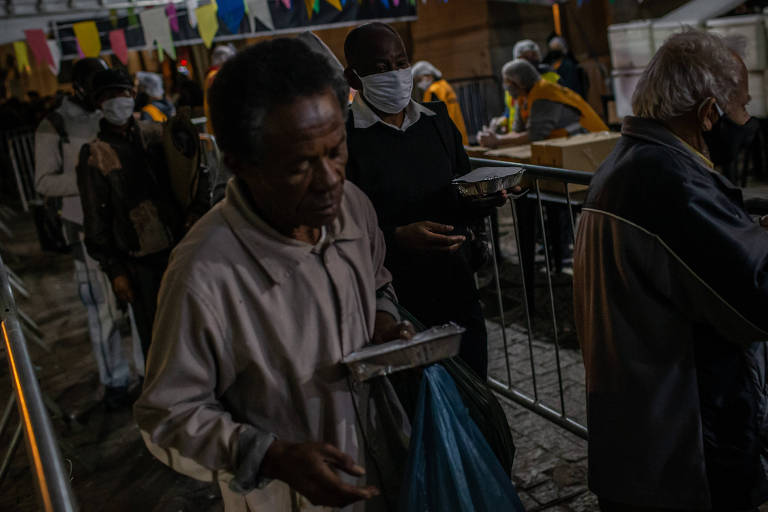
Although quotas in universities were a crucial step, they need to be complemented by other measures, which are today less feasible because of the limits on the expansion of public spending.
“The quota is an entrance policy. There is a lack of policies that guarantee that these young people stay in the university. They face difficulties that range from low family income to weaker previous schooling,” says Almeida.
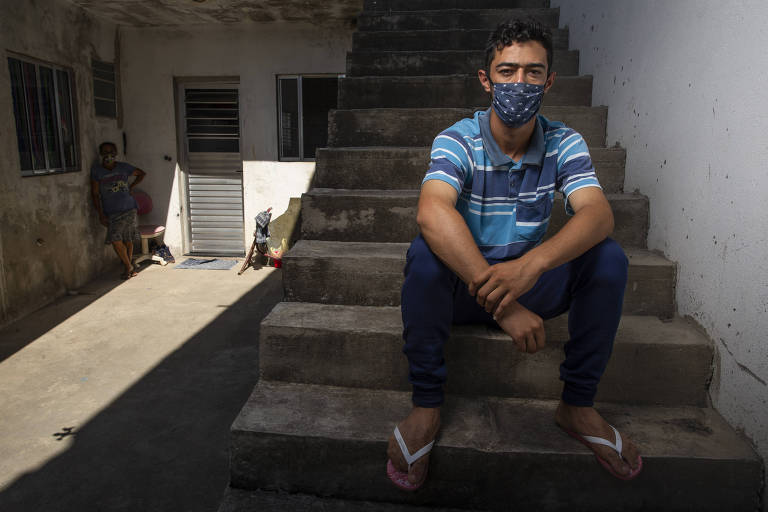
Financial difficulties like those mentioned by Almeida were the main reason that prevented José Ilton Santos Dantas, 18, from entering college after finishing high school. “I almost did, but I was broke,” he says.
The youngest of six children, Dantas, still studied two years more than his parents, who only reached the first year of high school. One of his brothers, he says, even started higher education. The course, however, had to be put on hold.
The priority in the house where they live today, in Francisco Morato, in the metropolitan region of São Paulo, is to get a job and help with the rent and other household bills.
“My father passed away in 2018. That’s why I’m looking for service work. Without him, everyone needs to help with the rent,” he says. “I did a lot of odd jobs as a bricklayer’s helper, but the job ended. Now I want to take whatever comes along.”
The goal of helping young people like Dantas is what leads Allan Greicon, 28, to divide his time between working in the Secretariat of Economic Development of the state of São Paulo and coordinating the popular pre-vestibular (university entrance exam) course Emancipa Jardim Jaqueline.
Born and raised in Itapevi, in São Paulo’s outskirts, Greicon attributes his graduation in international relations at USP (University of São Paulo) to the dedication and constant encouragement he received from his mother, the cook Val Macedo.
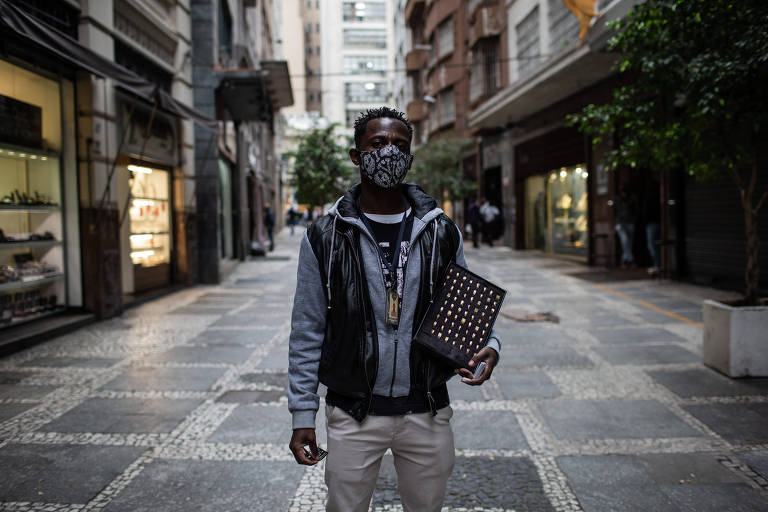
“My father died when I was six years old, leaving my mother with only bills to pay,” says he, who is a technical advisor in the management area of professional education programs for the São Paulo state government.
According to Greicon, although she did not complete elementary school, his mother always believed in the importance of education. She worked hard and tirelessly to allow him and his older brother to dedicate themselves only to their studies.
“She didn’t have time to accompany us, to go to school meetings, but she would call the teachers to inquire about our performance,” he says.
In addition to his mother’s support, Greicon has always been inspired by his older brother, who entered the University of São Paulo a year earlier than he did, where he studied journalism. Both took popular pre-vestibular courses to reinforce their educational base.
Greicon agrees with professor Catarina from UnB that Brazil needs educational policies that complement those existing today to guarantee that low-income young people have more chances to go beyond their parents’ schooling.
“The cursinhos populares (low-cost exam prep courses) are important, first of all, because they lead students to dream about university because this is not an obvious dream for a low-income youth,” she says.
Also, he points out and families need to have an income to reach a sufficient level of well-being so that their children can, in fact, dedicate themselves to their studies. “It’s tough to study when you’re hungry,” says Greicon.
To the already existing barriers to the educational advancement of the less favored Brazilians are now added others created by the coronavirus pandemic. “Low-income students have been harmed by the lack of national protocols, which should have been adopted a long time ago by the Ministry of Education,” says Veloso from FGV.
“The breakdown we see in health, in this crisis, also occurs in education,” says the researcher.
According to specialists, the losses resulting from poor students’ precarious access to education in the pandemic could be permanent and even lead to a setback in the schooling of the current young generation in relation to their parents’ schooling.
Veloso points out that the picture is aggravated by the worsening of future job perspectives for the less-educated population, amid the acceleration of a trend, before the crisis, of substituting less qualified labor with increasingly advanced technologies.
Source: Folha
More: Brazil news in English, every day from The Rio Times.
This article was produced by The Rio Times’ automated newsroom system. How we use AI · Report an error · Editorial responsibility: Matthias Camenzind, Editor-in-Chief