Key Facts
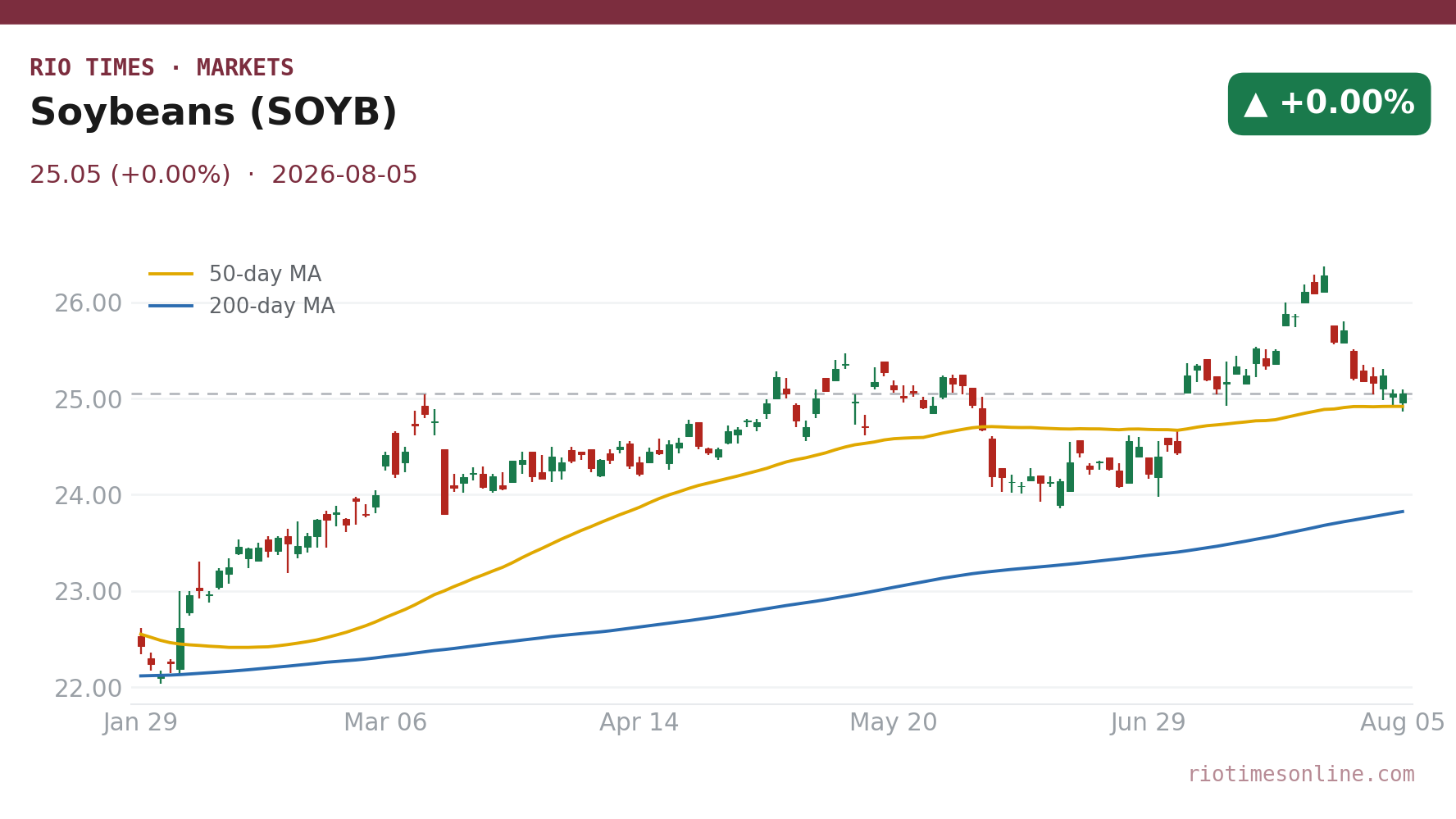
- Soybean tracker SOYB settled flat at US$25.05, unmoved on the session as traders weighed a little-changed US dollar against strong global demand signals.
- Corn tracker CORN fell 0.73 per cent to US$17.62, pressured by a stronger Brazilian real that makes the world’s top exporter less competitive on global boards.
- Wheat tracker WEAT rose 0.84 per cent to US$24.06, finding a bid even as the US Dollar Index held little changed near 99.68, a broadly neutral backdrop for dollar-priced grain and overseas buyers.
- The Brazilian real traded firmly near 5.10 per dollar, a level that dampens the local-currency return for exporters while easing the cost of dollar-priced fertiliser in Mato Grosso.
- Argentina’s official peso was virtually unchanged at 1,496 per dollar, a weak rate that encourages farmers in Rosario to sell soy and corn aggressively to capture high-world-price pesos.
- The Shanghai Composite rose 1.47 per cent to 3,878.43, steadying the mood around near-term Chinese demand for Brazilian soybeans and Argentine soy meal.
Today’s Focus
Soybean funds held firm at US$25.05 on Wednesday, while corn slipped 0.73 per cent to US$17.62 and wheat added 0.84 per cent to US$24.06. The moves reflected a currency cross-current in the Americas. A stronger Brazilian real, trading near 5.10 per dollar, clipped the export advantage for Brazil’s giant corn crop. At the same time, Argentina’s peso held near 1,496 per dollar, a level that makes selling wheat and soy on the world market highly attractive for farmers around Rosario.
The global backdrop gave grains a mixed platform. The US Dollar Index was little changed near 99.68, a broadly neutral setting for dollar-denominated wheat and soybean contracts. Meanwhile a 1.47 per cent rise in the Shanghai Composite to 3,878.43 lent modest support to the demand outlook. China is the destination for the vast majority of Brazilian soybeans leaving Paranaguá and Santos, and any macro wobble there quickly feeds into the CBOT price that SOYB ultimately tracks.
US grain futures reflected this indecision. The CBOT corn benchmark at 427.75 US cents per bushel did not budge, showing a market unwilling to price in supply risk while North American weather remains benign. For the Latin American export engine, the tight rope is between the real’s strength, which squeezes farmer margins in Mato Grosso, and the peso’s perpetual weakness, which acts as a persistent subsidy for Argentine supply hitting global silos.
What matters today. The widening divergence between a strong Brazilian real and a weak Argentine peso is reshaping export competition across the soy-corn-wheat complex.
01 The session in one read
Grain tracker funds closed mixed on Wednesday in a session dominated by foreign-exchange dynamics rather than crop fundamentals. The soybean fund SOYB was unchanged at US$25.05, a reading of equilibrium in a market where a steady dollar and firmer Chinese equities left little to trade on. Corn slipped 0.73 per cent to US$17.62 as the Brazilian real’s strength pinched the profit outlook for a giant harvest heading to port. Wheat rose 0.84 per cent to US$24.06, helped by a steady global dollar index near 99.68 and by the relentless weakness of the Argentine peso, which incentivises shipments from the River Plate.
The hard numbers from the futures pit underscored the lethargy: the CBOT corn benchmark sat absolutely still at 427.75 US cents per bushel, registering no change. This flatlining in the most actively traded grain futures contract suggests large speculative funds were rebalancing across currencies and equities rather than taking a directional view on supply and demand. The result was a grain complex that acted like a mirror of the morning’s FX print rather than a signal from a field.
The grain board on Wednesday was moved not by a weather map or a crop report, but by a tale of two currencies. A strengthening Brazilian real clipped the edge off corn, Argentina’s sliding peso gave wheat a lift, and a broadly steady US dollar kept the backdrop neutral. The session offered a textbook illustration that in 2026, trading Latin American grain means trading FX first and agronomy second. The variable to watch is any sudden rally in the real below 5.05, which would decisively slow Brazilian farmer selling and tighten the global pipeline.
02 The board
The Teucrium Corn Fund, trading as CORN, was the session’s unambiguous loser, slipping to US$17.62. The fund, which holds corn futures across multiple contract months to track the forward curve, absorbed steady selling pressure that contrasted with its flat performance on the actual CBOT board. This divergence between a slightly negative exchange-traded fund and a flat underlying futures price often points to curve movement, with deferred months softening.
| Asset | Level | Change |
|---|---|---|
| Soybeans (SOYB) | US$25.05 | +0.00% |
| Corn (CORN) | US$17.62 | -0.73% |
| Wheat (WEAT) | US$24.06 | +0.84% |
Source: RT close, 2026-08-05. Where a commodity has no spot feed, an exchange-traded tracker or leading producer is shown as a labelled proxy.
Live Market IntelligenceThe live market board
Rio Times · Live Market Intelligence
Latin America — Cross-Market Board
| Instrument | Last | Change | YoY | Prev. | High | Low | Volume |
|---|---|---|---|---|---|---|---|
| IBOV | 186,299.96 | -0.16% | +21.85% | 186,595.60 | 168,310 | 167,142 | — |
| IPSA | 11,426.61 | +0.61% | — | 11,357.82 | 11,210 | 10,984 | 1,513,213,483 |
| IPC MEX | 63,536.96 | +0.25% | +12.17% | 63,375.93 | 66,121 | 65,405 | 108,886,187 |
| MERVAL | 2,998,979 | +0.00% | +30.51% | 3,022,485 | 3,042,365 | 2,991,150 | — |
| COLCAP | 2,580.80 | +0.59% | — | 9.04 | 9.05 | 9.02 | 4,133 |
| BVL PERÚ | 59,529.36 | +1.61% | — | — | — | — | — |
| USD/BRL | 5.16 | +0.01% | -5.13% | 5.16 | 5.18 | 5.14 | — |
| EUR/BRL | 5.95 | +1.01% | -5.83% | 5.89 | 5.98 | 5.94 | — |
| USD/MXN | 17.06 | -0.24% | -8.58% | 17.10 | 17.08 | 17.01 | — |
| USD/CLP | 913.98 | +0.04% | -5.67% | 913.65 | 915.11 | 906.68 | — |
| USD/COP | 3,140 | +0.03% | -22.04% | 3,139 | 3,141 | 3,105 | — |
| USD/PEN | 3.36 | -0.66% | -4.82% | 3.38 | 3.38 | 3.35 | — |
| USD/ARS | 1,493 | +0.10% | +12.96% | 1,491 | 1,494 | 1,480 | — |
| USD/UYU | 40.27 | +1.24% | +1.80% | 39.77 | 40.27 | 40.23 | — |
| USD/PYG | 5,939 | +1.68% | -19.54% | 5,841 | 5,939 | 5,925 | — |
| USD/BOB | 11.64 | -0.76% | +72.04% | 11.73 | 11.72 | 11.64 | — |
| USD/DOP | 58.34 | +1.25% | -3.44% | 57.62 | 58.34 | 58.04 | — |
| USD/CRC | 445.92 | +0.89% | -9.71% | 441.97 | 448.50 | 445.92 | — |
03 What moved it
The immediate driver was the Brazilian real, which an aggregate of The Rio Times snapshots showed trading comfortably stronger than 5.10 per dollar. A stronger real makes each tonne of soy and corn shipped from Santos or Paranaguá generate fewer reais back home, which tends to slow the wave of farmer selling that normally caps rallies. Simultaneously, the Argentine peso traded at 1,496 per dollar, a level so weak that it creates an almost automatic incentive for a farmer in Córdoba to price grain for export immediately. The peso was flat on the session, easing 0.02 per cent, ensuring Argentine wheat and corn flows remain ultra-competitive even as global benchmarks tread water.
A second layer came from a steady US dollar. With the DXY little changed near 99.68, prices stayed broadly stable because a large share of the world’s grain is benchmarked in dollars; a stable dollar means importers across North Africa and the Middle East see a more attractive price in their local-currency terms when the WEAT fund rises. Counterbalancing this, however, was a 1.47 per cent rise in the Shanghai Composite to 3,878.43, a signal that eased doubts about Chinese import demand. China is the absentee buyer that can always shift a session’s mood, even when it does not place a single order.
04 The Latin American read
For Brazil, the firm real is a double-edged tool. A rate near 5.12, as recorded in The Rio Times morning call for the first week of August, cuts the cost of the potash and diammonium phosphate brought in from Russia and Morocco to power Mato Grosso’s fields. But that same rate shrinks the domestic price of corn so sharply that producers may choose to stuff silo bags rather than ship. The Ibovespa’s near-flat close, easing 0.09 per cent to 177,726 points, suggests domestic investors stayed cautious ahead of the central bank rather than chasing marginal grain margins.
Argentina operates under a wholly different logic. With an official rate at 1,496 and the blue-chip swap market implying an even weaker de facto exchange rate, grain is effectively a parallel hard currency. A farmer holding soybeans is not storing a commodity but holding a dollarised asset that constantly appreciates in peso terms. This asymmetrical stimulus means that any wheat rally, like Wednesday’s modest lift in WEAT, has a high probability of flushing Argentine stock onto the market almost immediately, acting to naturally cap sustained price spikes.
05 The names to watch
Investors tracking the Latin American grain complex through equities will recognise that SOYB, CORN, and WEAT are pure US-listed derivatives of Chicago futures and do not directly hold physical grain or Latin American farm assets. However, the most direct proxy for Brazilian agribusiness currency risk remains the US dollar versus the real. The morning call data showing the real near 5.12 puts the currency at a knife-edge. If the real strengthens below 5.05, exporters such as SLC Agrícola or BrasilAgro in the local market would see their forward-pricing strategies undercut.
On the Argentine side, the main pressure point is policy. The official rate of 1,496 per dollar is a managed number, and any acceleration of the managed depreciation, even by one per cent, would significantly boost the effective domestic price of wheat and soy. International agricultural trading houses with heavy River Plate exposure, particularly those which have built crushing capacity around the Rosario hub, stand to benefit most from a peso that remains frozen while global wheat and soy prices grind higher.
06 The outlook
The coming sessions rest on a trio of signals: the Brazil real holding support at 5.10, the pace of depreciation of the Argentine peso versus a softening US dollar, and whether the Shanghai Composite’s 1.47 per cent gain signals steadier Chinese demand. With the corn benchmark frozen at 427.75 US cents per bushel, the cost of producing and shipping a tonne of grain is equally static. That places the entire impetus for a price move on the demand side, leaving the market squarely dependent on China and on the currency arbitrage between Brazilian and Argentine sellers.
07 What to watch
- Chinese demand signals: After the Shanghai Composite’s 1.47 per cent rally to 3,878.43, watch whether firmer Chinese sentiment turns into fresh soybean bookings from Brazilian ports. China buys most of the beans leaving Santos and Paranagua, so its pace sets the tone for SOYB.
- The Brazilian real: A move through 5.05 to 5.10 per dollar would slow farmer selling in Mato Grosso and tighten the export pipeline, while renewed weakness would speed shipments and cap corn and soy rallies.
- The Argentine peso: Watch the pace of the managed peso slide near 1,496 per dollar. Any acceleration gives Rosario farmers an even stronger reason to price soy, corn and wheat for export right away, capping global price spikes.
- US weather and CBOT corn: With the corn contract near 427.75 US cents per bushel, calm North American weather keeps a lid on prices, so a sudden Midwest heat or dryness scare is the most likely spark for the grain board.
Frequently Asked Questions
Why did the grain trackers barely move on August 5, 2026?
The session was driven by currencies, not crops. The soybean fund SOYB held flat at US$25.05, CORN eased 0.73 per cent to US$17.62 and WEAT added 0.84 per cent to US$24.06, as a steady US dollar and a firmer Brazilian real offset each other while North American weather stayed calm.
How did the stronger Brazilian real affect grain exports?
A real near 5.10 to 5.13 per dollar shrinks the local-currency value of each tonne shipped from Santos or Paranagua, which tends to slow Brazilian farmer selling and can tighten global corn and soybean supply, even as it lowers the cost of imported fertiliser.
Did China’s stock market help or hurt the demand outlook?
It helped a little. The Shanghai Composite rose 1.47 per cent to 3,878.43, a steadier tone that eased worries about Chinese buying, since China takes most of Brazil’s soybeans and is a key swing buyer for the whole complex.
This article was produced by The Rio Times’ automated newsroom system. How we use AI · Report an error
LatAm Markets: Live Signals → — real-time movers, turnover leaders and FX across Latin America.
Read More from The Rio Times