Key Facts
- Wheat tracker surged the Teucrium Wheat Fund rose {{WEAT:pct}} on Wednesday to {{WEAT:level}}, its largest move among the three grain proxies.
- Corn tracker gained the Teucrium Corn Fund closed at US$18.76, up +1.85%, as export jitters from the Black Sea supported grain markets.
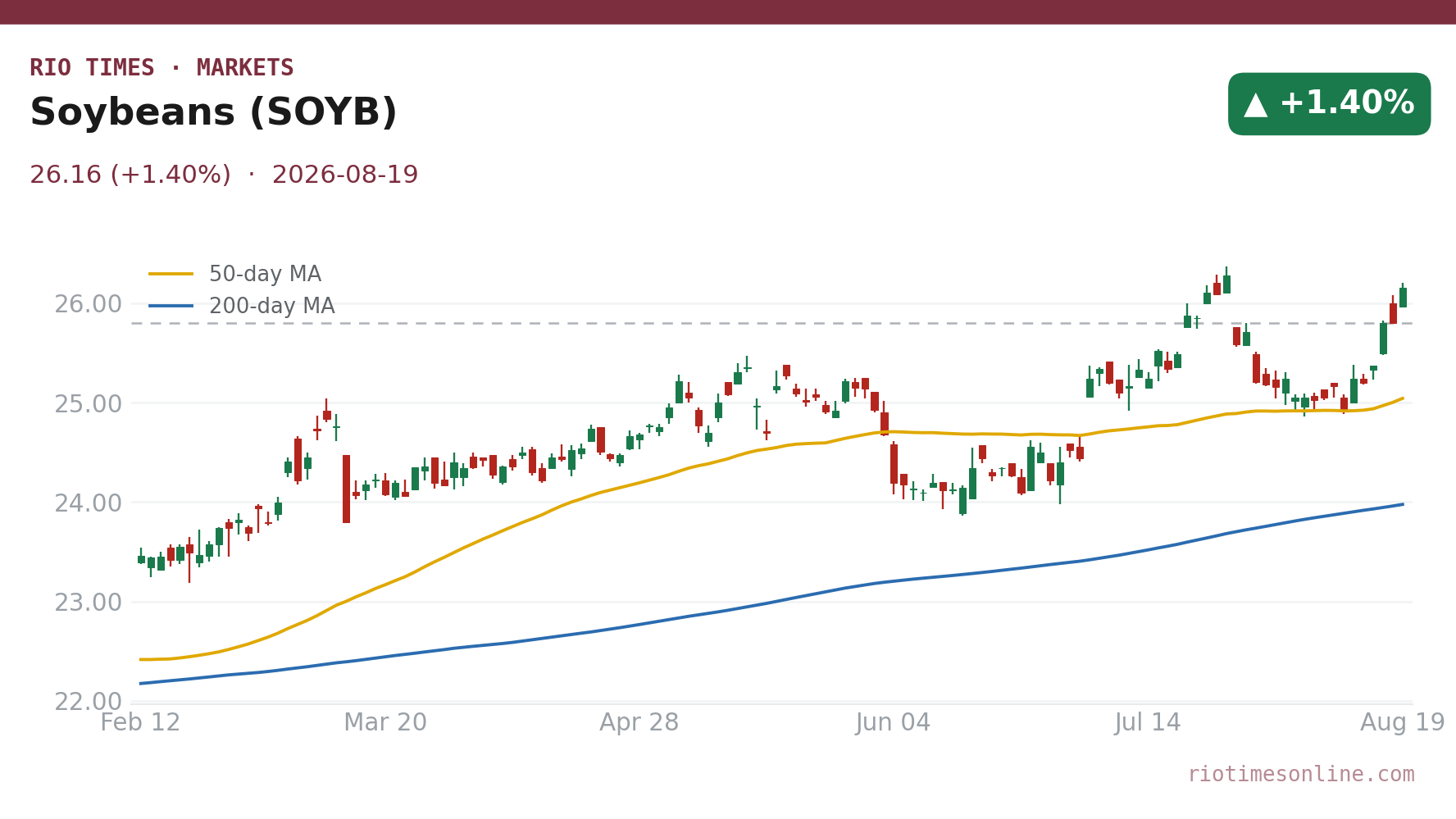
- Soybean tracker advanced the Teucrium Soybean Fund settled at {{SOYB:level}}, a rise of {{SOYB:pct}}, underpinned by fresh Chinese buying from South American suppliers.
- Brazil harvest lags AgRural reported Brazil’s 2025/26 second-crop corn harvest reached 85% of planted area as of August 13, below 94% a year earlier.
- China corn imports jumped July 2026 imports of corn and corn flour totalled 350,000 tonnes, up 527.3% year-on-year, according to Chinese customs data.
- Currency link matters a stronger Brazilian real can blunt export competitiveness for dollar-priced corn and soybeans, although the session focused on supply risks.
Today’s Focus
Grain proxies rallied across the board on Wednesday, August 19, 2026, with wheat leading the charge. The wheat tracker jumped {{WEAT:pct}}, outpacing corn and soybeans as reports of Russian export disruption rippled through markets.
The soybean tracker rose {{SOYB:pct}} on persistent Chinese demand and tight South American availability. The corn tracker gained +1.85%, finding support from a slower-than-normal Brazilian second-crop harvest.
Brazil’s safrinha corn harvest hit 85% of planted area as of August 13, well below the 94% seen a year earlier. That delay, combined with Black Sea wheat shipping concerns, gave buyers reason to bid grain futures higher.
What matters today. Supply-side risks and steady Chinese appetite are giving grain markets a firmer floor, but the pace of Brazil’s harvest will determine how much upside remains.
01 The session in one read
All three grain trackers closed higher on Wednesday, August 19, 2026, with wheat making the strongest statement. The wheat fund jumped {{WEAT:pct}} to {{WEAT:level}} after news of Black Sea port damage slowed Russian exports.
The corn fund advanced +1.85% to US$18.76, extending recent gains as traders digested a slower-than-usual Brazilian second-crop harvest. The soybean fund rose {{SOYB:pct}} to {{SOYB:level}}, supported by Chinese buyers taking advantage of South American offers.
The moves reflect a market increasingly sensitive to supply disruptions. Any hiccup in major export corridors, whether in the Black Sea or in Brazil’s interior logistics, is translating into higher bids for grain.
T
h
e
m
a
r
k
e
t
‘
s
u
p
w
a
r
d
m
o
v
e
o
n
W
e
d
n
e
s
d
a
y
w
a
s
d
r
i
v
e
n
b
y
c
o
n
c
r
e
t
e
s
u
p
p
l
y
c
o
n
c
e
r
n
s
r
a
t
h
e
r
t
h
a
n
b
r
o
a
d
s
e
n
t
i
m
e
n
t
.
R
u
s
s
i
a
n
w
h
e
a
t
e
x
p
o
r
t
s
l
o
w
d
o
w
n
s
a
n
d
a
d
e
l
a
y
e
d
B
r
a
z
i
l
i
a
n
c
o
r
n
h
a
r
v
e
s
t
g
a
v
e
t
r
a
d
e
r
s
t
a
n
g
i
b
l
e
r
e
a
s
o
n
s
t
o
l
i
f
t
p
r
i
c
e
s
.
T
h
e
v
a
r
i
a
b
l
e
t
o
w
a
t
c
h
i
s
B
r
a
z
i
l
‘
s
h
a
r
v
e
s
t
p
a
c
e
o
v
e
r
t
h
e
n
e
x
t
t
w
o
w
e
e
k
s
,
b
e
c
a
u
s
e
a
q
u
i
c
k
f
i
n
i
s
h
w
o
u
l
d
r
e
s
t
o
r
e
e
x
p
o
r
t
s
u
p
p
l
y
a
n
d
l
i
k
e
l
y
c
a
p
f
u
r
t
h
e
r
g
a
i
n
s
.
02 The board
The soybean tracker settled at {{SOYB:level}}, up {{SOYB:pct}} on the day. The corn tracker closed at US$18.76, a gain of +1.85%, while the wheat tracker ended at {{WEAT:level}}, up {{WEAT:pct}}.
Wheat was the clear leader, reflecting the Black Sea export shock. Corn and soybeans followed a gentler path but held firm, suggesting broad-based demand for agricultural commodities rather than a single-commodity spike.
| Asset | Level | Change |
|---|---|---|
| Soybeans (SOYB) | US$26.16 | +1.40% |
| Corn (CORN) | US$18.76 | +1.85% |
| Wheat (WEAT) | US$25.34 | +2.55% |
Source: RT close, 2026-08-19. Where a commodity has no spot feed, an exchange-traded tracker or leading producer is shown as a labelled proxy.
Live Market IntelligenceThe live market board
Rio Times · Live Market Intelligence
Latin America — Cross-Market Board
| Instrument | Last | Change | YoY | Prev. | High | Low | Volume |
|---|---|---|---|---|---|---|---|
| IBOV | 167,830.27 | +0.90% | +21.85% | 166,334.86 | 168,310 | 167,142 | — |
| IPSA | 11,241.32 | +0.49% | — | 11,186.57 | 11,210 | 10,984 | 1,513,213,483 |
| IPC MEX | 64,193.66 | +0.41% | +12.17% | 63,933.69 | 66,121 | 65,405 | 108,886,187 |
| MERVAL | 2,874,493 | -0.59% | +30.51% | 3,022,485 | 3,042,365 | 2,991,150 | — |
| COLCAP | 2,453.87 | -0.30% | — | 9.04 | 9.05 | 9.02 | 4,133 |
| BVL PERÚ | 57,612.45 | +1.33% | — | — | — | — | — |
| USD/BRL | 5.16 | +0.01% | -5.13% | 5.16 | 5.18 | 5.14 | — |
| EUR/BRL | 5.95 | +1.01% | -5.83% | 5.89 | 5.98 | 5.94 | — |
| USD/MXN | 17.06 | -0.24% | -8.58% | 17.10 | 17.08 | 17.01 | — |
| USD/CLP | 913.98 | +0.04% | -5.67% | 913.65 | 915.11 | 906.68 | — |
| USD/COP | 3,140 | +0.03% | -22.04% | 3,139 | 3,141 | 3,105 | — |
| USD/PEN | 3.36 | -0.66% | -4.82% | 3.38 | 3.38 | 3.35 | — |
| USD/ARS | 1,493 | +0.10% | +12.96% | 1,491 | 1,494 | 1,480 | — |
| USD/UYU | 40.27 | +1.24% | +1.80% | 39.77 | 40.27 | 40.23 | — |
| USD/PYG | 5,939 | +1.68% | -19.54% | 5,841 | 5,939 | 5,925 | — |
| USD/BOB | 11.64 | -0.76% | +72.04% | 11.73 | 11.72 | 11.64 | — |
| USD/DOP | 58.34 | +1.25% | -3.44% | 57.62 | 58.34 | 58.04 | — |
| USD/CRC | 445.92 | +0.89% | -9.71% | 441.97 | 448.50 | 445.92 | — |
03 What moved it
Wheat rallied hardest after reports that damage to a Black Sea port slowed Russian exports. Russia is one of the world’s largest wheat shippers, so any bottleneck there tightens global supply expectations.
Corn found its own support from Brazil, where the second-crop harvest reached 85% of the planted area as of August 13. That is well below last year’s 94% at the same point, keeping near-term export supply tighter than usual.
Soybeans continued to draw strength from Chinese purchasing interest. Chinese importers have been active in Brazilian and Argentine markets, using competitive South American offers to build stocks.
04 The Latin American read
Brazil and Argentina remain the swing suppliers for global grain markets, particularly corn and soybeans. A delayed Brazilian second-crop harvest means importers must wait longer for fresh supply, which supports near-term prices.
China’s corn imports in July totalled 350,000 tonnes, up 527.3% year-on-year. Cumulative imports from January to July reached 1.36 million tonnes, up 61.3% year-on-year, highlighting China’s growing reliance on South American corn.
The currency link adds another layer. A stronger Brazilian real makes dollar-priced soybeans and corn less competitive on international markets, though for now the supply delay is the more pressing factor for buyers.
05 The names to watch
The Teucrium Soybean Fund and Teucrium Corn Fund are the primary listed proxies for the two South American export staples. The Teucrium Wheat Fund captures the global wheat market, where Black Sea logistics are now the key risk.
For physical-market signals, watch Brazil’s second-crop corn harvest progress from AgRural and the pace of Chinese tenders from Brazilian and Argentine exporters. The USDA’s world grain circular listed FOB wheat bids at Argentina’s Up River and Brazil’s Paranaguá, underscoring South America’s role in global price discovery.
06 The outlook
The grains complex looks well supported while Black Sea wheat flows remain constrained and Brazil’s safrinha harvest lags its normal pace. Chinese buying adds a steady demand base for soybeans and corn.
The main risk is that Brazil’s harvest accelerates sharply in the coming days, restoring export liquidity and pressuring prices. For now, however, the supply-side delays give grain trackers a firmer footing.
07 What to watch
- Black Sea wheat flows: whether Russian export disruptions resolve quickly or spread further will set the tone for wheat
- Brazil safrinha harvest pace: how fast the second-crop corn harvest catches up to normal levels will decide corn supply
- Chinese import volumes: any change in Chinese buying from Brazil and Argentina will shift soybean and corn balances
- USD/BRL exchange rate: a stronger real would dent Brazilian export competitiveness for dollar-priced grains
Frequently Asked Questions
Why did wheat rise so much?
Reports of Black Sea port damage slowed Russian exports, tightening wheat supply expectations.
What does Brazil’s harvest have to do with corn prices?
Brazil’s second-crop corn harvest is behind last year’s pace, delaying fresh export supply and supporting prices.
Is China still buying soybeans?
Yes, Chinese importers have been active in Brazilian and Argentine markets, taking advantage of competitive offers.
How does the Brazilian real affect grain prices?
A stronger real makes Brazilian corn and soybeans less competitive in dollars, while a weaker real boosts export competitiveness.
This article was produced by The Rio Times’ automated newsroom system. How we use AI · Report an error
LatAm Markets: Live Signals → — real-time movers, turnover leaders and FX across Latin America.
Read More from The Rio Times