Gerdau Drops 4.5% as Steel Tariffs Fail to Lift Brazil
Key Facts
- Gerdau’s ADR fell 4.50% to US$4.46 giving back tariff-driven gains as profit-taking hit the Brazilian long-steel producer.
- CSN’s New York-listed shares dropped 2.22% to US$0.88 despite Brazil’s five-year anti-dumping duties on Chinese flat steel.
- Ternium advanced 0.58% to US$54.00 with Mexico’s auto supply chain hopes offsetting pressure from Chinese slab imports.
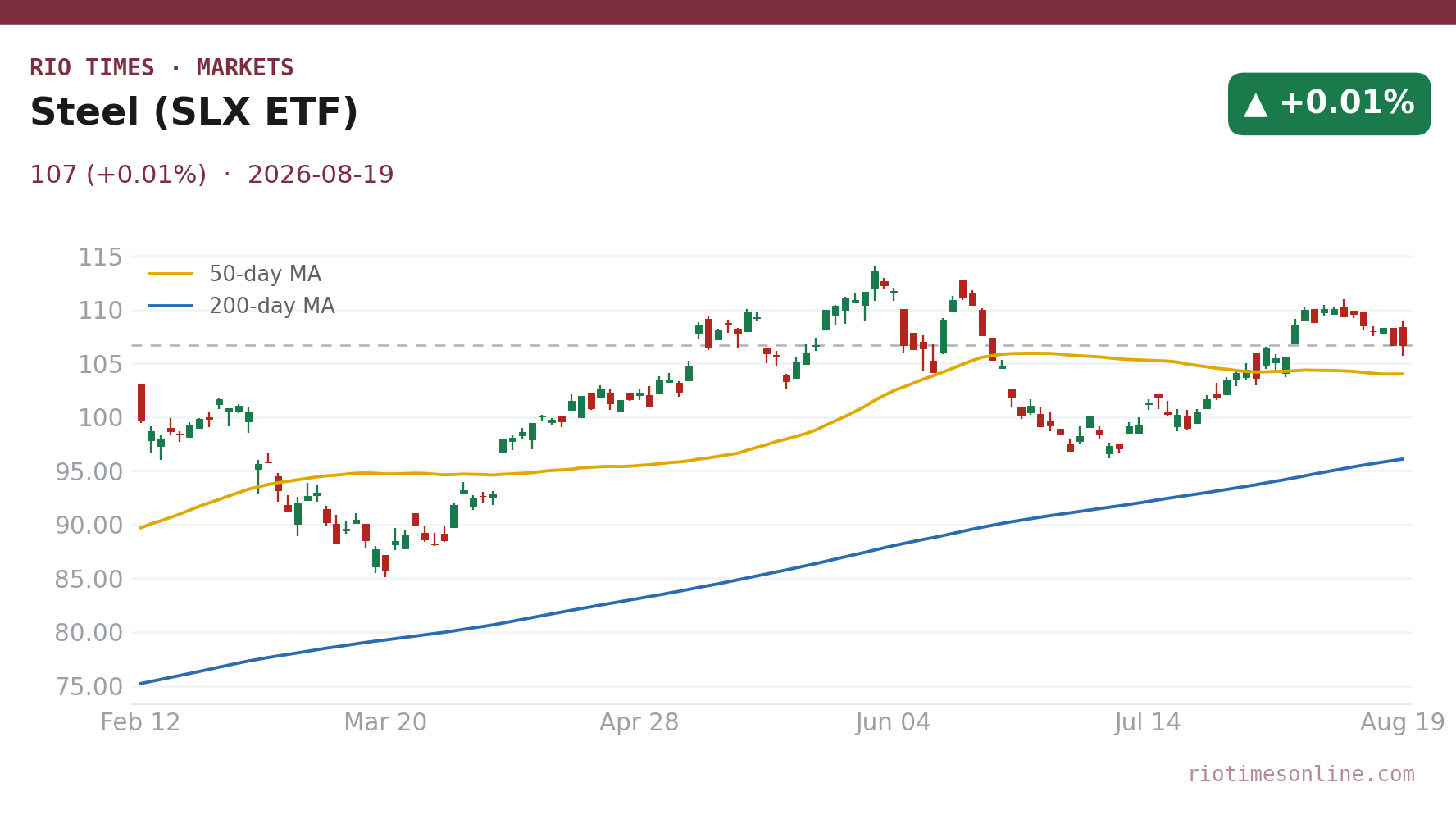
- The VanEck Steel ETF (SLX) finished at US$106.70 up just 0.01% in a largely flat session for global steel equities.
- Brazil keeps a 25% tariff on several steel categories through 2026 while Mexico applies duties up to 50% on Chinese-origin products.
- Latin American steel imports fell 8.6% year-on-year in March to 2.5 million tonnes, easing pressure after a flood of cheap Chinese steel.
Today’s Focus
Wednesday’s session split Brazilian and Mexican steel names. Gerdau clawed back a chunk of its recent tariff-driven rally, sliding 4.50% to US$4.46, while CSN shed 2.22% to US$0.88 despite renewed anti-dumping protection for flat steel.
Ternium, Mexico’s main listed steel proxy, rose 0.58% to US$54.00, as optimism about North American auto demand outweighed the drag from cheap Chinese slab imports and uncertainty over US Section 232 tariffs.
The global steel-producers ETF SLX barely moved, closing at US$106.70 with a 0.01% gain. Investors are weighing hardened trade defences against evidence that Chinese supply continues to distort regional pricing.
For foreign investors, the lesson is policy alone has not repriced Brazilian steel equities. Construction and auto demand, not tariff headlines, will determine whether Gerdau and CSN can hold gains.
What matters today. Brazilian steel stocks retreated on profit-taking despite active tariff protection, while Mexico’s Ternium held firmer on auto-linked demand.
01 The session in one read
Brazilian steel ADRs had the weakest session of the region on Wednesday, August 19, 2026. Gerdau dropped 4.50% to US$4.46, giving back Monday’s tariff-led advance, while CSN fell 2.22% to US$0.88 even with fresh anti-dumping support for Chinese sheet.
Mexico bucked the decline. Ternium gained 0.58% to US$54.00, helped by hopes for the North American auto supply chain, while the VanEck Steel ETF SLX closed virtually flat at US$106.70, up 0.01%.
Wednesday’s moves show investors are no longer rewarding each new trade-defence headline. Gerdau and CSN fell even with Brazil’s anti-dumping duties in place, a sign that cheap Chinese supply and soft domestic demand remain the stronger forces in the short term. The variable to watch is whether auto and construction orders firm into September, which would shift attention back to fundamentals and away from policy.
02 The board
The price board reveals a split between long-steel and flat-steel exposure. Gerdau’s US-listed shares reflected heavy profit-taking after recent tariff news, while CSN’s smaller decline suggests flat-steel producers still hold some policy support from Brazil’s anti-dumping duties on cold-rolled and hot-dip galvanised coil.
Ternium’s gain to US$54.00 stands out against the Brazilian names. Investors treated it as the region’s auto-linked proxy, rewarding exposure to Mexico’s vehicle supply chain despite persistent Chinese slab competition and looming questions over US Section 232 steel tariffs.
| Asset | Level | Change |
|---|---|---|
| Steel (SLX ETF) | US$106.70 | +0.01% |
| Gerdau | US$4.46 | -4.50% |
| CSN (ADR) | US$0.88 | -2.22% |
| Ternium | US$54.00 | +0.58% |
Source: RT close, 2026-08-19. Where a commodity has no spot feed, an exchange-traded tracker or leading producer is shown as a labelled proxy.
Live Market IntelligenceThe live market board
Rio Times · Live Market Intelligence
Latin America — Cross-Market Board
| Instrument | Last | Change | YoY | Prev. | High | Low | Volume |
|---|---|---|---|---|---|---|---|
| IBOV | 167,830.27 | +0.90% | +21.85% | 166,334.86 | 168,310 | 167,142 | — |
| IPSA | 11,241.32 | +0.49% | — | 11,186.57 | 11,210 | 10,984 | 1,513,213,483 |
| IPC MEX | 64,193.66 | +0.41% | +12.17% | 63,933.69 | 66,121 | 65,405 | 108,886,187 |
| MERVAL | 2,874,493 | -0.59% | +30.51% | 3,022,485 | 3,042,365 | 2,991,150 | — |
| COLCAP | 2,453.87 | -0.30% | — | 9.04 | 9.05 | 9.02 | 4,133 |
| BVL PERÚ | 57,612.45 | +1.33% | — | — | — | — | — |
| USD/BRL | 5.16 | +0.01% | -5.13% | 5.16 | 5.18 | 5.14 | — |
| EUR/BRL | 5.95 | +1.01% | -5.83% | 5.89 | 5.98 | 5.94 | — |
| USD/MXN | 17.06 | -0.24% | -8.58% | 17.10 | 17.08 | 17.01 | — |
| USD/CLP | 913.98 | +0.04% | -5.67% | 913.65 | 915.11 | 906.68 | — |
| USD/COP | 3,140 | +0.03% | -22.04% | 3,139 | 3,141 | 3,105 | — |
| USD/PEN | 3.36 | -0.66% | -4.82% | 3.38 | 3.38 | 3.35 | — |
| USD/ARS | 1,493 | +0.10% | +12.96% | 1,491 | 1,494 | 1,480 | — |
| USD/UYU | 40.27 | +1.24% | +1.80% | 39.77 | 40.27 | 40.23 | — |
| USD/PYG | 5,939 | +1.68% | -19.54% | 5,841 | 5,939 | 5,925 | — |
| USD/BOB | 11.64 | -0.76% | +72.04% | 11.73 | 11.72 | 11.64 | — |
| USD/DOP | 58.34 | +1.25% | -3.44% | 57.62 | 58.34 | 58.04 | — |
| USD/CRC | 445.92 | +0.89% | -9.71% | 441.97 | 448.50 | 445.92 | — |
03 What moved it
Cheap Chinese steel remains the central pressure point for Latin American producers. Although regional imports fell 8.6% year-on-year in March to 2.5 million tonnes, following a 1.2% first-quarter drop to 7.6 million tonnes, underpriced Chinese material still distorts local pricing and squeezes margins for Gerdau, CSN, Usiminas and Ternium.
Trade defences have hardened but not yet been enough to trigger a sustained re-rating. Brazil’s 25% tariff on several steel categories runs through 2026, while Mexico adds duties of up to 50% on Chinese-origin products on top of a 25% levy held since August 2023 under President Claudia Sheinbaum.
04 The Latin American read
Brazil’s producers are caught between policy protection and real demand. Gerdau, leveraged to long steel for construction and infrastructure, looks vulnerable to any slowdown in building activity, while CSN and Usiminas depend on flat-steel orders from autos and appliances to convert anti-dumping measures into firmer volumes.
Mexico offers a slightly brighter short-run story. Ternium is positioned in regional value chains feeding US automakers, and Wednesday’s rise suggests investors see auto supply-chain continuity as a stronger near-term driver than Chinese slab imports are a negative.
05 The names to watch
Gerdau is the clearest signal on Brazilian construction and infrastructure demand. Its 4.50% slide to US$4.46 shows that tariff optimism fades quickly without evidence of stronger domestic order books.
CSN remains the flat-steel bellwether. The 2.22% decline to US$0.88 indicates that even renewed anti-dumping duties on Chinese sheet have not restored investor confidence in the near term.
Ternium is the Mexican auto and slab-import story in one ticker. At US$54.00, it reflects a market prepared to look through Chinese competition toward North American vehicle production.
SLX at US$106.70 offers a global check on regional moves. Its flat 0.01% session confirms that Wednesday’s action was about Latin American positioning, not a broad steel-sector trend.
06 The outlook
The next catalyst is whether construction and auto orders firm into September. If Brazilian long-steel volumes improve, Gerdau could recover quickly from oversold levels; if Mexican auto schedules hold, Ternium may keep outperforming.
US trade policy remains the wildcard. Any change to Section 232 tariffs would hit export prospects for both Brazilian and Mexican producers, while further anti-dumping decisions on Chinese flat steel would matter most for CSN and Usiminas.
07 What to watch
- Brazil construction demand: Long-steel order flow into September will determine whether Gerdau can recover from Wednesday’s 4.50% drop.
- Mexico auto schedules: US vehicle production and supplier demand are the main support for Ternium at current levels.
- US Section 232 tariffs: Any shift in US steel trade policy would change export assumptions for Gerdau, CSN, Usiminas and Ternium.
- Chinese import flows: Further easing or a renewed flood of cheap Chinese steel will set the tone for regional pricing and margins.
Frequently Asked Questions
Why did Gerdau fall on Wednesday, August 19, 2026?
Gerdau’s ADR dropped 4.50% to US$4.46 as investors took profits after recent tariff-driven gains, reflecting doubt that trade protection alone can lift Brazilian long-steel demand.
What do Brazil’s steel tariffs cover?
Brazil has a 25% tariff on several steel categories through 2026 and five-year anti-dumping duties on Chinese flat steel, including rates around US$323 per tonne for cold-rolled coil and US$285 to US$710 per tonne for hot-dip galvanised coil.
Why did Ternium rise while Brazilian steel fell?
Ternium gained 0.58% to US$54.00 because investors are focused on Mexico’s auto supply chain potential, which is seen offsetting pressure from cheap Chinese slab imports.
What is SLX and why does it matter here?
SLX is the VanEck Steel ETF, a US-listed fund tracking global steel producers. It closed at US$106.70 on Wednesday and acts as a benchmark for how Latin American names perform relative to the global steel sector.
This article was produced by The Rio Times’ automated newsroom system. How we use AI · Report an error
LatAm Markets: Live Signals → — real-time movers, turnover leaders and FX across Latin America.
Read More from The Rio Times