Soybeans, Corn, Wheat: Black Sea Risks Lift Grains

Key Facts
- —Wheat led the complex the wheat-tracking fund WEAT settled at US$27.94, a gain of 2.65% on Friday, August 28, 2026.
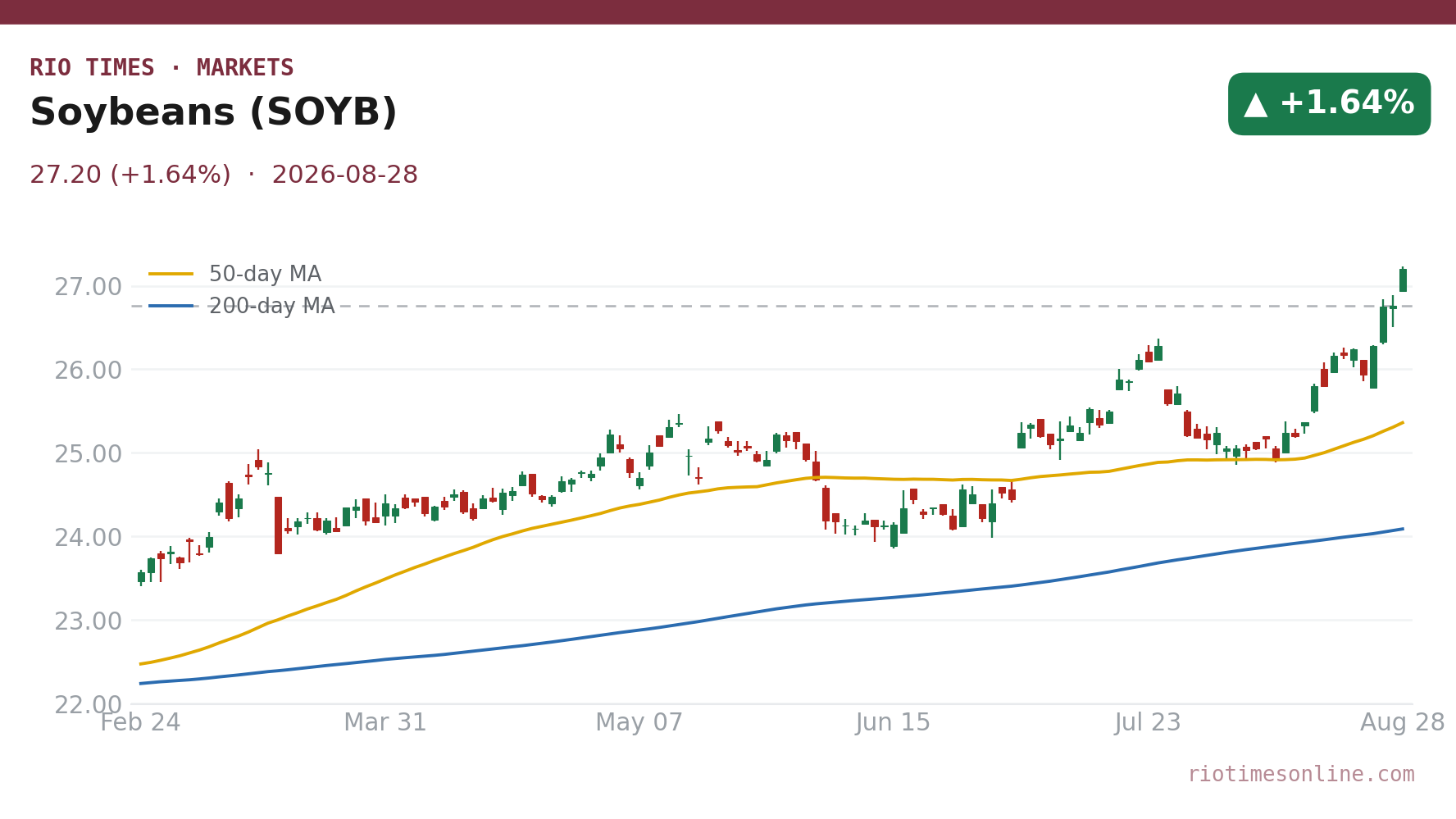
- —Soybeans held firm the soybean-tracking fund SOYB settled at US$27.20, up 1.64%, supported by steady Chinese demand for oilseeds.
- —Corn advanced modestly the corn-tracking fund CORN settled at US$19.95, a rise of 0.76% as traders added positions into the weekend.
- —Black Sea tensions returned supply concerns from the region pushed Chicago wheat futures to their highest level in more than three years.
- —Brazil and Argentina remain the southern-hemisphere export engine currency moves against the US dollar are once again at the centre of South American competitiveness.
- —The quoted instruments are funds SOYB, CORN and WEAT hold futures contracts and are priced in US dollars per share, not in futures cents.
Today’s Focus
Grain markets closed higher on Friday, August 28, 2026, with wheat making the most dramatic move. The wheat-tracking fund WEAT jumped 2.65% to settle at US$27.94, after touching a 52-week high of US$28.00, as Black Sea supply worries flared, pushing Chicago wheat futures to a three-year high.
Soybeans followed a different, steadier path. The soybean-tracking fund SOYB rose 1.64% to US$27.20, driven by continued Chinese buying of oilseeds.
Corn was the quietest of the three, with the corn-tracking fund CORN up 0.76% to US$19.95, supported by expanding speculative positions.
For Latin America, the session underlines the power of two forces: external demand and the currency link. Brazil and Argentina, which together dominate world soybean exports and rank behind only the United States in corn, see their competitiveness shift with every move in the real and the peso against the US dollar.
What matters today. The wheat spike is a supply story from the Black Sea, while soybeans are anchored by demand from China; both forces are now moving at the same time.
01 The session in one read
Friday, August 28, 2026 closed with a clear hierarchy in the grain complex: wheat surged, soybeans advanced on demand, and corn made a quieter gain. The moves reflected two distinct drivers acting at once, supply anxiety from the Black Sea and steady Chinese appetite for South American oilseeds.
The wheat-tracking fund WEAT settled at US$27.94, a rise of 2.65% that placed it firmly at the top of the board. The soybean-tracking fund SOYB finished at US$27.20, up 1.64%, while the corn-tracking fund CORN settled at US$19.95, gaining 0.76%.
The market is paying for Black Sea risk in wheat while continuing to price a steady flow of Chinese buying in soybeans. A weaker Brazilian real or Argentine peso would make South American exporters even more aggressive sellers, potentially capping further gains in futures.
The variable to watch is whether China’s buying pace continues through the end of the harvest window.
02 The board
The three trackers told the story with unusual clarity. WEAT’s 2.65% jump to US$27.94 was the standout, reflecting genuine anxiety about wheat availability.
SOYB’s 1.64% rise to US$27.20 showed that oilseed demand remains robust without being panicked. CORN’s 0.76% increase to US$19.95 was the most muted of the three, a market still waiting for a catalyst.
These are exchange-traded funds that hold futures contracts, quoted in dollars per share. They track — but are not identical to — the price of grain futures in Chicago.
| Asset | Level | Change |
|---|---|---|
| Soybeans (SOYB) | US$27.20 | +1.64% |
| Corn (CORN) | US$19.95 | +0.76% |
| Wheat (WEAT) | US$27.94 | +2.65% |
Source: RT close, 2026-08-28. Fifty-two-week ranges: WEAT US$19.78-28.00, SOYB US$21.36-27.23, CORN US$16.36-20.08.
WEAT completed a one-for-five reverse split in November 2025. Where a commodity has no spot feed, an exchange-traded tracker or leading producer is shown as a labelled proxy.
Live Market IntelligenceThe live market board
Rio Times · Live Market Intelligence
Latin America — Cross-Market Board
| Instrument | Last | Change | YoY | Prev. | High | Low | Volume |
|---|---|---|---|---|---|---|---|
| IBOV | 206,756.11 | -1.11% | +21.85% | 209,066.90 | 168,310 | 167,142 | — |
| IPSA | 10,974.58 | -0.62% | — | 11,043.36 | 11,210 | 10,984 | 1,513,213,483 |
| IPC MEX | 66,746.78 | +1.06% | +12.17% | 66,048.57 | 66,121 | 65,405 | 108,886,187 |
| MERVAL | 2,883,107 | +1.95% | +30.51% | 3,022,485 | 3,042,365 | 2,991,150 | — |
| COLCAP | 2,555.55 | +0.96% | — | 9.04 | 9.05 | 9.02 | 4,133 |
| BVL PERÚ | 60,645.95 | -0.68% | — | — | — | — | — |
| USD/BRL | 5.16 | +0.01% | -5.13% | 5.16 | 5.18 | 5.14 | — |
| EUR/BRL | 5.95 | +1.01% | -5.83% | 5.89 | 5.98 | 5.94 | — |
| USD/MXN | 17.06 | -0.24% | -8.58% | 17.10 | 17.08 | 17.01 | — |
| USD/CLP | 913.98 | +0.04% | -5.67% | 913.65 | 915.11 | 906.68 | — |
| USD/COP | 3,140 | +0.03% | -22.04% | 3,139 | 3,141 | 3,105 | — |
| USD/PEN | 3.36 | -0.66% | -4.82% | 3.38 | 3.38 | 3.35 | — |
| USD/ARS | 1,493 | +0.10% | +12.96% | 1,491 | 1,494 | 1,480 | — |
| USD/UYU | 40.27 | +1.24% | +1.80% | 39.77 | 40.27 | 40.23 | — |
| USD/PYG | 5,939 | +1.68% | -19.54% | 5,841 | 5,939 | 5,925 | — |
| USD/BOB | 11.64 | -0.76% | +72.04% | 11.73 | 11.72 | 11.64 | — |
| USD/DOP | 58.34 | +1.25% | -3.44% | 57.62 | 58.34 | 58.04 | — |
| USD/CRC | 445.92 | +0.89% | -9.71% | 441.97 | 448.50 | 445.92 | — |
03 What moved it
Wheat’s surge was driven by renewed tensions in the Black Sea, a region critical to global wheat exports. Reports that Russia was preparing to step up strikes on Ukraine after peace talks stalled followed tit-for-tat attacks that cut grain loadings at Russian and Ukrainian ports to a near halt, and the consultancy SovEcon trimmed its estimate of Russian August wheat exports by about 300,000 tonnes to 1.9 million tonnes.
The move to a three-year high in Chicago futures recalled the 2022 spike, when war and blocked ports sent prices soaring.
Soybeans drew strength from the broader rally and from expectations of continued Chinese demand; China is the world’s largest importer of oilseeds. No fresh purchase was confirmed by the US Department of Agriculture on the day.
Corn’s gain was the smallest of the three, but it came with the market already trading close to its highest levels in more than three years. The same Black Sea risk premium did the lifting, rather than any corn-specific catalyst.
04 The Latin American read
Brazil and Argentina are the world’s leading soybean exporters and, after the United States, its largest corn suppliers, so the currency link is never far from traders’ minds. The real closed at R$5.2005 (US$1.00) to the dollar and the Argentine wholesale peso at 1,512 per US dollar on Friday, with the dollar index up about 0.5% after Fed Chair Kevin Warsh’s hawkish Jackson Hole speech.
A weaker Brazilian real makes dollar-denominated grain sales more lucrative in local currency terms, encouraging farmers to sell and exporters to ship.
Argentina’s peso operates under different pressures, but the logic is the same: when the domestic currency weakens against the US dollar, export competitiveness improves. Friday’s firm soybean prices, combined with the demand pull from China, keep the incentive structure favourable for South American producers.
The risk is that an aggressive wave of selling from Brazil or Argentina caps further price gains. Exporters that see a strong dollar price and a weak local currency often rush to lock in sales, adding supply to the global pipeline just as demand firms.
05 The names to watch
The trackers themselves are the simplest way to follow the moves. SOYB at US$27.20 is the cleanest read on soybean sentiment, WEAT at US$27.94 now carries the Black Sea risk premium, and CORN at US$19.95 remains a waiting game for a catalyst.
Currency markets are the invisible hand in all this. Any sharp move in the Brazilian real or Argentine peso against the US dollar will change the arithmetic for exporters within days, not weeks.
06 The outlook
The grain complex is now running on two engines at once. Wheat is driven by fear of supply disruption, while soybeans are anchored by real, measurable demand from China.
For Brazil and Argentina, the moment is promising but delicate. Strong dollar prices and steady Chinese buying are exactly what exporters want, but the temptation to sell aggressively could temper further gains.
07 What to watch
- Black Sea headlines: Any escalation in shipping or port disruptions could push wheat higher and drag the whole complex with it.
- China’s buying pace: Weekly export sales data will show whether the soybean demand is structural or a short-term flush.
- Brazilian real vs US dollar: A weakening real makes Brazilian soybeans and corn cheaper on world markets, increasing export pressure.
- South American harvest logistics: Port delays or trucking strikes in Brazil or Argentina could tighten near-term supply and support prices.
More: Brazil news, every day from The Rio Times.
Frequently Asked Questions
Why did wheat jump so sharply on Friday?
Renewed tensions in the Black Sea region revived fears about disruption to wheat exports, pushing Chicago futures to a three-year high and lifting the wheat-tracking fund WEAT by 2.65% to US$27.94.
What is supporting soybean prices?
Steady Chinese buying of oilseeds is the main driver, keeping the soybean-tracking fund SOYB firm at US$27.20 with a 1.64% gain on Friday.
How do currencies affect Brazil and Argentina in grain markets?
A weaker Brazilian real or Argentine peso makes dollar-denominated grain sales more valuable in local currency, encouraging more aggressive selling and export competition.
Is corn following wheat and soybeans higher?
Corn rose only 0.76% to US$19.95, with traders adding positions but no fresh supply or demand catalyst emerging. It remains the quietest of the three markets.
Market data: RT
This article was produced by The Rio Times’ automated newsroom system. How we use AI · Report an error · Editorial responsibility: Matthias Camenzind, Editor-in-Chief
LatAm Markets: Live Signals → — real-time movers, turnover leaders and FX across Latin America.