Germany’s Democracy Tested: Merz’s Fiscal Coup and the People’s Voice
(Analysis) Friedrich Merz, Germany’s Chancellor-in-waiting, announced a landmark fiscal reform agreement that promises to fundamentally reshape the country’s economic trajectory.
After intense negotiations, Merz has secured crucial Green Party support for his €500 billion package by doubling climate transformation funding to €100 billion. This breakthrough has significant implications not just for Germany’s economy, but for democratic governance and European security.
The most controversial aspect of Merz’s maneuver is his decision to push these constitutional changes through the outgoing parliament before the newly elected one convenes on March 25.
With the hard-right AfD and far-left parties gaining significant ground in recent elections, Merz is deliberately using the current parliamentary configuration to secure the required two-thirds majority that would be unattainable in the new Bundestag.
“This momentous step is going to be taken by a parliament that is defunct and which the German people have basically thrown out,” notes one critic, highlighting the democratic deficit created when voted-out representatives make generational decisions.
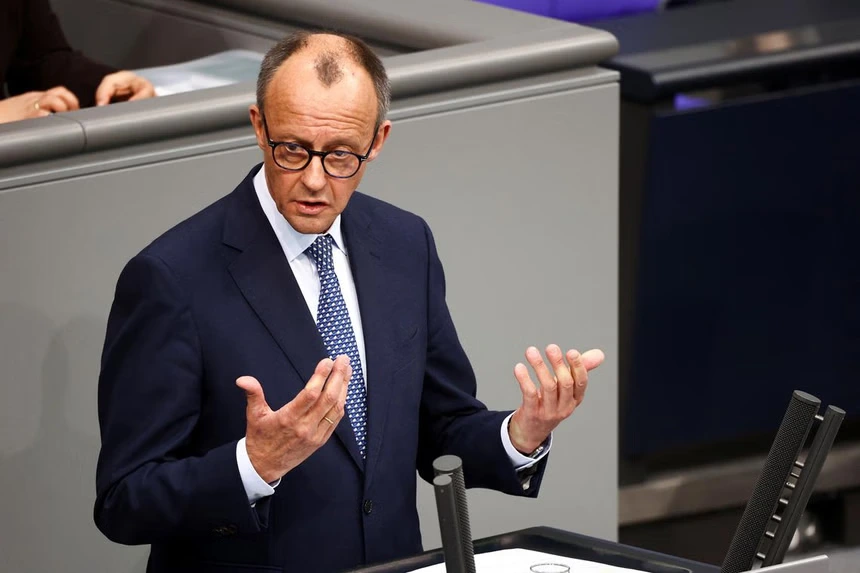
While technically legal, this approach bypasses the fresh electoral mandate and raises profound questions about democratic legitimacy.
The Constitutional Court must still determine whether such consequential measures can be approved by an outgoing parliament, with the AfD and The Left filing legal challenges ahead of Tuesday’s scheduled vote.
From Industrial Giant to Financial Player: Germany’s BlackRock-Inspired Metamorphosis
For Merz, long associated with fiscal conservatism and previously a BlackRock director, this reform represents a remarkable philosophical pivot.
Critics view Merz’s financial sector background as crucial to understanding his true agenda—using massive public borrowing not simply to modernize infrastructure but to fundamentally transform Germany’s economic model away from industrial production toward financialization, similar to shifts seen in Britain and the United States.
These critics connect his BlackRock background to a potential agenda of “financializing the German economy” that could accelerate deindustrialization rather than reverse it.
The agreement consists of three major components: defense spending exemptions from the debt brake (for expenditures exceeding 1% of GDP), new borrowing capacity for German states, and a massive €500 billion infrastructure fund distributed over twelve years. This fund rivals Germany’s entire annual federal budget of approximately €477 billion.
While proponents see these investments as addressing Germany’s deteriorating infrastructure and economic stagnation, skeptics question whether Germany—unlike Britain with its established City of London—has the financial ecosystem to successfully transition from industrial powerhouse to financial center.
This fundamental transformation of Germany’s economic identity—pushed through by representatives voters have already rejected—illustrates how democratic shortcuts can enable sweeping economic reforms without proper public deliberation.
Beyond Defense and Infrastructure: Redefining German Economic Identity
“Germany is back,” declares Merz, positioning this reform as essential for both economic renewal and European security in an increasingly uncertain global environment.
With Russia’s ongoing war against Ukraine and uncertainties about American security guarantees under Trump, the security rationale appears compelling.
The expanded definition of “defense” now encompasses not only traditional military capabilities but also civil defense, intelligence services, information technology security, and support for states under attack. Meanwhile, the €500 billion infrastructure package aims to modernize everything from aging bridges to digital networks.
However, the German Taxpayers Association warns that Germany faces “not a revenue problem, but a spending problem,” suggesting the new government should reduce inefficient expenditures alongside new investments.
As costs inevitably rise and debt levels grow, the question remains whether Germany can maintain its economic identity through this fundamental transformation.
Procedural Legitimacy vs. Electoral Mandate: The Constitutional Dilemma
This fiscal reform reveals a fundamental tension in democratic systems between government effectiveness and democratic legitimacy. While Germany’s fiscal reform may address critical economic and security challenges, the manner of its implementation risks undermining the democratic foundations it purports to defend.
As Tuesday’s vote approaches, Germany faces not just an economic inflection point but a democratic one. The outcome will reveal whether Europe’s most powerful democracy prioritizes procedural integrity or political expediency when the two come into conflict.
The stakes could not be higher, as Merz himself acknowledged: “The world is watching.” Whether this fiscal transformation delivers the promised economic and security benefits remains to be seen, but the significance of the shift in German fiscal philosophy is undeniable.
Read More from The Rio Times