Eduardo Bolsonaro’s Exile: A Mirror to Moraes’ Judicial Reach
(Analysis) Eduardo Bolsonaro, a Brazilian congressman and son of former President Jair Bolsonaro, has chosen to remain in the United States, citing Supreme Court Justice Alexandre de Moraes as the reason.
In a CNN interview on March 19, 2025, Bolsonaro stated he would not return to Brazil while Moraes remains on the bench, asserting that doing so risks imprisonment without just cause.
This development invites a closer examination of Moraes’ judicial actions, their impact on Brazil’s political landscape, and the broader ramifications for its democratic institutions and international relations.
Bolsonaro’s decision stems from a series of high-profile moves by Moraes, who has spearheaded investigations into alleged disinformation and coup-related activities since assuming a prominent role in Brazil’s Supreme Court.
These efforts have included ordering the nationwide suspension of the social media platform X, freezing assets of political figures, and initiating arrests—often under conditions of judicial secrecy.
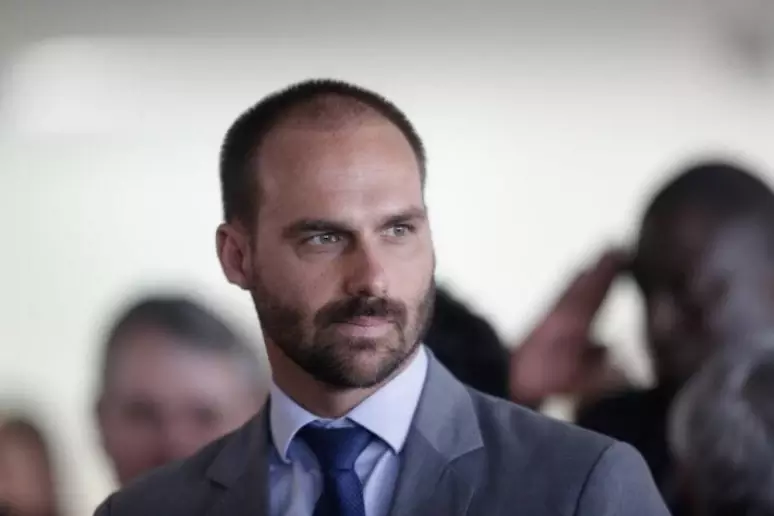
Bolsonaro’s assertion that returning would make him “another innocent imprisoned,” leaving his family to suffer, points to a pattern of judicial interventions that have disproportionately targeted allies of his father’s administration, including himself.
Moraes’ Expanding Judicial Reach
The congressman’s subsequent request for a leave of absence from the Chamber of Deputies, formalized on March 20, underscores the immediacy of this perceived threat. Moraes’ approach raises structural questions about the concentration of judicial power.
He frequently serves as both investigator and adjudicator in these cases, a dual role that deviates from traditional separations of responsibility within legal systems.
His decision to ban X, for instance, was enacted unilaterally, bypassing legislative input and prompting debates over the judiciary’s scope in regulating public discourse.
Similarly, his involvement in barring Jair Bolsonaro from political office for eight years and suspending a state governor demonstrates a willingness to reshape the political arena directly from the bench.
These actions, while framed as defenses against democratic threats, test the boundaries of due process and transparency, as evidenced by the limited public disclosure of evidence in many instances.
The international dimension of Moraes’ tenure further complicates the analysis. Eduardo Bolsonaro highlighted the potential for a “commercial war” with the United States, pointing to Moraes’ expulsion of American companies like X as a flashpoint.
This concern aligns with the platform’s ownership by Elon Musk, a figure closely tied to U.S. political and economic interests, particularly under the Donald Trump administration.
Should such tensions escalate, Brazil could face retaliatory measures affecting trade and diplomacy, with consequences extending beyond Moraes to the nation’s economy.
The congressman’s critique—that “what arrives abroad is not Alexandre de Moraes, but Brazil”—suggests a judiciary risking broader national interests for domestic control.
Comparisons to other judicial systems illuminate the stakes. In Venezuela, the Supreme Court has historically neutralized opposition by banning candidates and upholding contested elections, consolidating power in the executive’s favor.
Moraes’ Judicial Overreach
Moraes’ actions, while not identical, share a trajectory: targeting political adversaries, restricting platforms of dissent, and altering electoral dynamics.
The Venezuelan precedent saw judicial overreach precipitate democratic backsliding and international isolation—a path Brazil has not yet fully traveled but one that emerges as a plausible risk given Moraes’ current course.
The implications of this judicial posture are multifaceted. Domestically, the flight of a sitting lawmaker signals a chilling effect on political participation, particularly among those critical of the administration aligned with Moraes’ rulings.
His censorship of elected officials and media outlets narrows the space for public debate, a cornerstone of democratic resilience. Internationally, the friction with American entities could strain Brazil’s position in global markets, testing its reputation as a stable democracy.
Eduardo Bolsonaro’s conditional mention of a 2026 Senate run—dependent on a “significant change” in the political climate—underscores the uncertainty these dynamics engender.
Moraes’ tenure thus presents a critical case study in judicial influence.
His interventions, expansive in scope and unilateral in execution, have reshaped Brazil’s political and legal contours, prompting a congressman’s exile and raising questions about the balance of power.
Whether this reflects a necessary response to emerging threats or an overreach that imperils democratic norms remains a point of contention.
What is clear is the tangible impact: a nation where elected representatives weigh flight over return, and where judicial decisions ripple from Brasília to the global stage.
More: Brazil news in English, every day from The Rio Times.
Editorial responsibility: Matthias Camenzind, Editor-in-Chief · Editorial standards · Report an error