Costa Rica Gasoline Prices Rise, Diesel Up 14%

ECONOMY · COSTA RICA
Key Facts
- —The country Costa Rica imports all of its finished fuels through RECOPE, the state refiner and importer, so pump prices follow world markets.
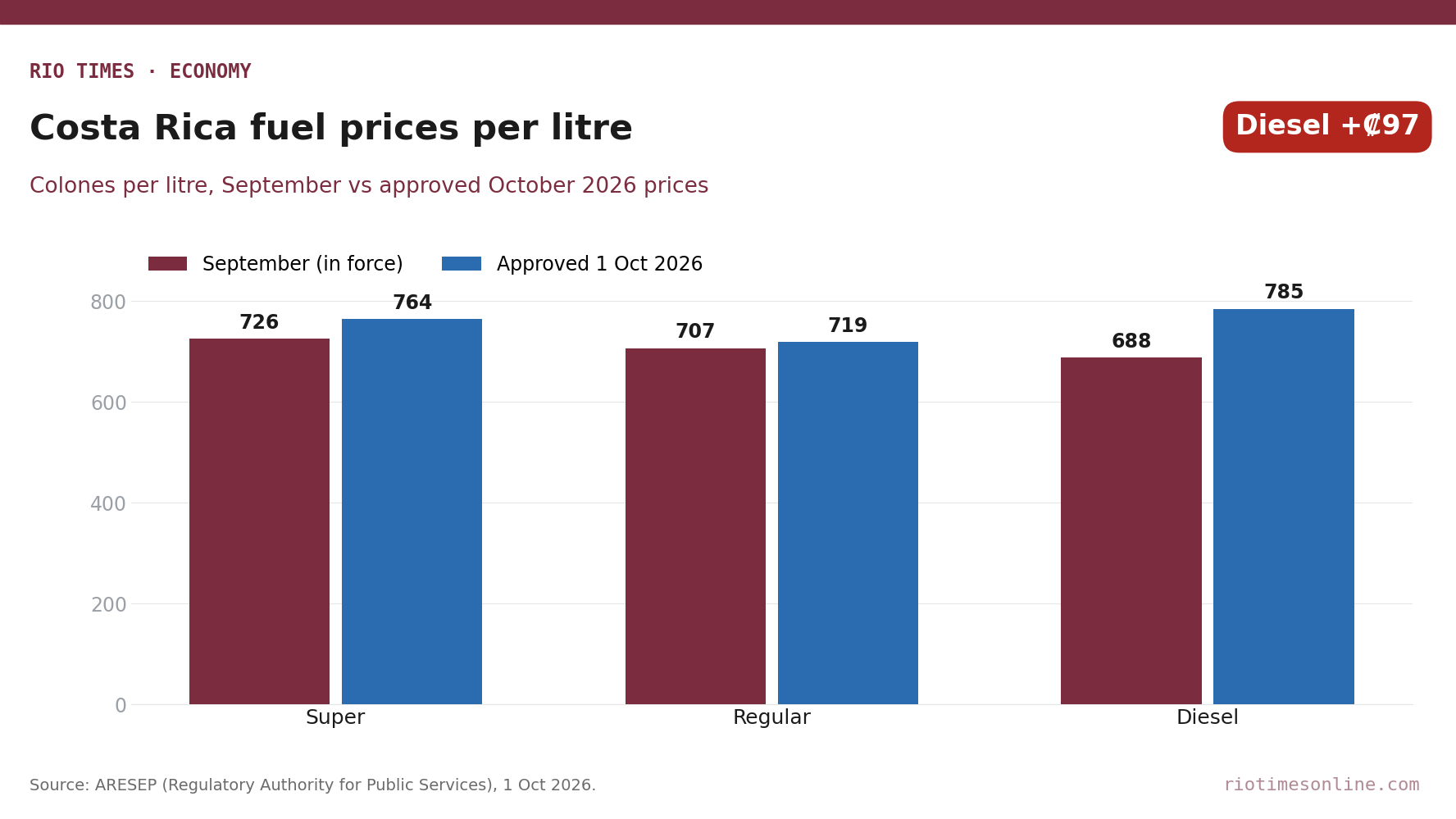
- —What happened On 1 October 2026 ARESEP, the public services regulator, approved rises of ₡38 (about US$0.08) a litre for Super, ₡12 (about US$0.03) for Regular and ₡97 (about US$0.21) for diesel.
- —The numbers Super goes to ₡764 (about US$1.67), Regular to ₡719 (about US$1.57) and diesel to ₡785 (about US$1.72) a litre, per ARESEP, 1 October 2026.
- —What it means for you Drivers pay about US$0.08 more per litre of Super. Diesel, used by buses, lorries and thermal power plants, rises about 14 percent.
- —Still open The prices start at midnight on the day La Gaceta, the official gazette, publishes the resolution. That date had not been confirmed by ARESEP.
Costa Rica gasoline prices rise in October after ARESEP, the Regulatory Authority for Public Services, approved a new fuel adjustment on 1 October 2026. Super petrol climbs ₡38 to ₡764 a litre, about US$1.67 at 456.6 colones per dollar (2 October).
The larger move is in diesel, which rises ₡97 to ₡785 a litre, about US$1.72. That makes diesel dearer than both petrol grades, which ARESEP said runs against its usual pattern.
What changes at the pump
Regular petrol rises only ₡12, to ₡719 a litre (about US$1.57). Liquefied petroleum gas in the 70–30 blend goes up ₡4 (about US$0.01), to ₡263 (about US$0.58) a litre.
A 25-pound household gas cylinder rises ₡101 (about US$0.22). The figures come from the ARESEP table released with the decision and were reported the same day by Semanario Universidad.
Why diesel now costs more than petrol
ARESEP said international diesel prices have risen faster than petrol prices in recent months. Diesel has historically been cheaper in Costa Rica, partly because it carries a lower tax load.
The regulator also applied a catch-up for the gap between what RECOPE paid abroad and what it recovered at home. The adjustment covers cargoes RECOPE handled between 14 August and 10 September.
This is the second large diesel rise in a row. ARESEP raised diesel ₡82 (about US$0.18) a litre in its September adjustment, announced on 8 September, while Regular then fell ₡51 (about US$0.11).
Who feels it first
ARESEP noted that diesel feeds public transport, freight haulage and thermal power plants. Higher diesel costs can feed into bus fares, delivery charges and food prices over the following months.
The pressure arrives from a low base, however, as consumer prices have been falling for more than a year (Costa Rica Inflation to End 16 Months Below Zero, Central Bank Chief Says). Regular petrol, at ₡719 (about US$1.57), also remains below its August level before September’s ₡51 (about US$0.11) cut.
How Costa Rica sets fuel prices
ARESEP stressed that it does not set fuel prices at its own discretion. A fixed formula combines import costs, the exchange rate, taxes and other legal components.
A stronger colón has eased some of that import bill this year (Costa Rica’s Economy Cools but Stays Solid in 2026). Even so, world diesel prices have outweighed that cushion in the last two adjustments.
What Is Not Yet Known
The exact start date depends on publication of the resolution in La Gaceta, the official gazette. ARESEP had not announced that date in its 1 October release.
It is also unclear whether bus operators will seek fare reviews because of the diesel rise. Whether world diesel prices ease before the November adjustment is not yet known either.
Sources: ARESEP (Autoridad Reguladora de los Servicios Públicos), Bulletin 47-2026, “Precio internacional provoca alza en combustibles”, 1 October 2026, and Bulletin 44-2026, 8 September 2026; Semanario Universidad, 1 October 2026. Exchange rate: 456.6 colones per US dollar, 2 October 2026.
This article was produced by The Rio Times’ automated newsroom system. How we use AI · Report an error · Editorial responsibility: Matthias Camenzind, Editor-in-Chief
LatAm Markets: Live Signals → — real-time movers, turnover leaders and FX across Latin America.