Colombia’s Courts Draw a Hard Line on Emergency Rule and Tax Power
Key Points
- Colombia’s top court froze emergency tax measures after Congress rejected a major revenue bill.
- The ruling exposes limits on executive power and reinforces institutional checks.
- Budget uncertainty now clouds Colombia’s 2026 fiscal plans and investor outlook.
Colombia’s Constitutional Court has stepped firmly into the country’s fiscal and political debate, ordering the suspension of President Gustavo Petro’s economic emergency decree while judges examine whether it meets constitutional standards.
The move halts all tax measures imposed under the decree and sends a clear message: emergency powers are not a substitute for legislative approval.
The decree was issued after Congress rejected a proposed tax bill designed to raise 16.3 trillion pesos, about $4.45 billion, to help finance the 2026 budget.
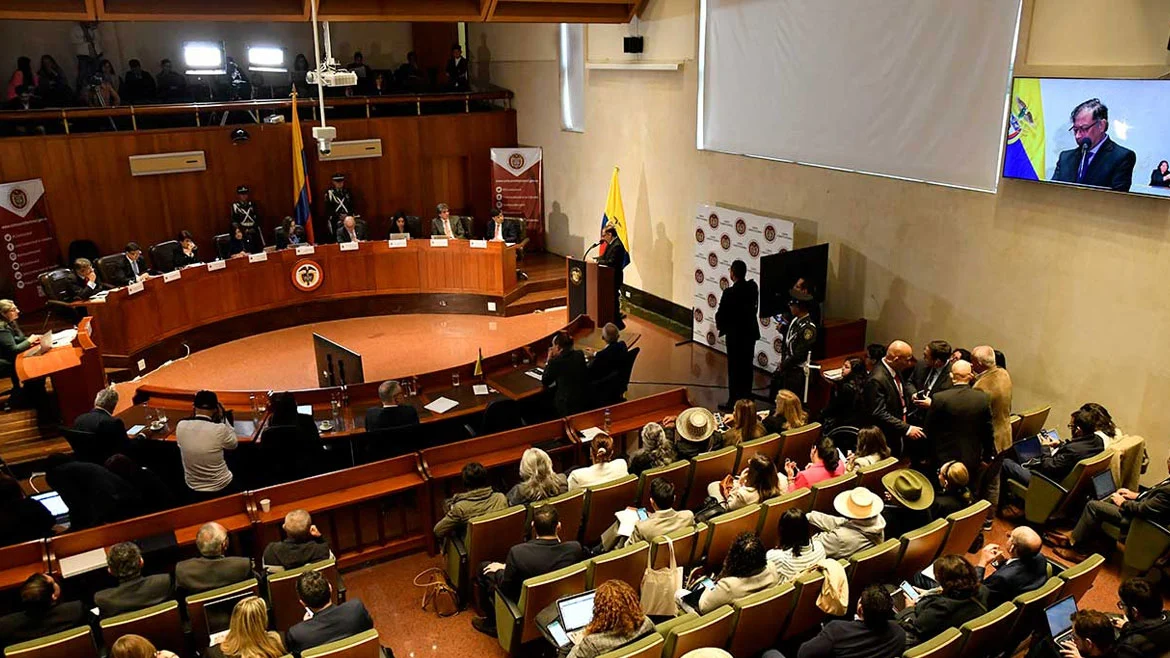
Facing that setback, the government declared an economic emergency and introduced decree-based taxes targeting wealth, gambling, alcohol, tobacco, and luxury consumption.
Court Blocks Colombia Emergency Tax Plan
Officials estimated these measures could generate roughly 11 trillion pesos, or about $3 billion, in new revenue. In a 6–2 decision, the Constitutional Court ruled that the emergency declaration must be paused while its legality is reviewed.
Judges questioned whether the government had demonstrated the kind of sudden, extraordinary economic shock required to bypass Congress.
While the ruling is provisional rather than final, its immediate effect is decisive: the new taxes cannot be enforced. The pause has practical consequences. Several hundred billion pesos had already been collected under the decree.
Those funds are now in legal limbo and may have to be returned if the court ultimately strikes the decree down. More broadly, the government must now confront a widening budget gap without its preferred fiscal tools.
President Petro and senior ministers reacted angrily, arguing that the court’s decision shields wealthy individuals and large businesses while undermining efforts to stabilize public finances.
Critics of the government counter that the ruling defends the constitutional order and prevents the executive from governing by decree after losing a vote in Congress.
Beyond Colombia’s borders, the episode matters because it underscores the strength of institutional checks in one of Latin America’s largest economies.
For investors, businesses, and international partners, the decision reinforces legal predictability, even as it introduces short-term fiscal uncertainty.
The court’s intervention does not end Colombia’s budget challenge. It does, however, clarify the rules of the game: lasting tax policy must pass through democratic debate, not emergency shortcuts.
In a region where executive overreach is often tolerated, Colombia’s judiciary has chosen restraint over expedience, with consequences that will shape the country’s economic path in 2026 and beyond.
Related coverage: Brazil’s Morning Call | Colombia’s Job Boom Hit a 25-Year Low in Unemployment, but 2 This is part of The Rio Times’ daily coverage of Colombia affairs and Latin American financial news.
This article was produced by The Rio Times’ automated newsroom system. How we use AI · Report an error · Editorial responsibility: Matthias Camenzind, Editor-in-Chief
Read More from The Rio Times