Medellín and Bogotá Beat São Paulo, Rio on Startup Density 2026
COLOMBIA · TECHNOLOGY
Friday, May 29, 2026 — 23:30 BRT — By Matias Sebastian Lopez
Key Facts
—The headline. Medellín now leads Latin America in startup density at 10.9 startups per 100,000 inhabitants, ahead of São Paulo, Santiago, Rio de Janeiro and Buenos Aires, per the StartupBlink 2026 index.
—The city depth. Seven Colombian cities now appear in the global top 1,000, with Bogotá at 64th, Medellín at 130th, and Cali, Barranquilla and three others further down. Only Brazil has more cities ranked in South America.
—The Medellín surge. Medellín climbed 15 positions to enter the global top 130 for the first time, ahead of Rome, Rio de Janeiro, Monterrey and Abu Dhabi.
—Bogotá closes on Mexico City. Bogotá ranks 64th globally and third in Latin America, narrowing its gap with Mexico City to a historical minimum of 0.6 percent and now exceeding it on startup density.
—Latin American impact. The reading positions Colombia as the second-largest regional ecosystem behind Brazil and ahead of Mexico in the composite metric.
The Colombian startup density ranking now places Medellín ahead of São Paulo, Santiago, Rio de Janeiro and Buenos Aires on the most-watched ecosystem metric, with Bogotá closing the historical gap with Mexico City to just 0.6 percent. The StartupBlink Global Startup Ecosystem Index 2026 lifts Colombia to 35th globally (up from 47th in 2021) and places seven Colombian cities in the global top 1,000, the second-deepest city footprint in South America. The reading reflects sustained ecosystem maturation across multiple cities rather than the single-hub pattern typical in some other Latin American countries.
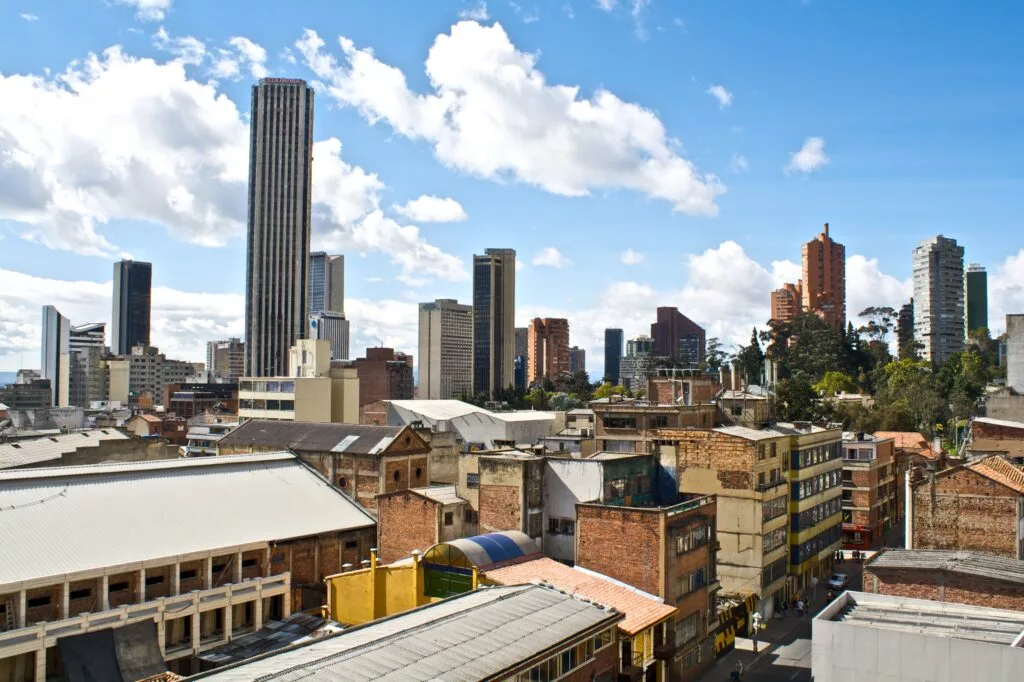
Where the Colombian startup density ranking stands
Medellín now leads Latin America in startup density at 10.9 startups per 100,000 inhabitants per the StartupBlink 2026 index, ahead of Bogotá, Santiago, São Paulo and Buenos Aires. Bogotá occupies third place in Latin America on the composite ecosystem score (behind São Paulo and Mexico City) but exceeds Mexico City on the density metric after narrowing the gap to a historical minimum of 0.6 percent. The Antioquia capital additionally entered the global top 130 for the first time, climbing 15 positions to overtake Rome, Rio de Janeiro, Monterrey and Abu Dhabi.
Colombia occupies 35th place in the broader country ranking, up one position from 2025 and twelve places since 2021. The country sits behind Brazil regionally but ahead of Mexico in the composite metric (which combines startup quantity, quality and business-environment factors). The index measures roughly 100 countries and 1,000 cities globally, with Colombia clearing a meaningful threshold by placing seven cities in the global ranking.
Bogotá grew approximately 18.4 percent year-on-year on the composite ecosystem score (ahead of the broader 20 percent regional average), while Medellín posted the largest year-on-year move among major Latin American cities. The Antioquia capital is now the sixth-strongest city in Latin America overall, an unprecedented position for a non-capital Colombian metro. The 2026 reading reflects accelerated venture-capital activity and corporate-innovation depth.
What the Colombia Tech Report 2026 shows
The KPMG-published Colombia Tech Report 2026, released alongside the StartupBlink data, identifies 2,295 startups across Colombia, a 9 percent year-on-year increase. Medellín hosts 698 of these startups (up 28.5 percent from 543 in 2024) and pulled in approximately $157 million in venture investment during 2025, a 400 percent year-on-year increase. The Antioquia capital recorded the fastest growth rate of any major Latin American city on the same metric.
The KPMG report also ranked Medellín as the Latin American city with the best business environment for technology firms (tied with Bogotá), placing both Colombian cities ahead of Mexico City, Santiago and Buenos Aires on the institutional-environment metric. Medellín was further recognized as the Latin American non-capital city with the strongest institutional ecosystem for innovators.
Sectoral strengths reflected in the data include fintech, proptech, e-commerce, logistics and software-as-a-service. Companies such as Rappi (delivery and services), Habi (real-estate technology), Laika (pet e-commerce) and Addi (digital financing) anchor the Colombian sector profile. The combination of consumer-tech and B2B software has driven the recent ecosystem expansion across both Bogotá and Medellín.
More: Colombia news in English, every day from The Rio Times.
Implications of the Colombian startup density ranking
For foreign founders and remote-tech professionals considering Latin American bases, the data underscore Colombia as a genuinely competitive alternative to Mexico City and Buenos Aires. The combination of Spanish-language ecosystem depth, multiple-city distribution (not solely Bogotá), competitive cost-of-living and improving institutional environment matters for hiring and operating decisions. The continued depth of the Medellín ecosystem in particular has drawn growing remote-work and digital-nomad inflows.
For regional venture capital, the Colombian ecosystem has consolidated as a separate destination from the Mexico-Brazil axis that historically attracted most LatAm tech investment. Several US and European venture funds have opened or expanded Bogotá and Medellín presence over the past two years. The capital channel has been particularly active for Series A and Series B rounds, where deal sizes have risen even as the total number of transactions has moderated.
For Colombian policymakers and ecosystem builders, the data suggest the ecosystem-development model has worked. The Cámara de Comercio de Bogotá, regional innovation agencies and several public-private programs have been credited in industry reporting with sustaining the trajectory through multiple political cycles. The challenge ahead is scaling Series C and later-stage capital availability to retain mature startups rather than seeing them relocate to Miami, São Paulo or US venues.
How is Colombia ranked globally?
Colombia occupies 35th place in the StartupBlink Global Startup Ecosystem Index 2026, up one position from 2025 and twelve places since 2021. The country sits behind Brazil regionally and ahead of Mexico in the composite metric.
Which Colombian cities lead?
Bogotá leads at 64th globally and third in Latin America. Medellín follows at 130th globally and sixth in Latin America, after climbing 15 positions. Cali, Barranquilla and three additional Colombian cities complete the seven that appear in the global top 1,000.
How many startups are in Colombia?
The Colombia Tech Report 2026 published by KPMG identifies 2,295 startups nationwide, a 9 percent year-on-year increase. Medellín hosts 698 of these (up 28.5 percent from 543 in 2024) and pulled in approximately $157 million in venture investment during 2025.
For more on Colombian economic dynamics, see our piece on the Banrep autonomy Consejo de Estado ruling. Also read our coverage of the Colombian Miami real-estate investment flow and our piece on the Latin American presidential approval rankings.
The Rio Times — Friday, May 29, 2026 — 23:30 BRT — By Matias Sebastian Lopez
This article was produced by The Rio Times’ automated newsroom system. How we use AI · Report an error
Read More from The Rio Times