Migrant Detention Reform in Chile Can Return With 29 Senate Votes, Not 33, Ruling Says
POLITICS · CHILE
Key Facts
- —The country Chile, governed since 11 March 2026 by President José Antonio Kast. Its Congress has a 155-seat Chamber of Deputies and a 50-seat Senate.
- —What happened On 29 September 2026 Senate president Paulina Núñez ruled that the government needs 29 of 50 senators to revive its rejected reform, not the roughly 33 first expected (Pauta, La Tercera).
- —The numbers The reform would raise detention before an expulsion from five days to 30. Deputies backed it 88 to 28 on 22 September, one vote short of 89.
- —What it means for you Nothing changes yet. The five-day limit stands, and residency permits and expulsion procedures follow the current rules.
- —Still open No Senate vote date is set. Government and allied senators hold 26 seats (La Tercera, 25 September), and the opposition may go to the Constitutional Court.
Chile’s migrant detention reform can return to Congress with 29 Senate votes, not 33, after a ruling by Senate president Paulina Núñez. Her decision, sent to party groups on Tuesday 29 September, lowers the bar for the government by four votes.
The reform would let authorities hold foreigners facing expulsion for up to 30 days instead of five. Its 22 September defeat is covered in Chile Migrant Detention Reform Fails by One Vote, Five-Day Limit Stays.

What the Senate President Decided
The government is pursuing a route called insistence, set out in Article 68 of the Constitution. It lets the Senate rescue a bill that the other chamber rejected at its first vote.
Without it, the rejected text could not be presented again for a year. That ban applies to any bill voted down in general, as this one was.
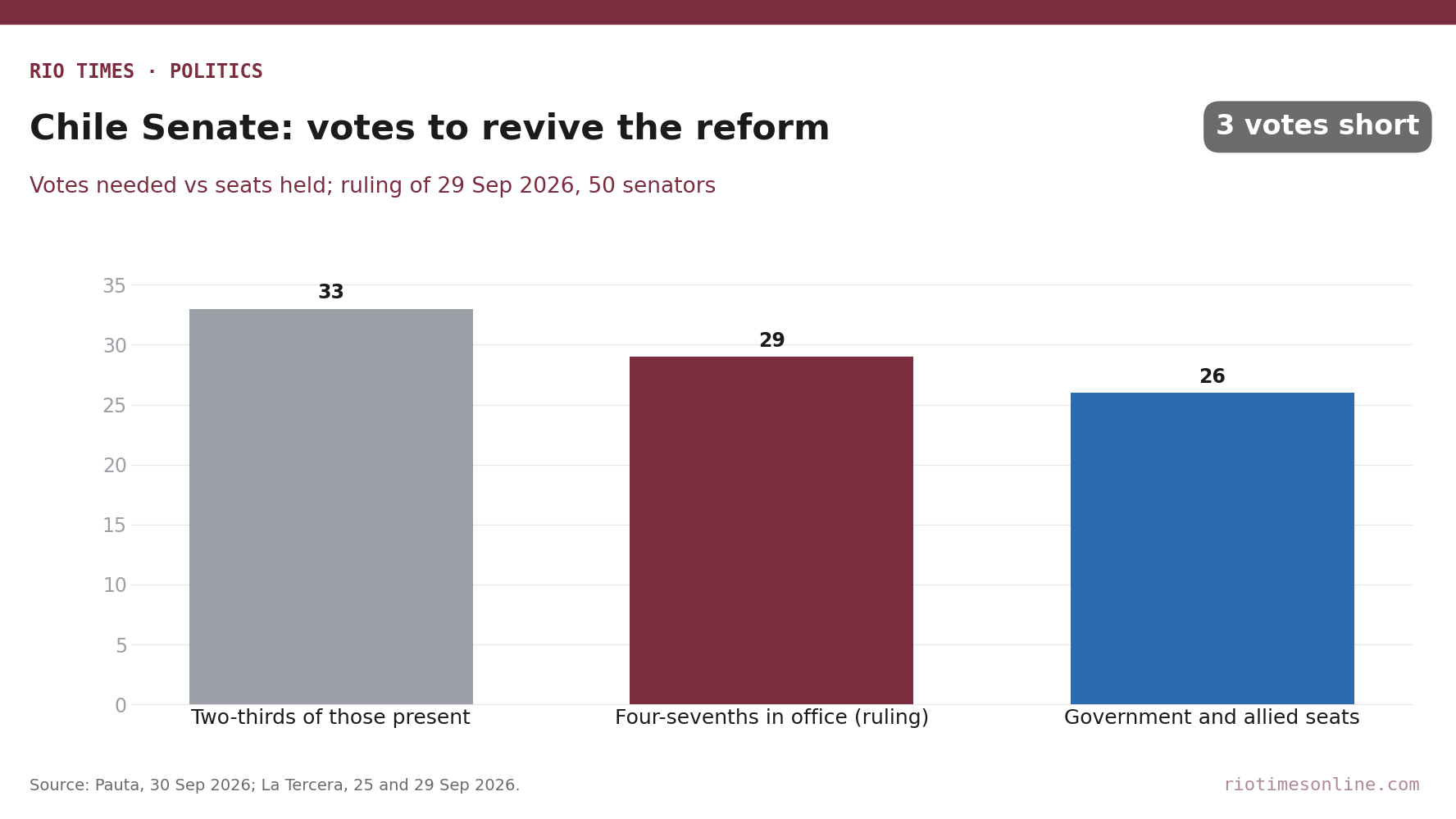
Article 68 normally asks for two-thirds of the senators present, about 33 votes in a full chamber. Núñez, of the centre-right National Renewal party (RN), ruled that constitutional reforms keep their own quorum instead.
That quorum, in Article 127, is four-sevenths of senators in office, or 29 of the 50. She relied on a legal report by the Senate’s secretary-general, Luis Rojas, and a 2006 Constitutional Court ruling.
Why 29 Votes Is Still a Stretch
The lower bar does not settle the vote. La Tercera counted 26 senators for the governing coalition and its allies, so at least three opposition votes are still needed.
Government minister Claudio Alvarado said he refused to believe the opposition lacked votes for a reform that eases expulsions. He called the 29-vote quorum ratified.
The ruling also reaches back to the lower house. If the Senate agrees, deputies must then approve it with four-sevenths of members in office, per the resolution quoted by La Tercera.
In a 155-seat chamber that means 89 votes. It is the same number the reform missed on 22 September.
The Opposition Objects
Senator Juan Luis Castro, who leads the Socialist-aligned group, asked the Senate leadership on Tuesday to reconsider. He said the reading demands more votes to insist on an ordinary bill than on a constitutional reform.
Castro said his group reserved the right to go to the Constitutional Court, which rules on disputes over the Constitution. He and Christian Democrat Yasna Provoste also asked the Senate’s Constitution Committee for a further report.
There is precedent on Núñez’s side. In 2008 the Senate applied the same method to an electoral reform sent by then-President Michelle Bachelet, and that insistence still failed.
What It Means for Foreigners in Chile
Nothing changes for now. The five-day limit on detention before an administrative expulsion, set in 2023, remains the law.
An administrative expulsion is a removal ordered by the government, without a criminal conviction. Residency permits are unaffected; see How to Get Residency in Chile in 2026: Permits, Fees and the Kast-Era Rules.
President Kast promised after the Chamber defeat to press the idea by other routes. The Senate insistence is the first of them to take formal shape.
What Is Not Yet Known
The Senate has not set a date for the insistence vote. It is also unclear whether any opposition senators will back the text.
Neither Pauta nor La Tercera reported a court challenge filed so far. A case could delay the vote or reopen the question of how many votes are needed.
If the text clears the Senate, deputies would face the same 89-vote bar that stopped the migrant detention reform in September.
More: Chile news in English, every day from The Rio Times.
Sources: Pauta, 30 September 2026; La Tercera, 29 September 2026; La Tercera, 25 September 2026; Constitution of Chile, Articles 68 and 127; Constitutional Court ruling of 31 January 2006 (case 464), as cited in the Senate president’s resolution.
This article was produced by The Rio Times’ automated newsroom system. How we use AI · Report an error
Read More from The Rio Times